How to Rank Higher in Google Maps
A tree service in Jim Thorpe has 117 Google reviews at 4.7 stars. The company holding the top map spot there has three. Not 30. Three. We recorded that pair in an audit of 402 contractors across the Lehigh Valley and the Poconos this year, and the tree service is the one nobody can find.
When you are out of the map pack, you are out of the only part of the search results most homeowners look at. They tap one of the three, they call, and the job is gone before your website ever loads. For a roofer that is real money: Google Ads charges around $47 a click for roofing lead terms in this country, which is what the traffic you are missing is worth to somebody buying it.
This is the checklist we run. Seven steps, in order, each with a point where you know you are done.
What it costs you to leave this alone
Three slots. Everyone else is on a second screen nobody scrolls to. Of the 362 businesses in our audit with usable map data, 259 are outside the pack for their main service term in their own town.
You do not need a study to price that. Count how many calls you got last week from people who found you on Google. Now assume the three companies above you each get that many, at no cost, every week, forever. That is the gap. The complete local SEO guide has the regional numbers behind it.
Your trade changes the difficulty
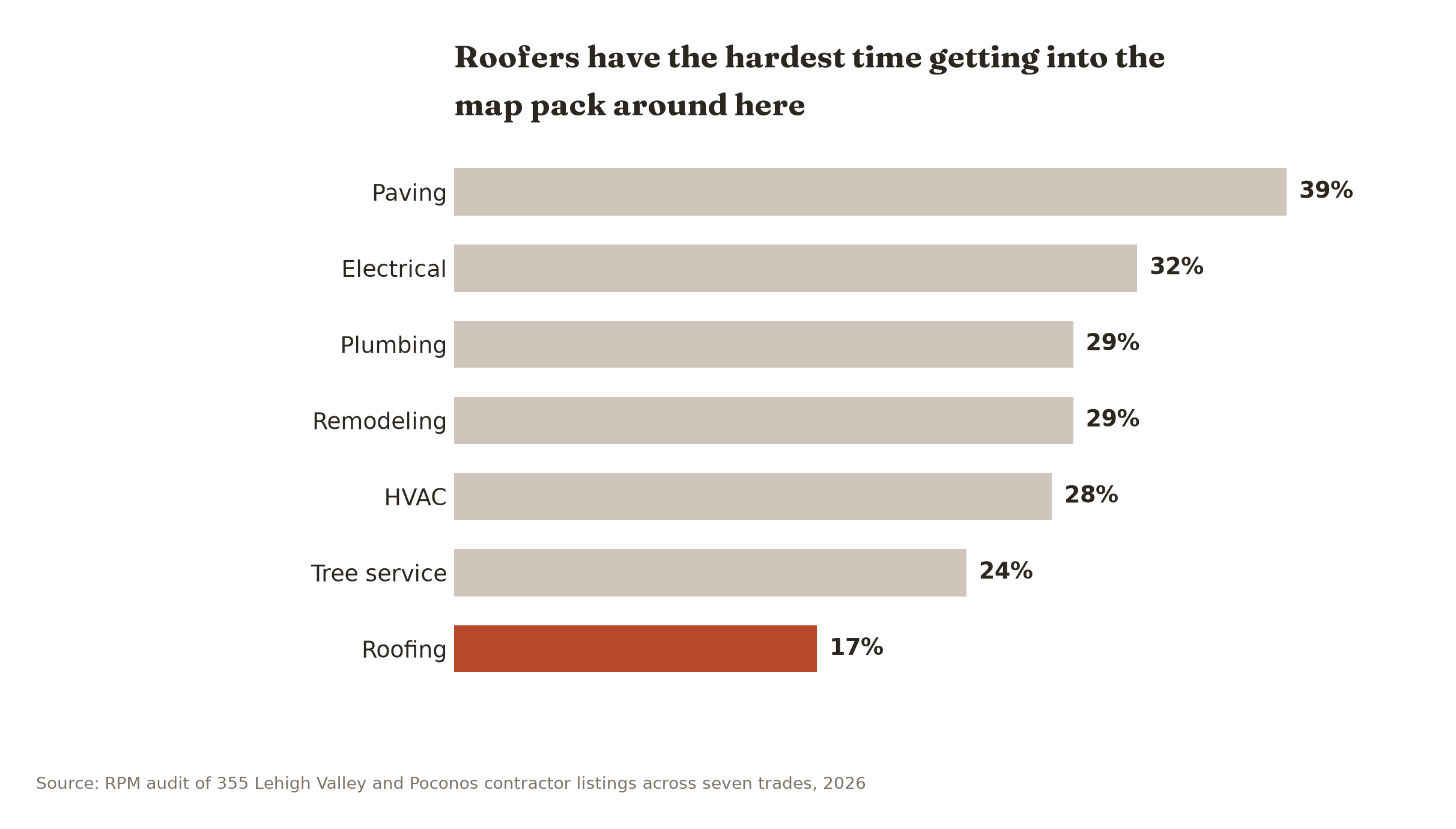
Roofing is the hardest field we audited. Seventeen percent of roofers hold a pack spot for their main term. Paving is the easiest at 39 percent, mostly because there are fewer of them and half the ones there are have no real listing at all.
If you are a roofer in Easton, plan for a longer fight than the plumber down the street. That is not an excuse, it is a budget. Roofing also spikes with weather, so the work you do on your listing in late March pays off when the first real spring storm comes through and 200 people search at once.
Start by studying the three above you
Before you change anything, spend ten minutes on the companies currently in the pack. Search your main service plus your town on your phone, from your shop, and write down what you find for each of the three.
| What to check | Where it is | Why you care |
|---|---|---|
| Primary category | Under the business name in the listing | Tells you the exact category Google is rewarding for that search |
| Review count and rating | Top of the listing | Sets the bar you actually have to clear, which is usually lower than you think |
| Distance from town center | The map pin | If all three are downtown and you are eight miles out, adjust the plan |
| Website link | The website button | Half the time around here it is missing, broken, or pointed at Facebook |
| Date of the most recent review | Bottom of the review list | A pack holder whose last review is from 2023 is beatable this year |
This sounds basic. It is also the exact exercise that tells a Nazareth contractor his problem is a category field and not a review deficit, which is the difference between a two-hour fix and a two-year project.
The seven steps
-
Set your primary category to the job, not the industry. Open your Google Business Profile, find the category field, and read it out loud. If it says “contractor” or “construction company,” you have told Google you do everything, which it reads as nothing in particular. It should name the service that pays your mortgage. “Roofing contractor.” “HVAC contractor.” “Drain cleaning service.”
Done when: the primary category matches the exact phrase a customer would type in an emergency.
-
Add the secondary categories, and stop at five. These are eligibility, not ranking power. A plumber who also does water heaters and drains should say so. A plumber who adds “general contractor” because it sounds bigger has diluted the only signal that was working.
Done when: every secondary category is something you would send a truck out for tomorrow.
-
Get a working website link onto the listing. Thirty-four of the 402 businesses we audited had none. Several pointed the link at a Facebook page, which Google reads as a page about Facebook. One Brodheadsville HVAC company sits at number two in the pack on 70 reviews and sends every click to nothing.
Done when: the link opens your own homepage and your phone number is visible without scrolling.
-
Fix hours, including the ones you do not want to admit. If the listing says you close at 5 and you answer the phone until 8, you are turning away the evening calls, which for plumbing and HVAC are the ones with an emergency price attached. If you genuinely do not take calls after 5, say that. A listing that promises 24/7 and goes to voicemail earns one-star reviews.
Done when: the hours on the listing match what actually happens when someone calls.
-
Set the service area to the towns you will actually drive to. Not the whole tri-county region. If you are in Kunkletown and you will not take a job in Allentown, listing Allentown does not get you Allentown work. It spreads your relevance across a circle you cannot service.
Done when: you can name the last job you did in each town on the list.
-
Get the rating over 4.7. Across the audit, contractors under 4.5 stars made the pack 15 percent of the time. At 4.9 and up it was 38 percent. Note that this is the rating, not the count. Ask the customer in the driveway, then text the link before you pull off the street.
Done when: you have added 15 new reviews and the average has moved.
-
Post photos with your truck and your crew in them, monthly. This is the weakest item on the list and I am including it because it costs nothing and I cannot prove it does not help. What I can tell you is that homeowners compare the three listings side by side. A real photo of a real van in a real driveway beats a logo on a white background every time.
Done when: it is on somebody’s calendar as a recurring task, not on yours.
The mistake almost everyone makes
Chasing review count.
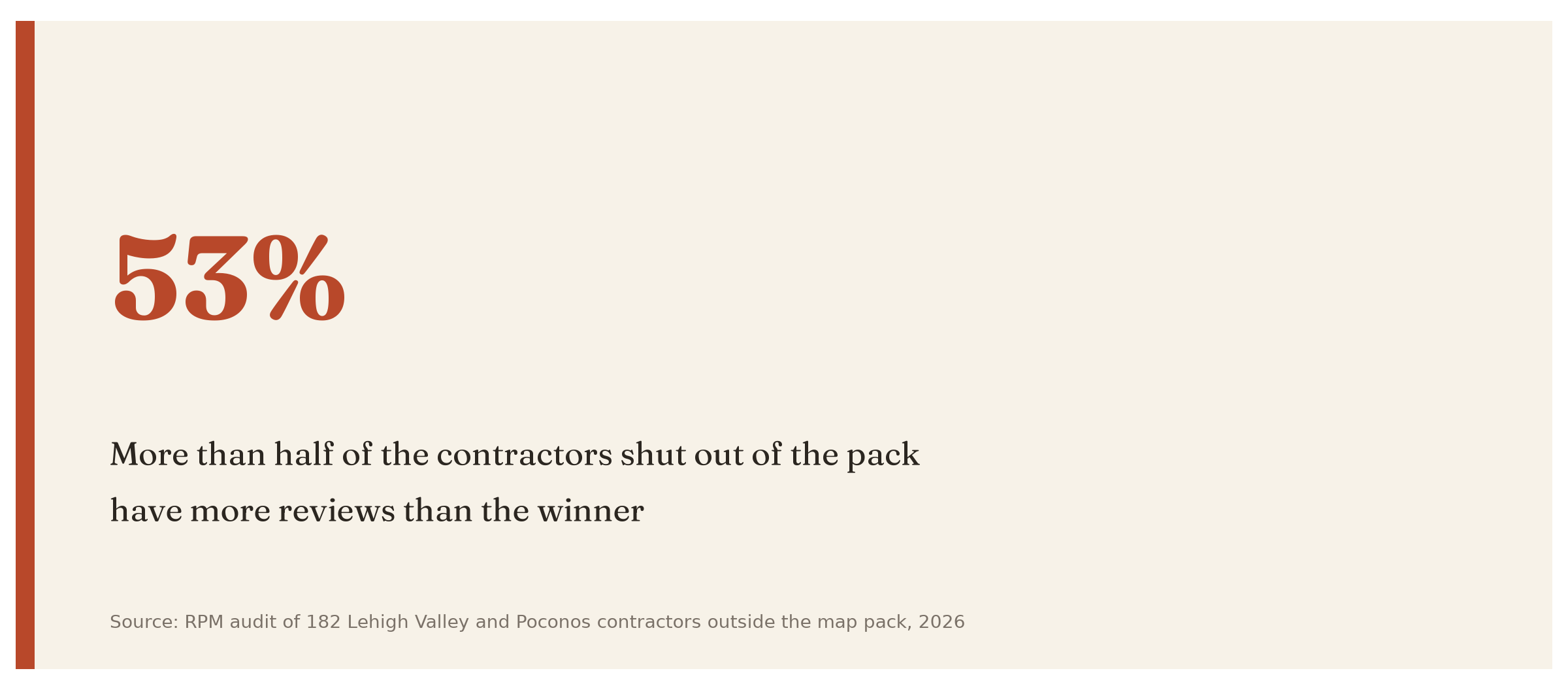
Of the 182 out-of-pack contractors where we recorded the pack holder’s numbers, 96 had more reviews than the company beating them. An Allentown roofer with 917 reviews is out while a competitor on 124 is in. A Nazareth HVAC shop at 4.8 on 101 reviews is out while the top spot sits on 55.
Reviews are still worth collecting. They close the customer once he is looking at you. They are just not the thing standing between you and the three-pack, and spending a year on them while your category field says “contractor” is a year wasted.
One more thing about reviews before we leave them. Recency counts for the reader even if we cannot prove it counts for Google. A homeowner comparing three listings on a Sunday night looks at the date on the newest review. A profile whose last one is from 2023 reads as a company that might not be in business anymore. Ten recent reviews beat eighty old ones at that moment, which is the moment the phone rings or does not.
Two more mistakes we see constantly around here. Stuffing the business name with a town, which gets you reported by a competitor and possibly suspended, and it happens in this region more than you would guess. And creating a second listing when you cannot get into the first one. Duplicate listings do not compete with each other. They split you and then one of them gets removed.
What you cannot fix
Proximity. It is the heaviest factor in the pack and your address is your address. If your shop is in Kunkletown, you are not ranking in Stroudsburg maps searches no matter how clean the listing is. The distance between those two is the whole reason.
That is worth saying plainly because it changes the plan. For the towns you cannot reach from your address, the map pack is not the channel. You need pages that rank organically, and probably some paid search during your season. Those cost money on an ongoing basis, and if the budget is not there, the honest move is to concentrate on the town you are actually in and win that one completely.
There is also a version of this where the answer is do nothing. If you are booked into July and turning down work, more calls is not your problem. Put the money into a second crew.
Do it now, not in June
It is late March. For HVAC, the first run of AC calls is about six weeks out, and the listing changes you make this week will have settled by then. Make them in June and you are editing your storefront during the only month that pays.
Roofers have the opposite timing problem. Spring storm season is already here, and demand arrives in one-day spikes. You cannot prepare for a hail event the week it happens, so the listing work has to be done before, and the website work can wait until the season slows.
Remodelers get the easiest schedule of the three. Kitchen and bath inquiries around here run steady from now through fall, which means you can fix things gradually and actually watch what each change does.
How long it takes
Category and listing fixes are the fast ones. In thin markets like Palmerton, Lehighton, or Brodheadsville, where five companies are in the running, we have seen movement inside two to three weeks.
Rating takes as long as your customers take. Fifteen reviews is six to ten weeks of asking every single time, which nobody does consistently for more than a month without a system.
Allentown, Bethlehem, and Stroudsburg are different. In Allentown, the 55 contractors we audited are losing to a field of 16 companies, several of which have held those spots for years. Six to eighteen months is the realistic range, and some businesses will not get in at all. Track your calls by source while you wait so you know whether any of it is working. Here is how we set that up.
You can check your category, your hours, and your rating tonight in about fifteen minutes. What you cannot see from your own phone is where you rank in the other towns you serve, because Google shows you results based on where you are standing.
Our Local Visibility Scan does that part. It maps where you show up across the Lehigh Valley and the Poconos, town by town, plus your reviews against your top three competitors and the three fixes we would make first. It is free, there is no call required, and you keep it.
If you want the deeper version, with your competitors, your site speed and what your reviews actually say, that is the $399 Strategy Session. The report is yours either way.