Choosing Google Business Profile Categories
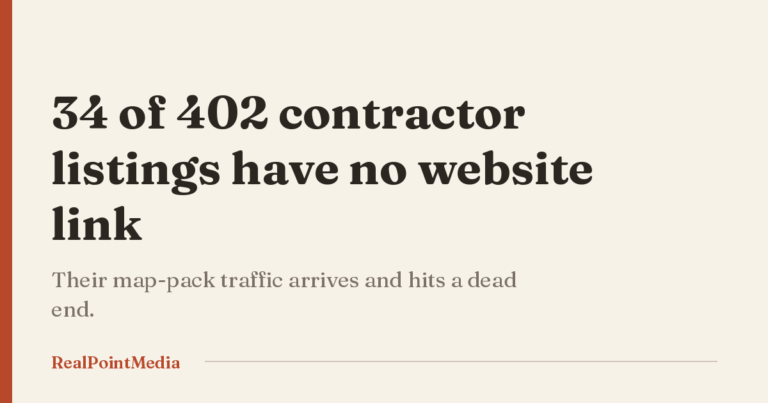
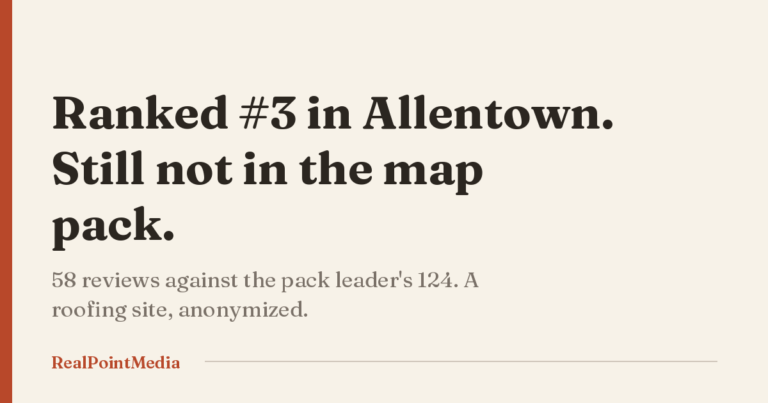
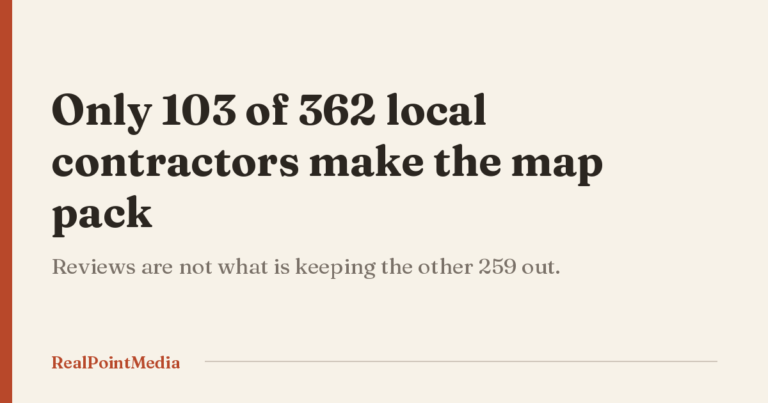
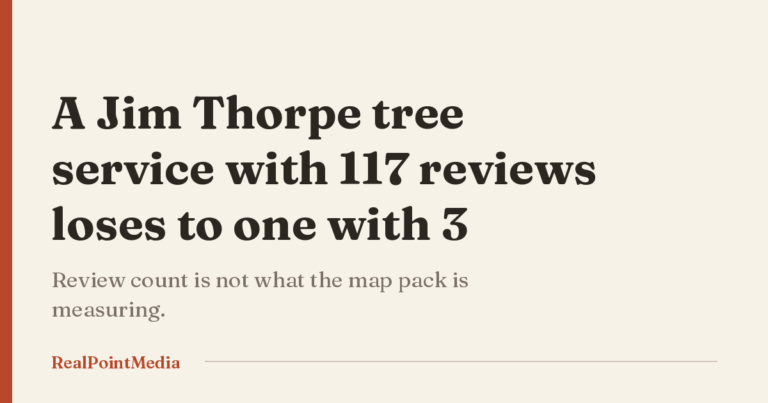
An HVAC company in Nazareth with 101 reviews at 4.8 stars is not in the map pack. The company holding the top spot has 55. We have used that pair a few times now. After auditing 402 contractors across the Lehigh Valley and the Poconos, the most common explanation we find for that kind of gap is not reviews and not the website. It is one dropdown field, and it sits underneath everything else in the local SEO guide.
Your primary category decides which searches you are allowed to appear for. Get it wrong and every other thing you do is aimed at searches you were never eligible for in the first place. That is a whole year of effort pointed at the wrong target, and it is a free fix.
Here is how to choose it, how many secondaries to add, and what to do if you genuinely run two trades out of one truck.
Name the job, not the industry
The rule is short. Your primary category should be the service that produces most of your revenue, stated as narrowly as Google will let you state it.
“HVAC contractor” beats “contractor.” “Roofing contractor” beats “construction company.” “Drain cleaning service” beats “plumber” if drains are what pay you, and “plumber” beats “drain cleaning service” if they are not.
Contractors resist this because narrowing feels like turning away work. It does not work that way. The narrow category is what gets you into the results for the search that matters; the secondary categories keep you eligible for the rest. Being broad does not make you eligible for more. It makes you weakly relevant to everything, which is a good way to rank for nothing in Allentown, where 76 companies we audited are fighting over three slots.
How to find out what is actually winning
You do not have to guess. Ten minutes, on your phone, standing in your own shop.
Search the exact phrase a customer would use. Not “HVAC services,” which nobody types. “Furnace repair nazareth pa.” Look at the three listings in the pack and read the category line that sits under each business name. That line is their primary category, it is public, and it tells you what Google is rewarding for that search today.
Do it for your top three money searches. If all three packs show the same category and you are running something different, you have your answer and your Tuesday project.
One caution. Do this for the town you have an address in. The pack you see from Kunkletown is not the pack a homeowner sees in Stroudsburg, and chasing a category that wins 20 miles away is how people end up worse off than they started.
Three to five secondaries, all of them real
Secondaries are eligibility, not power. They let you show up for adjacent searches without diluting the main signal.
A good list for a heating and air company: HVAC contractor as primary, then air conditioning repair service, furnace repair service, heating contractor. That is it. Four entries, all of them jobs you dispatch for.
A bad list adds general contractor, home improvement, and handyman because those sound like more opportunity. What they do is tell Google you are three different kinds of business, which is what we think is happening to some of the companies stuck outside the pack with strong reviews.
The test for any secondary category: would you send a truck out for that tomorrow, at your normal rate. If no, take it off.
The two-trade problem
Half the shops in Carbon and Monroe County do more than one thing. Heating and plumbing. Electrical and HVAC. Remodeling and roofing. That is how a small market works, and the category field does not love it.
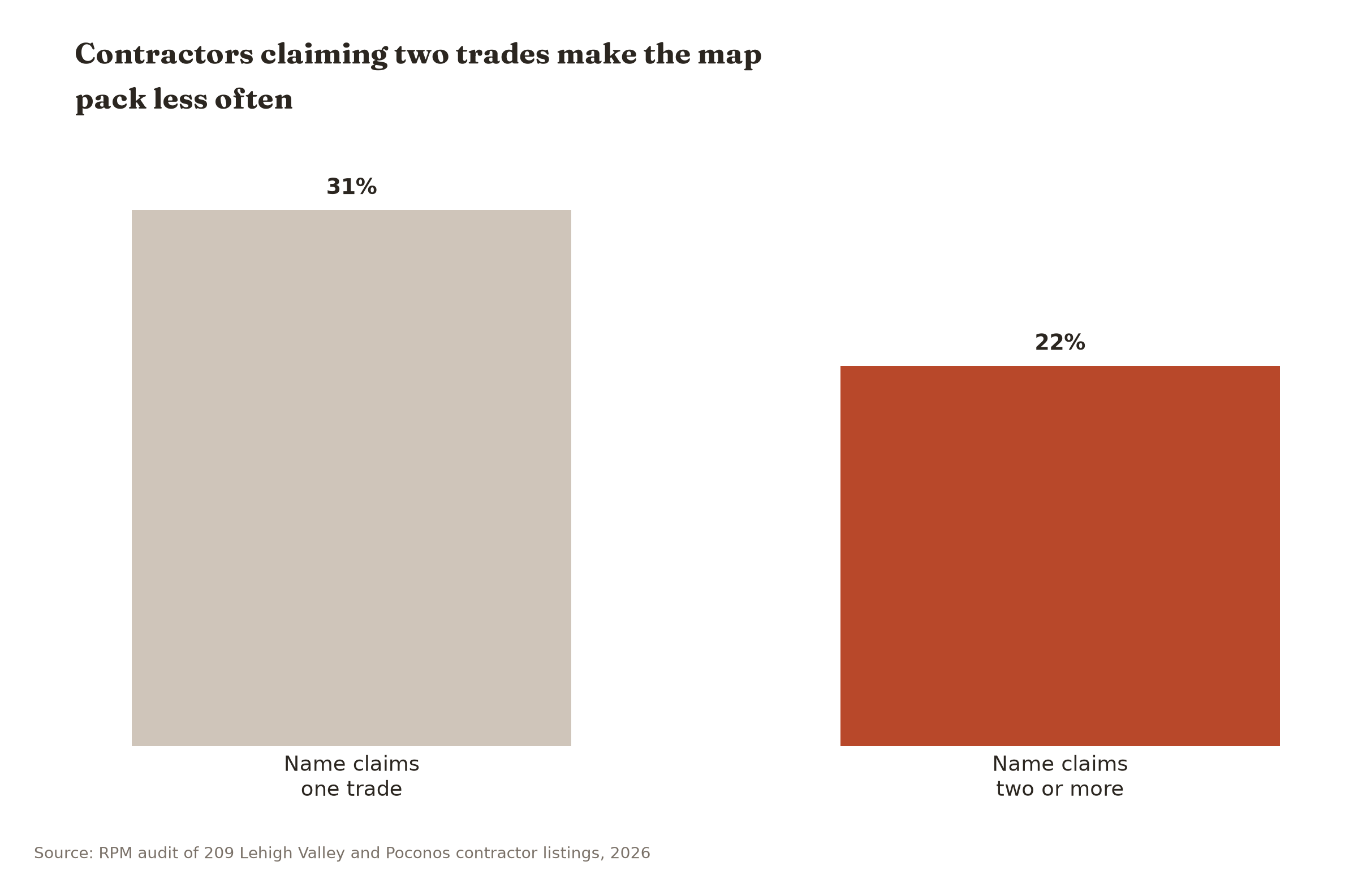
Among the businesses we audited, 169 have a name that claims a single trade and 40 claim two or more. The single-trade group made the map pack 31 percent of the time. The two-trade group, 22 percent. Median review counts and ratings between the two groups are nearly identical, so it is not a reviews story.
I want to be careful here. Forty businesses is a small sample, and a company name is not the same thing as a category setting. Treat this as a hint, not proof. We have not tested it at scale and we are not going to pretend otherwise.
What we do with it in practice: pick the trade that makes the most money and set the profile to that. Put the second trade in the secondary categories and on its own page of your website. A plumbing-and-heating company in Lehighton should decide which line pays the bills, commit the primary category to it, and stop trying to be equally visible for both.
Three categories we see set wrong every month
“Contractor” on a company that only does roofs. It is the default a lot of auto-created listings get, and it is the single most common wrong answer in our audit notes. Roofing contractor exists. Use it.
“Construction company” on a kitchen and bath remodeler. Construction company reads as new builds and additions. Homeowners searching to redo a bathroom in Emmaus are not typing that, and neither is Google matching it.
“Air conditioning contractor” on a company whose money is furnace and boiler work. In this region, heating is the longer season and the bigger ticket. Around Blue Mountain the heating calls start in October and do not stop until April. Set the primary to the season that pays and let the other one ride in the secondaries.
When a second profile is the right answer
Rarely, and only under real conditions.
If the second trade is a separate legal business, with its own license, its own phone number, and its own staffed address, it can have its own profile. Google allows that because it is true.
If it is the same truck, same phone, same guy, a second profile is a duplicate. Duplicates do not compete with each other. They split your reviews, and one usually gets removed, which costs you weeks. We covered this in the setup guide and it is worth repeating because the temptation is strongest exactly when you are stuck.
Do not switch categories with the season
It is the end of April, which is when heating companies around here start thinking about AC. Every year somebody asks whether they should flip the primary category from heating to air conditioning for the summer and back in the fall.
Do not. Category changes can trigger a re-review of the listing, and a listing under review during the first hot week of June is an expensive way to learn a lesson. Leave the primary alone. Use the services list and profile posts for the seasonal push, and let the secondary categories carry the AC eligibility year round.
What the category will not do
It will not overcome distance. Proximity is the heaviest factor in the pack, so the perfect category on a Kunkletown address does not produce Stroudsburg rankings. The Maps checklist covers what to do about the towns you cannot reach.
It will not fix a rating under 4.5, where our audit put the map-pack rate at 15 percent against 38 percent for contractors at 4.9 and up.
And if you are already in the pack and the phone is ringing more than you can service, leave the field alone entirely. Changing a category that is working, to chase a slightly better one, is the kind of optimization that costs a month and gains nothing. If you are not sure where you sit, the order to work in is in the guide linked at the top.
Tonight
Open your profile, read your primary category, then search your main service and your town and read the three categories above you. If they do not match, change yours, write down the date, and leave everything else alone for 30 days.
What you cannot see from your own phone is which category is winning in the other towns you serve, because Google answers based on where you are standing when you ask.
Our Local Visibility Scan checks it from the outside, town by town across the Lehigh Valley and the Poconos. You also get your reviews against your top three competitors, and the three fixes we would make first. Free, no call required, and the report is yours.
The full version, with your competitors’ categories and reviews read properly, is the $399 Strategy Session. You keep the report regardless.