How We Tear Down a Local Website
A plumbing company in Palmerton sent us a link and one line of email: “Tell me why this thing doesn’t work.” The site loaded fine. It looked fine. It had been built in 2019 by somebody’s nephew and it had not produced a form fill in eleven months.
He was not imagining it. Most of the money a local website loses, it loses quietly, in places the owner never looks. A phone number that is a picture instead of a link. A service area page that never got written. A Google listing that says the business has been open three years when it has been open twenty-six.
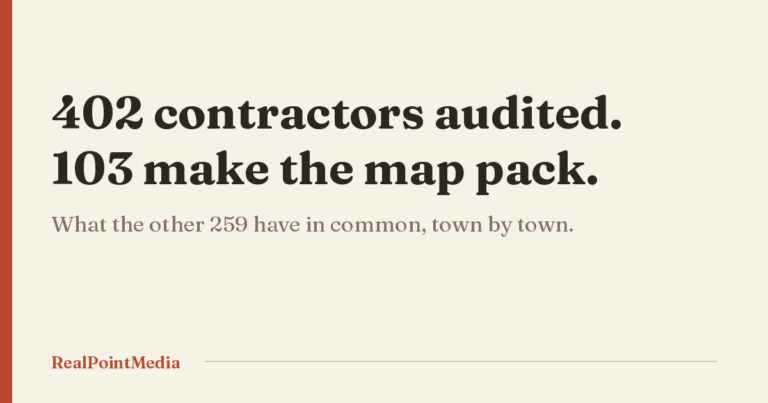
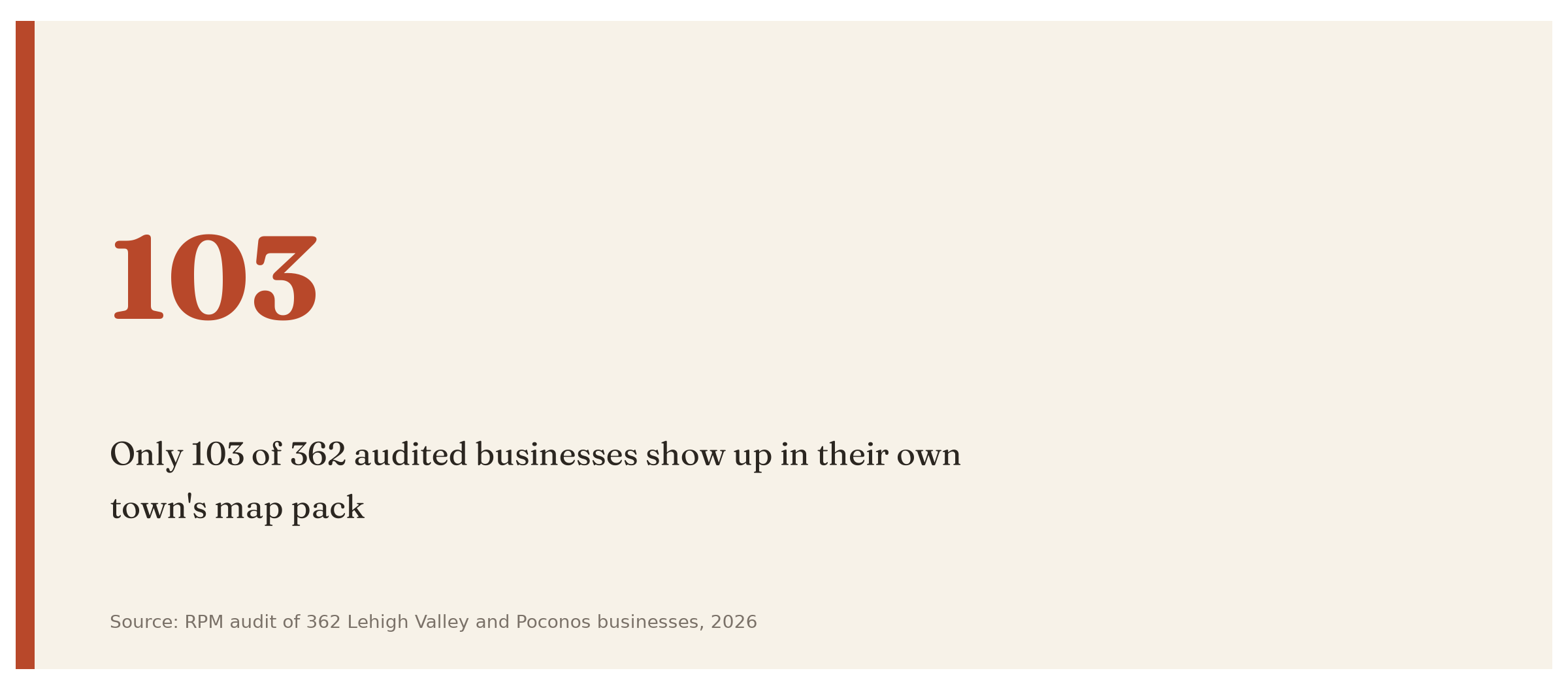
Across 402 Lehigh Valley and Poconos businesses we have audited, only 103 of the 362 with a clear result show up in their own town’s map pack. That is roughly one in four. The other three are paying for a website that a customer searching two miles away will never see.
This post is the whole teardown method, written out, so you can run it on your own site this week without paying anybody.
What a teardown is, and what it is not
A teardown is not a design critique. Nobody has ever lost a job because their hero image was the wrong blue.
It is a hunt for the specific places where a person who already wanted to hire you gave up. That person exists. He searched “furnace repair Brodheadsville” at 6:40 on a January morning, he found something, and he called somebody. The question is whether it was you, and if not, exactly where he fell out.
So every item below has to pass one test: does it change what the owner does on Monday. If a finding does not have a fix attached and a rough dollar figure beside it, we cut it from the report. We have written audits with forty findings. They get read once and filed. Seven findings with numbers get acted on.
The scorecard
Every teardown starts with the same eight numbers on one page. This is the sheet we fill in before we look at anything else, because it decides where the rest of the day goes.
| What we measure | Where it comes from | The line we use |
|---|---|---|
| Map pack position for the head term in your own town | A search from your town, not your office chair | In the three, or not |
| Google rating and review count | Your Google Business Profile | Compared against the three in the pack, not against last year |
| Reviews in the last 90 days | Your profile, sorted newest | Fewer than four is a stall |
| Time to interactive on a phone | A page speed run on the homepage | Under two seconds |
| Tappable phone number above the fold | Your own phone, thumb only | Yes or no |
| Working contact path | Submit the form. Watch for the email. | Arrives, or does not |
| Service area pages that actually exist | Your sitemap | One per town you will drive to |
| Lead source tracking in place | Analytics and your phone system | You can name last month’s best source |
Eight rows. If six of them are green, you do not have a website problem, you have a sales or a capacity problem, and we will tell you that instead of selling you a rebuild.
The phone, held the way a customer holds it
Pick up your phone. Turn off wifi so you are on cell data, the way somebody standing in a driveway in Effort is. Open your site.
Count the seconds before you can read something. Then try to call the business using only your thumb, without scrolling more than one screen.
That is the test. Most sites we look at fail on the second half, not the first. The number is on the page, but it is baked into the header image, so tapping it does nothing. Or it is at the bottom of the page, below four paragraphs about the company’s commitment to quality.
We have found sites in this region with no phone number on them at all. Not buried. Absent. One of them holds a Northampton County map pack spot right now on about 100 reviews, and we wrote that one up separately in the HVAC teardown.
Done when you can tap and dial in under five seconds without scrolling.
Search from the town, not from your desk
This is the step owners get wrong most often, and it is not their fault. Google personalizes what you see. Search your own company name from your own office and you will look like the market leader every time.
The honest version is to check each town you actually serve, from that town’s coordinates. A Lehighton HVAC company that also runs trucks to Jim Thorpe and Palmerton has three separate map packs to win, and they do not move together. Winning Lehighton does nothing for you in Jim Thorpe, eleven minutes up the road.
The pattern we see in Carbon and Monroe counties is different from the one in Lehigh and Northampton. Poconos packs are thinner. There are towns up there where the three businesses in the pack have 5, 8 and 0 reviews between them, because almost nobody local has bothered. That is a cheap win, and it is sitting there.
Down in Allentown the same three slots cost a great deal more. Of ten Allentown roofing companies we audited, one was in the pack. The company with 917 reviews was not.
That gap changes the advice we give. A Brodheadsville or Palmerton business gets told to go claim the pack now, this month, because the bar is low and it will not stay low. An Allentown business gets told something slower and less fun. This is a two-quarter project. Here is the review number you need, and here is what your profile has to look like before it is worth trying.
Done when you have a written list: town, whether you are in the three, and who is.
Reviews, measured against the pack and nothing else
Your review count is not good or bad on its own. It is only ever good or bad compared to the three businesses currently holding the pack in the town you want.
So we write the four numbers side by side. Yours, and theirs. Then we look at recency, which matters more than most owners expect. Thirty reviews with the newest one from 2024 reads worse to a homeowner than twelve reviews with four from this month.
And we read them. Not the stars, the sentences. The complaints in a roofing company’s two-star reviews are usually about scheduling and callbacks, not about roofs, and that tells you what the website should say and what the office should fix. The review engine post covers how to get the count moving without nagging anyone.
Done when you know your number, their three numbers, and the date of your most recent review.
Then we follow the money path all the way
We fill out the contact form on every site we tear down. With a real email address. Then we wait.
A meaningful share of local sites never deliver that email. The form says thank you and the message goes nowhere. Usually the site changed hosts, or the office manager who owned the inbox left in 2022, or a plugin update broke the mailer. Nobody noticed, because nobody was watching.
You cannot know this from the outside. The form looks like it works. It says thank you. Test yours today, from your phone, and check the inbox it is supposed to land in, not the one you think it lands in.
The same pass covers the other exits. Where does the “request an estimate” button go. Does the booking link open. Does the call button on mobile dial the same number your Google listing has, and is that the number your answering service actually picks up.
We also check whether the site publishes one phone number or two. Two is more common than you would think, and it splits your tracking and confuses Google about who you are. We found a Bethlehem HVAC company running one number in the header and a different one in the footer.
Done when a test submission has physically arrived in a human’s inbox and someone has replied to it.
What the site is built on, and what that costs
Now the technical pass, which is the shortest one, because most of it does not matter.
What matters is short. How long the homepage takes to become usable on a phone. How much of the page is text a search engine can read. Whether the pages sit on a platform you control. What does not matter: nearly every item on a free SEO scanner’s list of ninety errors.
We do look for a few specific tells, because they predict other problems. Reseller templates with the vendor’s placeholder copy still live on the page. Copyright years that stopped updating. Images with no alt text, which is both an accessibility failure and a sign nobody has touched the site in years. Sites that render only in JavaScript, where the raw page a crawler receives is empty.
One Stroudsburg roofing company we audited, 4.8 stars and 226 reviews, still has the theme’s demo testimonials on its homepage. Fictional people with job titles. A monthly pricing table left over from a software template. A roofing company that appears to sell subscriptions.
That is not a ranking problem. It is a trust problem, and it costs the same money. A homeowner comparing three estimates does not think “this site has unresolved template content.” He thinks something is off and he calls the next one.
Ranking well and converting well are also separate skills, and plenty of sites do one without the other. An Allentown roofer in our file sits at organic position three for the term that matters most in his market and still cannot get into the map pack or out of a phone-sold template. We took that one apart in the roofing teardown.
Done when you have a load time number, and you have read your own homepage looking for words the builder left behind.
Does any of it tie back to a job
The last pass is the one that decides whether any of the other five can be proven.
We ask the owner one question: which marketing produced your best job last month. If the answer is a shrug or “the phone just rings,” that is the actual finding, and it outranks everything else on the list.
Without call tracking and a lead source field, a rebuild is a bet. With them, the next six months of decisions get easy. This post walks through how to set that up without turning your office into a data department.
Done when you can name the source of three specific jobs from last month.
What we actually find
Here is the honest distribution. Of the 283 audited businesses in our file where we recorded a single biggest problem, the most common one is not on the website at all.
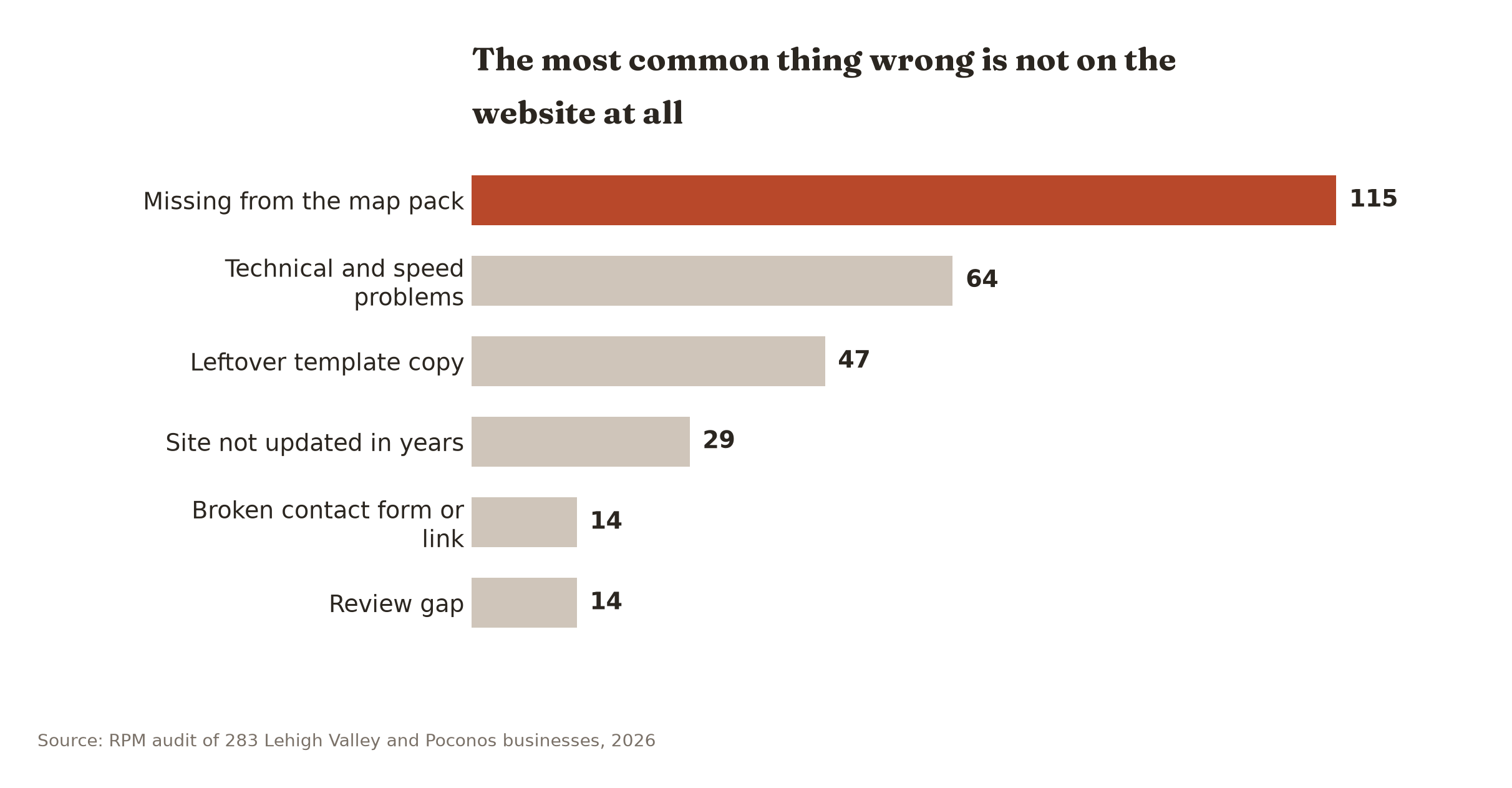
Missing from the map pack leads by a wide margin. That means the most expensive thing wrong with most local websites is a Google Business Profile nobody has touched, plus a review count that stalled out.
Second is technical: slow pages, broken markup, sites that crawlers cannot read. Third is leftover template copy, which is its own kind of embarrassing, and which we see most often on reseller builds sold to contractors by phone.
Three ways owners get this wrong when they do it themselves
First, searching from the office. Covered above, and it is the big one. You will always look like you are winning.
Second, fixing the design before fixing the listing. A new homepage does not get you into the map pack. We have watched owners spend $9,000 on a rebuild and land in exactly the same three-pack position they started in, because the thing holding them back was 14 reviews and an unverified profile.
Third, running the audit in December and acting on it in June. Local search shifts with the season here. An HVAC company’s pack position in Allentown in mid-August is not the same fight as the one in late March, when everybody is switching from furnace calls to early AC tune-ups. Audit in the two weeks before your season starts, not during it.
When you should not pay anybody for this
Two cases, and we turn away work on both.
If you are booked eight weeks out and turning jobs down, a teardown will find things, and fixing them will get you more calls you cannot serve. Hire first. That is not us being noble, it is that a marketing project that ends in worse reviews because nobody could answer the phone is bad for both of us.
If your business is under about $400,000 a year and you are the only truck, run the six passes above yourself. It will take a Saturday. The passes are all here, and everything they need is free. Spending $399 on a report that tells you to claim your Google listing and get to 25 reviews is not a good trade when the post you are reading already told you that.
The case where paying makes sense is narrower. You have real revenue, and you have spent money on marketing that did not obviously work. You cannot tell which of six possible things is the problem. That diagnosis is the product.
What we fix first, almost every time
One priority, not a list.
If the Google Business Profile is incomplete, unverified, or carrying wrong hours, that gets fixed before a single line of the website changes. It is free, it takes an afternoon, and it moves more calls than anything else on the sheet. Around here it is also the item most likely to be flatly wrong, because it was set up once by a vendor who has since stopped returning calls.
Only after that do we touch the site, and the first thing we touch is the contact path. Phone number tappable, form delivering, one number everywhere. That is a half day of work and it is where the money is.
Everything else, including the rebuild, waits until those two are done and we have four weeks of clean tracking to measure against. If a vendor proposes the rebuild first, ask them what your current conversion rate is. If they cannot answer, they are guessing with your money.
What to do next
You can run all six passes yourself this weekend. The phone test, the form test, the review comparison and the listing check cost nothing and take about four hours. Most owners find two things they can fix by Tuesday.
What is genuinely hard to do alone is the town-by-town picture. Your service area might be nine towns, each with its own three-pack and its own set of competitors, and Google will not show you an honest version of it from your own desk.
That is most of what the $399 Strategy Session is. Every town you serve, mapped, with your position and the three holding each pack. Plus the speed numbers, the review comparison and the one leak we would plug first. You keep the report whether you hire us or not. Hire us inside 60 days and the $399 is credited against the invoice.