Missed Call Text Back: The Cheapest Close Rate Fix There Is
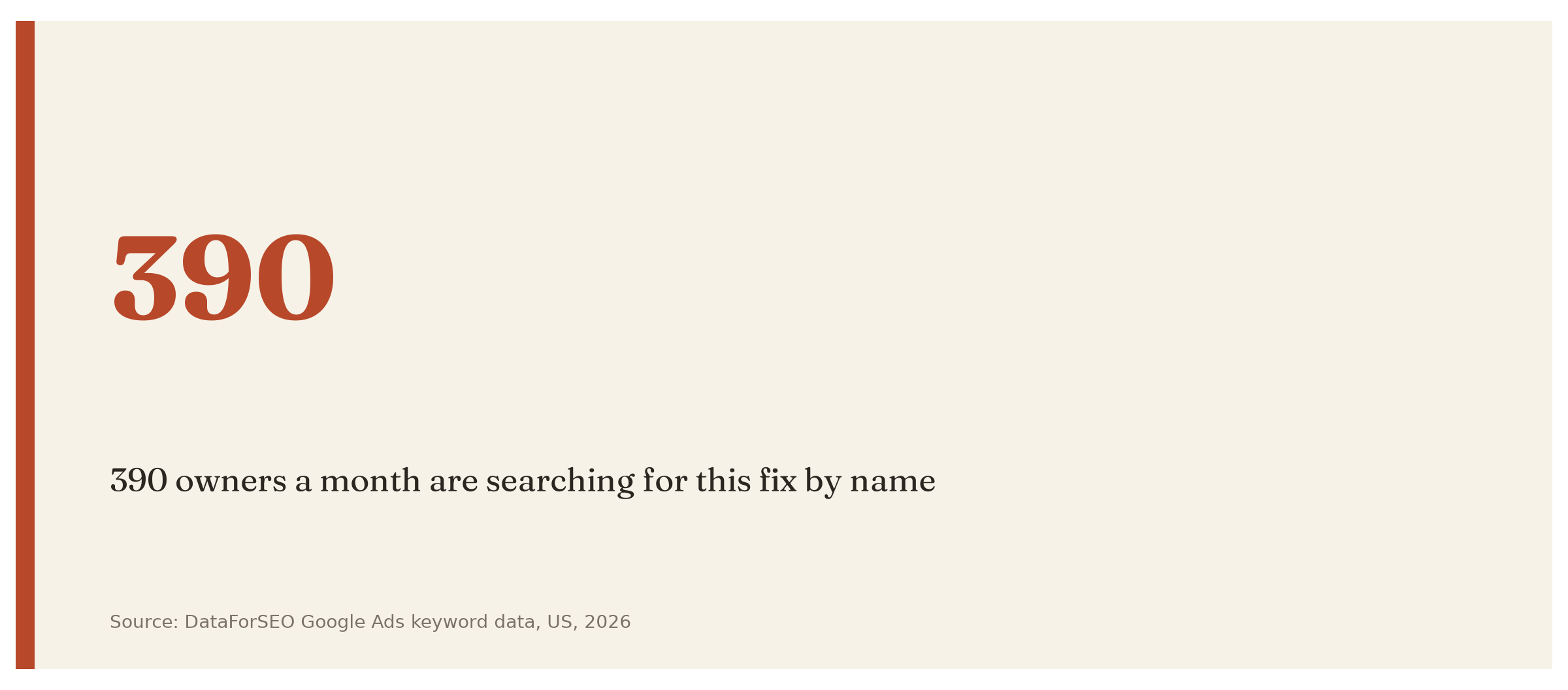
Three hundred and ninety people a month type “missed call text back” into Google (DataForSEO, 2026). My guess is that almost all of them are owners who just worked out how many calls their company does not return.
Here is the situation it solves. It is a Thursday in late April, your two crews are out on roof jobs off Route 33, and the phone rings while everyone’s hands are full. The homeowner gets four rings and voicemail. She does not leave a message. She goes back to the map pack and calls the next company on the list, which takes her eleven seconds.
You never knew that call happened. It is not in your CRM, it is not in your analytics, and it will not show up in any report you buy.
Missed call text back sends that homeowner a text within about five seconds of the call dropping. It costs less than a month of ads, and of everything in our writing on tracking what produces your jobs, it is the one that pays back fastest. Here is how it works and what to put in the message.
What it actually is
An automated text, sent from your business number, triggered by a call you did not answer. That is the whole mechanism. The homeowner’s phone buzzes while she is still looking at your listing, and instead of a dead end she has a conversation open.
Most people text back. That is the part owners underestimate. A homeowner will not leave a voicemail for a stranger, but she will tap out “my water heater is leaking, are you available today” without thinking about it.
From your side, the reply lands wherever your business texting lives, and somebody answers it between jobs. The crew does not stop. The office manager handles it, or you handle it from the truck at lunch.
The math, with your numbers
Do not take my figures. Take yours, because this only works if you believe the arithmetic.
Write down three things. How many calls you miss in a normal week, which your phone will tell you if you scroll. Your average job value. Your close rate on estimates you actually get in front of.
Then: missed calls per month, times the share who text back, times your close rate, times your average job. Even at conservative guesses, a company missing ten calls a week with a $2,400 average job does not need many recoveries to cover the cost of the tool. One is usually more than enough.
The reason I will not hand you a recovery percentage is that I do not have one I can stand behind across trades. Emergency plumbing and kitchen remodeling behave completely differently. A burst pipe in East Stroudsburg gets answered in seconds by whoever replies first. A kitchen in Bethlehem sits in someone’s head for three weeks. Run your own numbers for a month and you will have a real figure instead of a vendor’s.
Writing the text so it does not read like a robot
This is where most setups fail, and it is entirely free to get right.
The default message every vendor ships with is some version of “Thanks for calling, we missed you. How can we help?” It says nothing, and it reads exactly like the automated message it is.
Write yours the way you would talk. Put the company name in the first four words, say plainly why nobody picked up, and end on one question a person can answer with a thumb.
For a heating and cooling company:
This is Mike at [company]. Sorry we missed you, we’re on a job in Brodheadsville. Is this a no-heat or no-cool emergency, or can we call you back this afternoon?
For a remodeler, where nothing is urgent and the sale is slower:
This is Mike at [company]. We’re out on a job site, so I missed your call. What are you looking to have done? I’ll text you back tonight either way.
Notice what is missing. No offer, no link, no “we value your business.” A homeowner who just called you about water on her floor does not want a landing page.
One local detail that matters more than it should. Say the town you are in. “We’re on a job in Brodheadsville” tells a Poconos homeowner you are actually nearby. That is the first thing she is trying to work out, and the reason she called three companies instead of one.
Setting it up
- Find out if your number can text at all. A traditional landline cannot. If your main number came from a copper line in the office and has been ported around for twenty years, this is the step that takes the longest. Your phone provider can usually enable texting on it, which keeps the number your customers already know.
- Pick where the texts live. If you already run Jobber or ServiceTitan, start there, because the conversation attaches to the customer record and your office manager only has one screen to watch. Whether automatic missed-call replies are included depends on your plan, so ask before you buy anything else. CallRail can text back from a tracking number, which is the natural choice if you already have call tracking running. Podium and its competitors do this as their main product.
- Register for A2P 10DLC. This is the part nobody mentions and the reason half of these setups quietly stop working. US carriers require businesses sending automated texts to register the company and the message campaign. Skip it and your messages get filtered, meaning your system reports a text sent and the homeowner never sees it. Registration runs through whatever platform you chose, takes a few days, and needs your legal business name and EIN. Do it before you go live, not after you wonder why nothing is working.
- Write the message and the after-hours version. Two messages. The daytime one says you are on a job. The evening one says you are done for the day and gives a real time in the morning. Nothing erodes trust faster than a text at 9pm implying somebody is standing by.
- Decide who answers, by name. Not “the office.” A person, with the app on their phone, who knows they own it. A text that goes unanswered for four hours is worse than no text, because you have now proven you ignore people.
- Test it from your own cell. Call your own office line, let it ring out, and wait. Check how the message looks on a phone screen rather than in the vendor’s preview box.
Done when: a call you deliberately miss produces a text on your own phone inside ten seconds, and it reads like a person wrote it.
When you should skip this
If you genuinely answer every call, do not buy it. Some three-truck operations with a real office manager do, and for them this is a subscription that fires twice a year.
Skip it also if nobody will monitor the replies. The whole point is that a conversation opens. If it opens into an empty room, you have automated a worse version of voicemail. I would rather see a contractor spend that money on somebody answering the phone.
And if your number cannot text and your provider wants a contract change to fix it, weigh that against the alternative, which is texting from a second number the customer does not recognize. That works, but it converts worse, and it muddies your records.
One more caution. This is a recovery tool, not a lead source. It will not produce calls. If your problem is that the phone does not ring at all, a missed call text back does nothing for you, and the money belongs somewhere further up the chain. Your call log tells you which of the two problems you actually have.
How fast it shows up
Immediately, which makes it unusual around here. Most of what we recommend takes 90 days to read. This one produces a recovered job in the first week or two for most companies, because you were already missing the calls.
The reporting is simple enough to do by hand. Count the texts that got a reply, and count the ones that turned into work. Put that number next to your monthly GA4 figures and your call log, and you will know within two months whether it earned its keep.
One warning about April specifically. Storm season and AC pre-season both start now, which means your missed call volume is about to climb for reasons that have nothing to do with your marketing. That makes this a good month to install it and a bad month to judge the results against March.
What to do next
Scroll your call history tonight and count the missed calls from the last seven days. That number is the whole business case, and it takes four minutes to get.
What you cannot count from your phone is the calls that never happened. The homeowner in Nazareth who searched, saw three companies in the map pack, and never saw you at all. That one leaves no trace anywhere in your systems.
Our free Local Visibility Scan finds it. You get a town-by-town map-pack grid across the Lehigh Valley and the Poconos, your reviews next to your top three competitors, your site speed, and the biggest single leak we can see. One page, no call to book, and we do not sell your details on.
If you want the deeper version, including what your call handling and your reviews are actually costing you, that is the $399 Strategy Session, and the report is yours either way. Get your free Visibility Scan.