How to Show Up in ChatGPT Search
A tree service in Jim Thorpe has 117 Google reviews at 4.7 and no website attached to its Google listing. Not a bad website. None.
When a homeowner off Route 903 asks ChatGPT who to call after a spring windstorm drops a limb on the garage, that company has nothing for the assistant to read, cite, or link to. The reviews are real and they are invisible to it.
Storm work in Carbon County in April is the busiest stretch of the year for tree crews. Missing from the answer during those six weeks is not a marketing problem, it is a payroll problem.
This is the checklist we run to make a local business findable inside ChatGPT, in order, with a way to tell when each step is done. It takes a weekend. Read the full picture on AI search first if you want the strategy behind it.
What skipping this actually costs
Less than the internet is telling you, and more than zero.
We cannot tell you that ChatGPT is sending Lehigh Valley contractors a measurable number of calls, because we have not been able to measure it and we have not seen anyone credible who has. OpenAI said ChatGPT was at roughly 800 million weekly users in 2025. Nobody has published what share of those are people looking for a plumber in Nazareth.
Here is why we do it anyway. Every step below takes under an hour, seven of the eight also help you in Google Maps, and none of them cost money. The worst case is that you spend a Saturday tightening up listings you should have tightened up in 2022.
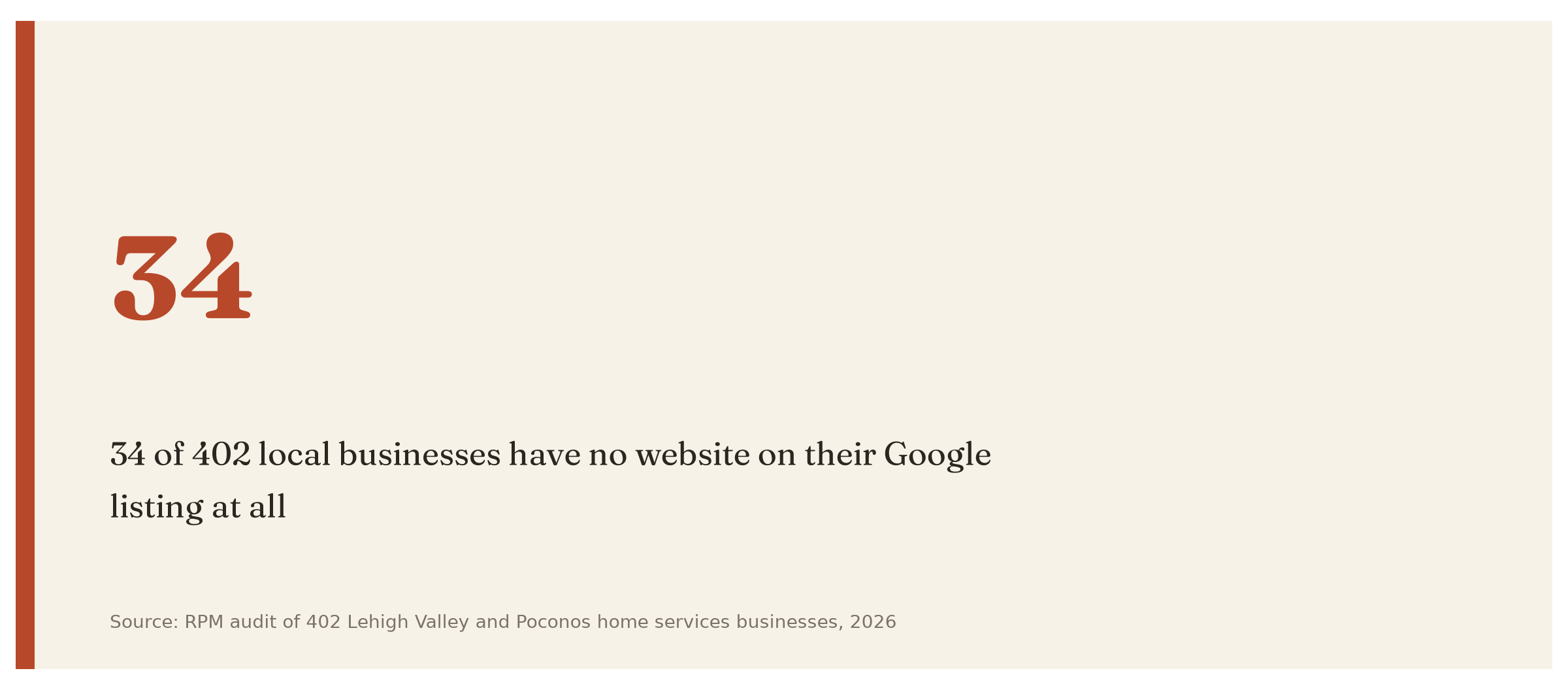
The real cost of skipping it is the one in the chart further down. Thirty-four of the 402 businesses we audited across this region have no website on their Google listing at all. Those thirty-four cannot be quoted by anything, ever.
Step 1. Make sure you are not blocking the thing you want to be in
OpenAI runs a separate crawler for ChatGPT’s search results. It published the name in 2024: OAI-SearchBot. Plenty of developers, sometime in 2023 or 2024, added a blanket block on AI crawlers to client sites because a blog post told them to. If yours did, you are asking to be found by a tool you locked out.
Type your domain followed by /robots.txt into a browser. Read it. If you see OAI-SearchBot with Disallow under it, that is the problem.
Done when: your robots.txt either says nothing about OAI-SearchBot or explicitly allows it.
Step 2. Claim Bing Places, which almost nobody around here has done
ChatGPT’s search leans on outside web indexes, and Microsoft’s has been widely reported since 2024 as one of them. Which means Bing’s local data matters to you, and Bing’s local data is a place almost no contractor in Monroe County has ever looked.
Bing Places for Business is free. It will import most of your Google Business Profile in about four minutes. Verification is a phone call or a postcard.
Of all eight steps, this is the one with the least competition behind it. We have checked dozens of regional trades and the Bing listing is usually either missing or auto-generated from a phone book record with a dead address.
Done when: Bing Places shows your business as verified, with the same phone number that rings your office.
Step 3. Finish the Google Business Profile properly
This is not a ChatGPT step, exactly. It is the step everything else is built on, because map data is where local answers start.
Fill the service list, not just the category. Set the service area to the actual townships you drive to, and be honest about it. If you do not really go to Palmerton, taking Palmerton out makes your other towns stronger. Set real hours, including whether somebody picks up at 10pm in February.
Done when: there is no empty field left on the profile and the service area matches where your trucks actually go.
Step 4. Get your towns onto the page as words a machine can read
An assistant asked about Brodheadsville needs to find the word Brodheadsville in the text of a page. Not inside a map embed, not inside an image of your service area, not in a PDF.
One paragraph on your service-area page does it. “We cover Brodheadsville, Effort, Gilbert, Kunkletown and the rest of Chestnuthill and Polk townships, plus Lehighton and Palmerton along Route 209.” That is one sentence and it does more than forty auto-generated city pages.
Check it the crude way. Open your site, hit Ctrl-F, type the town. If the browser cannot find it, neither can anything else.
Done when: every town you want calls from appears as plain text on at least one page.
Step 5. Say the thing in the first two sentences
Assistants quote sentences. They do not quote page layouts.
If your pricing page opens with “Every project is unique and we tailor our approach to your needs,” there is nothing on it to repeat. If it opens with “A full roof replacement on a typical Lehighton ranch runs $9,000 to $16,000 depending on pitch and tear-off,” that is a sentence that can be read back to a homeowner.
Write the sentence you want a stranger to say about you. Put it first. Everything else on the page is supporting material.
Done when: a person could read the first two sentences of your main service page out loud and a homeowner would know the price range and the area.
Step 6. Kill the contradictions
We found an HVAC company in Lehighton whose Google listing says “7+ years in business.” Its own homepage says “over 25 years.” Both live, same day, on the two pages a homeowner checks before calling. We found a Brodheadsville HVAC hero slider that says 34 years on one slide, 22 years on the next, and “celebrating our 23rd year” in between.
A human squints and moves on. A machine reading both has no basis to pick one, so it usually says nothing about you at all.
Make a list: years in business, phone number, service area, hours, business name spelling. Check each one against your site, your Google profile, your Facebook page, and your Yelp listing. Pick one version. Fix the rest.
Done when: all five facts read identically in all four places.
Step 7. Claim the directories that keep showing up in the citations
When these tools show their sources for a local question, Yelp, Angi and the BBB turn up constantly. You do not have to like those platforms or pay them. You do have to have a claimed listing with the right phone number on it.
Thirty minutes each, once, forever.
Done when: Yelp, Angi and your BBB listing all show the phone number that rings your office.
Step 8. Ask it yourself, twice, and write down what it says
Open ChatGPT on your phone. Ask the way a customer would. “Who should I call for AC repair in Emmaus PA?” Write down every name it gives.
Ask again the next day. The list will change. That is not a bug in your marketing, that is how these tools work, and it is why we do not sell an AI ranking report.
Do it on the first of the month, log the names in a spreadsheet, and look at it twice a year. Over six months you will see whether you are drifting into the answer or out of it. Over six days you will see nothing but noise.
Done when: you have a dated spreadsheet with at least two entries in it.
Where the bar actually sits in your town
Steps 1 through 8 make you readable. Reviews are what make you the obvious pick, and the number you need is local.
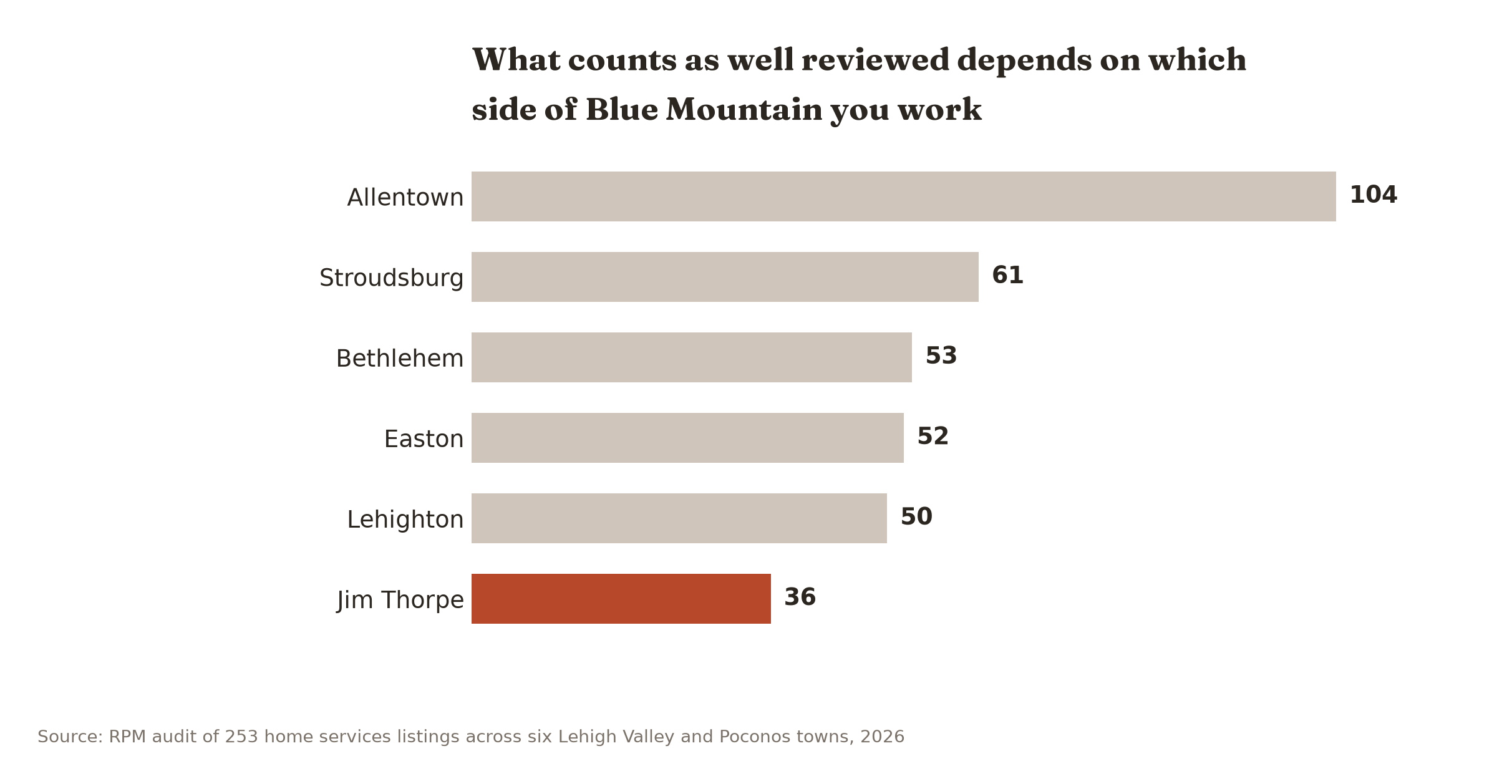
The median company we audited in Allentown carries 104 Google reviews. In Jim Thorpe it is 36. Same trades, same work, a bar that is almost three times higher on one side of Blue Mountain.
If you run out of Stroudsburg and take jobs down Route 33 into Bethlehem and Easton, you are competing at two different levels at once, and the Stroudsburg half is winnable much sooner. Start there.
What most people get wrong
They build a city-page farm. Forty separate pages, one per town, the same 600 words with the name swapped. We still see this pitched locally. It reads as junk to a person and it gives an assistant forty near-identical pages to choose between, so it quotes none of them. One honest service-area paragraph beats all forty.
They pay for an AI monitoring subscription. These tools ask an assistant your keywords on a schedule and chart the results. The results change on their own. You are paying $300 a month to chart weather.
They do this before they do the map pack. In Palmerton, only 2 of the 16 companies we checked are in the map pack for their trade. If you are one of the fourteen, the map pack is a bigger and more measurable prize than anything in this post, and it is the same work. Do both, but judge yourself on the map.
How long this takes to show up
Robots and Bing Places: days to a few weeks. Bing verification by postcard is the slow part.
Profile and consistency fixes: two to six weeks before you see anything change in an answer, in our experience, and the change will be hard to distinguish from normal drift.
Reviews: six to nine months to move your count meaningfully at an honest pace. Start in April, be in position for the heating season.
One warning. Because the answers move on their own, you will have a week where you show up in every answer and a week where you show up in none. Neither week means anything. Check your map-pack position instead, because that one holds still long enough to read.
What to do next
Every step above is yours to run this weekend, and most of them you can verify in a browser tab. Our teardown method is the longer version of the same checks if you want to run the whole thing yourself.
The part you cannot see from your own phone is the comparison. Where you stand across every town you serve, not just the one you are sitting in, and which of your listings disagree with each other.
The Local Visibility Scan does that, and it is free. You get a grid of where you show up across the Lehigh Valley and the Poconos. Your review count against your top three competitors in each town, your site speed, and the three things we would fix first. One page, no sales call, and your information does not leave our office.
If you want the deeper version, with competitors, review content and the AI answers included, that is the $399 Strategy Session. You keep the report either way.