Seven Signs Your Site Needs a Rebuild, Not a Refresh
A Jim Thorpe remodeler’s website footer says “copyright 2035.” The call button at the top of the page dials a 201 number and the one at the bottom dials a 570 number. He has 50 reviews at 4.8 and is not in either map pack he should be in, while a competitor with 33 reviews holds both. He asked whether a refresh would do it. It would not, and the reason is the two phone numbers, not the date. A wrong year is paint. Two live phone numbers on one page means nobody has owned this site in years, which is foundation. Here is how to tell which one you have before somebody quotes you either.
What the wrong call costs
A refresh runs $1,500 to $4,000 around here. New photos, new copy, maybe a new template on the same platform. A rebuild is $4,500 to $15,000 and starts over.
Refresh a site that needed a rebuild and you have spent $3,000 repainting a structure that still cannot hold town pages and still hides the phone number on a phone. You will be back inside eighteen months, and the second bill is not smaller.
Rebuild a site that only needed a refresh and you spent an extra $6,000 for the same three estimates a week. Agencies make that one on purpose.
So count the signs first. They come out of the same regional audit behind our full list of what a failing site looks like, 402 companies opened one at a time in a browser.
The copyright year is not this year, and it is not close
We read the copyright year on 70 sites in our regional audit. Thirty-seven of them said 2024 or earlier.
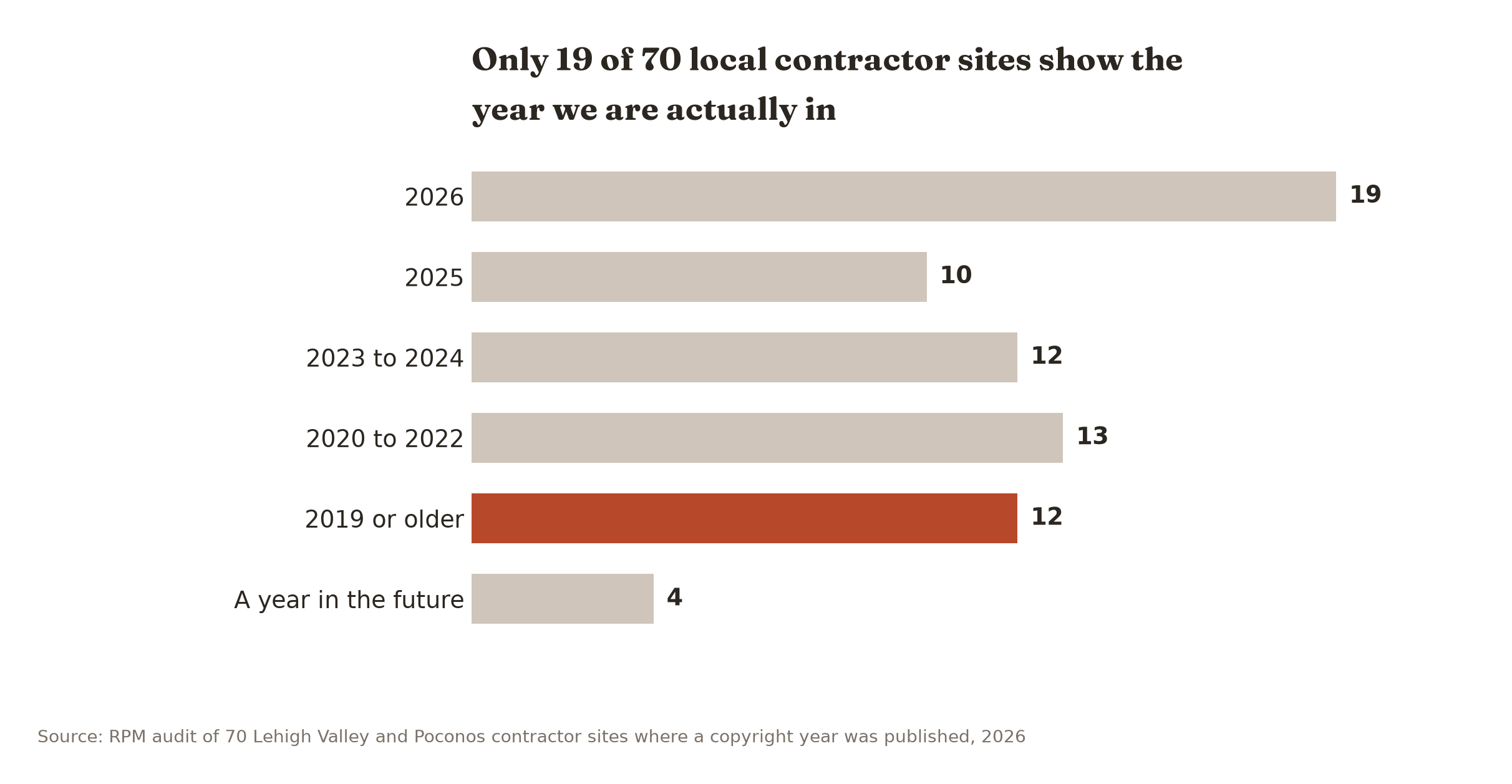
The year itself ranks nothing. What it tells you is how long it has been since anybody opened the site with intent. One Lehighton roofer’s footer reads 2013, and the page is served over plain HTTP with no secure version at all, and the browser tab says only “Home.” Those three facts arrive together because they have the same cause.
On its own, a stale year is a refresh. Combined with anything below, it is a rebuild.
The template still shows through
Forty-seven of the sites we audited were still displaying text the builder shipped with. A Hellertown HVAC homepage reads <<Core Business Keyword>>. A Nazareth HVAC site renders its own tel: and mailto: links as the words a visitor reads.
One or two of those, a good developer removes in an afternoon. A refresh.
But when the placeholder copy is structural, when the services grid, the hero and the footer are all still carrying the demo, nobody ever built this site. Somebody bought a template and turned it on. There is nothing underneath to keep.
Your site and your Google listing contradict each other
A Lehighton HVAC company is listed by Google as “7+ years in business” while its own homepage says “over 25 years.” A different Lehighton company publishes a Lansford ZIP code on its contact page. A Palmerton remodeler’s page title carries a Lehighton address while the Google listing carries a Palmerton one.
Fixing the text is a refresh. But if the wrong address is baked into the title tag, the map embed, the footer and the metadata all at once, you are editing a build, not a page. On locked-down builders that means a support ticket, a week of waiting, and finding out the field is not editable.
The contact path does not work
Fourteen sites in our audit had a broken way to reach the business. A Nazareth HVAC contact form shows an error message where the form should be. A Jim Thorpe remodeler’s email link displays a scrambled string and mails it to the same scrambled string, so nothing sent from that site has ever landed anywhere.
A Northampton County HVAC company holding a map spot on about 100 reviews runs a fully JavaScript-rendered site with no phone number on it at all. Not hidden. Not small. Absent.
Ask your developer to fix it. If the answer involves the phrase “that’s how the platform works,” you have your answer about the platform.
You cannot add a page for a town
This is the one that actually decides it for most companies here, and almost nobody asks about it before buying.
If you run out of Kunkletown and cover Carbon, Monroe and part of Northampton, you need real pages for the towns you want work in. Not a footer list. A page with your jobs in that town and the permit office you deal with.
Five of the sites we audited were single pages with nothing behind the menu. One Stroudsburg remodeler has a Wix build where the nav links resolve to /blank-2 and /blank-3.
Try it yourself. Add a page, give it a real URL with the town in it, put it in the menu. If that takes more than twenty minutes or requires calling someone, your site cannot grow into your service area. We watched that play out in Brodheadsville, where a competitor’s dedicated town page holds organic number one while the company next door reaches the same search from its homepage at number seven.
The pictures are not there
Nine of the sites we opened had images with nothing behind them. A Brodheadsville remodeler has a twelve-item gallery where every item is empty. A Stroudsburg remodeler has about twenty gallery images with no files.
Missing images are usually a migration scar. Somebody moved the site, the media library did not come along, nobody looked. A handful you replace. A structurally empty gallery means the migration failed and you are running on the wreckage.
Your gallery is your close. A homeowner in Emmaus comparing three kitchen remodelers is looking at photos, not paragraphs. An empty gallery reads as no work to show.
Nobody owns it
The last sign is not technical.
Can you name the person who can change your homepage this week? Do you have the login? Does the domain renew to a card you still have?
One site in our audit had two of its three free-estimate buttons pointed at a subdomain on the old web host, over plain HTTP, while the third went to the real domain. Nobody noticed because nobody was looking.
If you cannot answer those three questions, the rebuild is not really about the site. It is about getting the keys back.
When a refresh is the right call
Do not let anybody talk you into a rebuild you do not need.
Refresh if the site loads fast, shows your phone number on a phone, has separate pages you can edit, submits its form to a real inbox, and looks dated. Dated is cosmetic. Photos, copy, and a cleaner layout on the same foundation will cost you a third as much and take three weeks instead of ten.
Also refresh, or do nothing, if the real problem is upstream. Thirty-four of the 402 businesses we audited have no website and five are in the map pack anyway. If your Google Business Profile is half-built and you have eleven reviews, a $9,000 rebuild is the wrong first dollar. Work out why you are not showing up first.
And if you are heading into spring roofing season with a full board, put this off to November. A rebuild during your busy months means approving copy at nine at night, and it takes four months instead of two.
How to decide in one sitting
Count your signs. One or two, refresh. Three or more, or any one of signs four, five and seven on its own, rebuild.
Then ask whoever is quoting you three questions. Who owns the domain when we are done. Can I add a town page myself. What happens to this site if you stop answering the phone. The answers sort most vendors in four minutes.
What to do next
Every sign above you can check yourself in an evening. Do it before you take a quote, because a vendor who finds the problems for you also gets to price them.
What you cannot check is whether the site is actually costing you position. Your own results are shaped by where you are standing, and the towns you are losing are the ones you never search from.
Our free Local Visibility Scan shows you that. Your rank in each town you serve, your reviews against the three companies above you, a measured load time, and the biggest single leak we find. One page. We do not phone you about it, and we do not sell your information.
If you want a real opinion on rebuild versus refresh with the numbers behind it, that is the $399 Strategy Session, and it comes off any project you start with us inside 60 days. You keep the report either way.