Teardown: A Lehigh Valley HVAC Site That Buries Its Phone Number
We loaded an HVAC company’s homepage in a browser, waited for it to finish, and then went looking for the phone number. There isn’t one. Not in the header, not in the footer, not in the body copy. No email either. The single “Contact us” button on the page links back to the homepage you are already standing on.
The company is a three-year-old heating and cooling outfit in Northampton County. Five stars, about 100 Google reviews, and it currently holds the third spot in its own town’s map pack. Anonymized, because the point is the pattern and not the company.
So Google is sending this business people. They arrive. Then they hit a wall and call somebody else. It is the last week of March, exactly when the calls swing from “my furnace is making a noise” to “book my AC tune-up before June.” That is the busiest booking window of the spring.
Here is the full scorecard, what the site does well, and the one thing we would change before lunch.
The scorecard
Everything below was checked in a real browser, not a crawler, because a crawler would have told a different story about this site. These are the same passes we run on every site we take apart, and the full method is written out here.
| Measure | Result |
|---|---|
| Google rating | 5.0 |
| Google reviews | About 100 |
| Years in business, per the Google listing | 3+ |
| Map pack position, HVAC, its own town | #3 of 3 |
| Reviews held by the pack leader | About 55 |
| Phone numbers printed anywhere on the site | 0 |
| Tappable tel: links | 0 |
| Email addresses on the site | 0 |
| Contact pages in the navigation | 0 |
| Working destination for the “Contact us” button | The homepage |
| Page text present before JavaScript runs | None |
Two of those rows are the whole post. Zero phone numbers, and a contact button that is a circle.
Three things this company is doing better than most of the region
This is not a bad business with a bad website. It is a good business with a website that forgot the point, and the difference matters, because the fix is cheap when the rest is healthy.
About 100 reviews in three years
Work out the rate. Roughly three new Google reviews a month, sustained, for three years, at a five-star average. We audit a lot of HVAC companies in this region and almost none of them do that. Plenty of twenty-year-old shops across the county are sitting on 30 or 40 reviews total.
Whatever their process is for asking, it works. That is the hardest thing on this list to buy and they already have it.
They are in a pack they have no business being in yet
Three years old, up against established names on the Route 33 corridor, and they hold a map spot. The company at the top of that same pack has about half their review count.
Look at the rest of the town and the picture gets clearer.
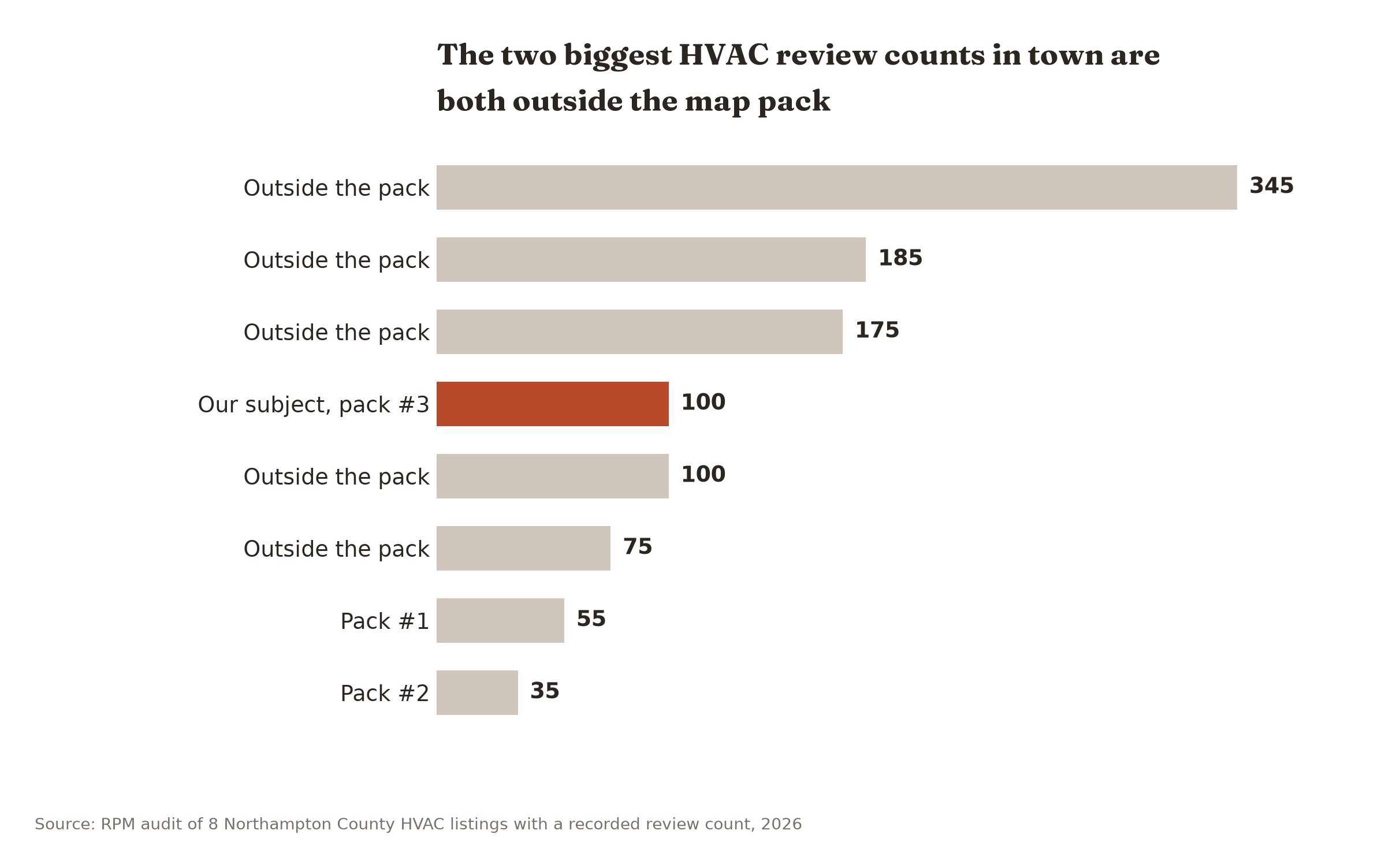
The two biggest review counts in that town, about 345 and 185, are both outside the pack. One of the three businesses in it has 35 reviews. Review count alone is not what decided this, which means proximity, categories and profile completeness are doing work here, and this company has clearly got those right.
The site itself is current
No 2014 copyright line. No leftover template text reading “Keyword Term H3,” which we find on live contractor sites in this region more often than we would like. No stock photo of a smiling family that also appears on four other HVAC sites.
It is a modern, clean build. Somebody spent real money on it. That is exactly what makes the next section frustrating.
Three things costing them money
A note on the dollar figures. I do not have this company’s analytics, and neither do you if you are running this check on your own site. So the arithmetic below is written out with the assumptions visible, and you should swap in your own numbers rather than trusting mine.
1. There is no phone number on the website
A map pack listing has a call button, so some people never touch the site. But the listing also has a website link, and the people who click it are usually the ones who want to look you over before they call. Those are the higher-value calls. Installs, not filter changes.
Say the website link gets 150 clicks a month from a pack position in a town this size. That is our guess, and a conservative one. If 8 of every 100 of those people would have tapped a call button, that is 12 calls. If one in four books and an average job is $450, the missing header phone number is worth about $1,350 a month. Push the average ticket up to a system replacement and the number stops being a rounding error.
The fix: a tappable phone number in the header, visible without scrolling, on every page. Half an hour of work on any platform built this decade. Repeat it in the footer and at the bottom of every service section.
2. The only contact button is a loop
The visitor who does not want to call is the one who is browsing at 9pm with a spouse. He wants to send a message and get a quote in the morning. He finds the one button labeled “Contact us,” taps it, and lands back on the page he was already reading.
There is no contact page in the navigation at all, so there is no second attempt. He is gone, and there is no record he was ever there.
Using the same assumptions, a working contact form on a site with this much profile strength should be taking 4 to 8 messages a month. Call it another $900 to $1,800 in booked work, and more importantly, those messages are a list you own.
The fix: a real contact page with a short form, four fields maximum, name, phone, town, what’s wrong. Then submit it yourself and confirm the email lands in a human’s inbox. Test it again in 60 days. Forms break silently and nobody notices.
3. The page has no text until JavaScript runs
Load this site with scripting off and you get nothing. That is fine for a modern browser. It is a problem for everything else that reads web pages, and there are more of those than there used to be.
When a homeowner asks an assistant “who does emergency furnace repair near me,” the assistant needs sentences to quote. This site has none it can reach. Google renders JavaScript, but it does it slowly and inconsistently, and it is not the only thing indexing you anymore.
The cost here is the hardest of the three to put a number on, so I will not pretend. What I will say is that this company has the reviews, the rating and the pack position to be the obvious answer to that question. It is not in the running, because there is no text to lift.
The fix: make sure the service descriptions, the town names and the hours exist as real HTML text that arrives with the page. Any competent developer can check this in five minutes by viewing the page source and searching for a sentence they can see on screen.
What we would do first if this were ours
The phone number in the header. Today, before anything else, before any conversation about a rebuild.
This business is in an unusual position. The expensive, slow half of local search is already done. Three years of review discipline and a pack spot is worth more than most of what an agency can sell you, and it cannot be bought in a quarter. The cheap half, a number a thumb can tap, is missing.
That is a thirty-minute fix on a site that already holds a map pack spot at the start of AC season. We would ship it, then build the contact page the same week, then argue about the JavaScript in May when the tune-up rush settles down.
Where this teardown could be wrong
Two honest limits, because a teardown that only finds what it went looking for is not worth much.
The first is that we checked one page on one day. It is possible there is a phone number on an interior page we did not reach, though the navigation gives no route to one. If that is the case, the finding shrinks from “no phone number” to “no phone number where anybody will look,” which costs nearly the same.
The second is bigger. This company may be perfectly happy. Three trucks booked out four weeks, a full spring calendar, no appetite for the twelve extra calls a month we are talking about. That is a real position and a common one around here. If you are turning work away in March, do not spend a dollar on any of this until you have hired. Fixing the front door when the kitchen is already backed up just produces worse reviews.
Run this on your own site in ten minutes
Four checks, all free, none requiring a tool.
- Open your homepage on your phone, on cell data, and try to call your business using only your thumb without scrolling. If you cannot, that is the finding.
- Tap every button on the page that sounds like contact. Note where each one actually goes.
- Fill in your own contact form with a real email address and wait an hour. If nothing arrives, it has probably been broken for months.
- View the page source and search for a sentence you can see on screen. If it is not in there, crawlers and assistants are not seeing it either.
If all four pass, your site is doing its job and your problem is somewhere else. This post covers the other symptoms worth ruling out next.
What to do next
The four checks above take ten minutes and you can do them from the truck. Most owners find at least one broken thing, and the broken thing is usually the contact form.
What you cannot see from your own phone is where you sit town by town. Bath, Wind Gap, Pen Argyl and Easton are four different packs with four different sets of competitors. Search from your own office and Google will show you a flattering version of all four.
The $399 Strategy Session maps that properly. Every town you serve, your position in each, the three businesses holding each pack, your speed and review numbers next to theirs, and the single leak we would plug first. You keep the report either way. Start a project with us inside 60 days and the $399 comes off the bill.