How to Respond to a Bad Review
Twenty-six of the 402 local businesses we audited are rated under 4.0. The lowest is a remodeler in Easton sitting at 2.3 stars on seven reviews.
Seven is the number that matters there. At seven reviews, two bad experiences are the entire public record of a company that has probably done a hundred good jobs.
Businesses in our audit rated between 4.0 and 4.4 showed up in the map pack 7% of the time. Everybody else ran three to five times better than that. So a couple of one-stars, handled badly, is worth real jobs every month.
Here is what to write, what not to write, and the thing that actually fixes it.
What a bad review costs, in numbers
The damage is not the star. It is the star divided by how many reviews you have.
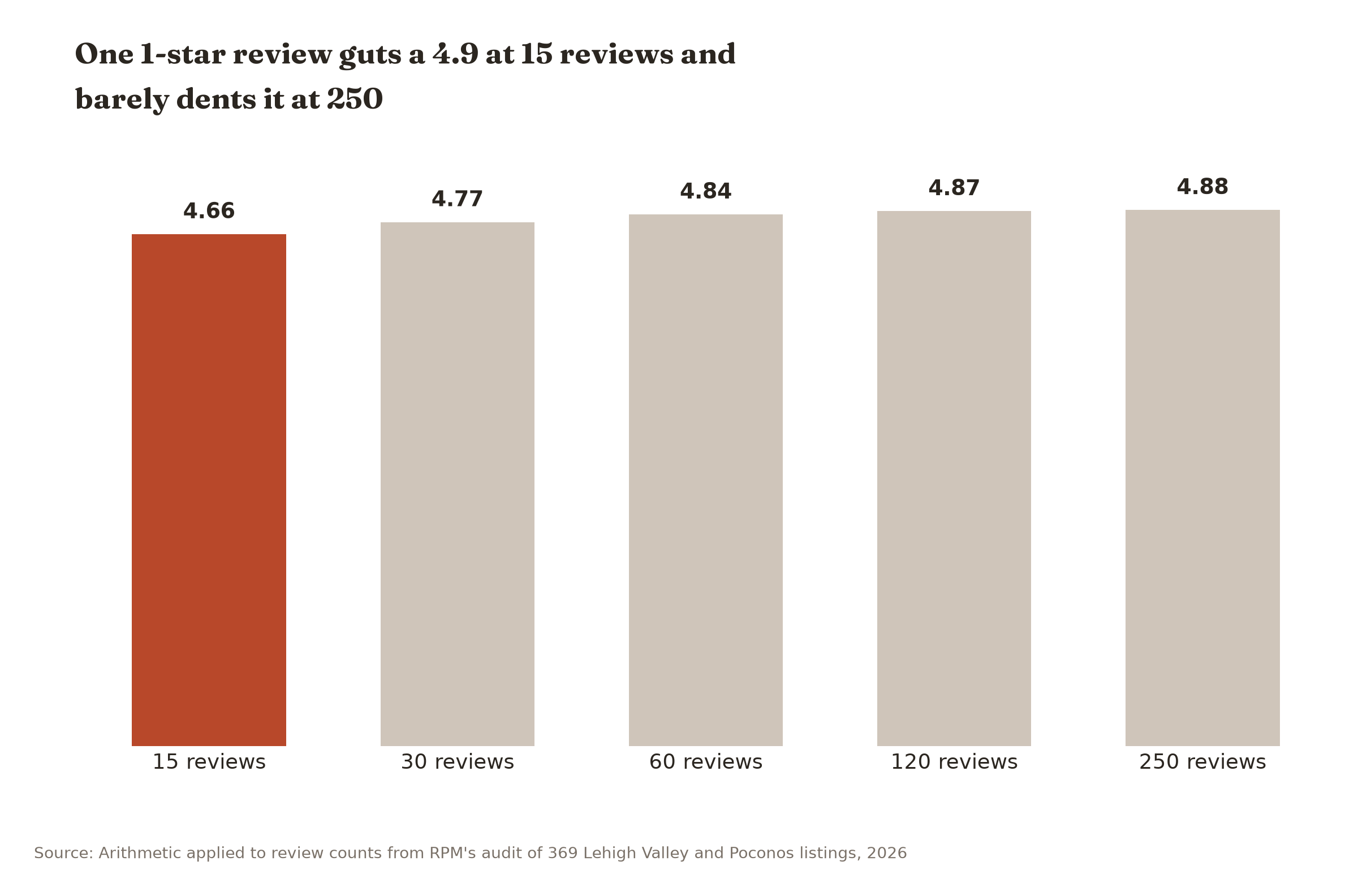
That is just division, but it is the whole strategy. At 15 reviews, one angry customer knocks you from 4.9 to 4.66 and puts you in the band where the map pack stops calling. At 250, the same customer costs you two hundredths of a star and nobody notices.
The pattern holds in the real data too. The businesses in our audit rated under 4.0 had a median of 32 reviews. The ones at 4.8 or 4.9 had a median of 88.
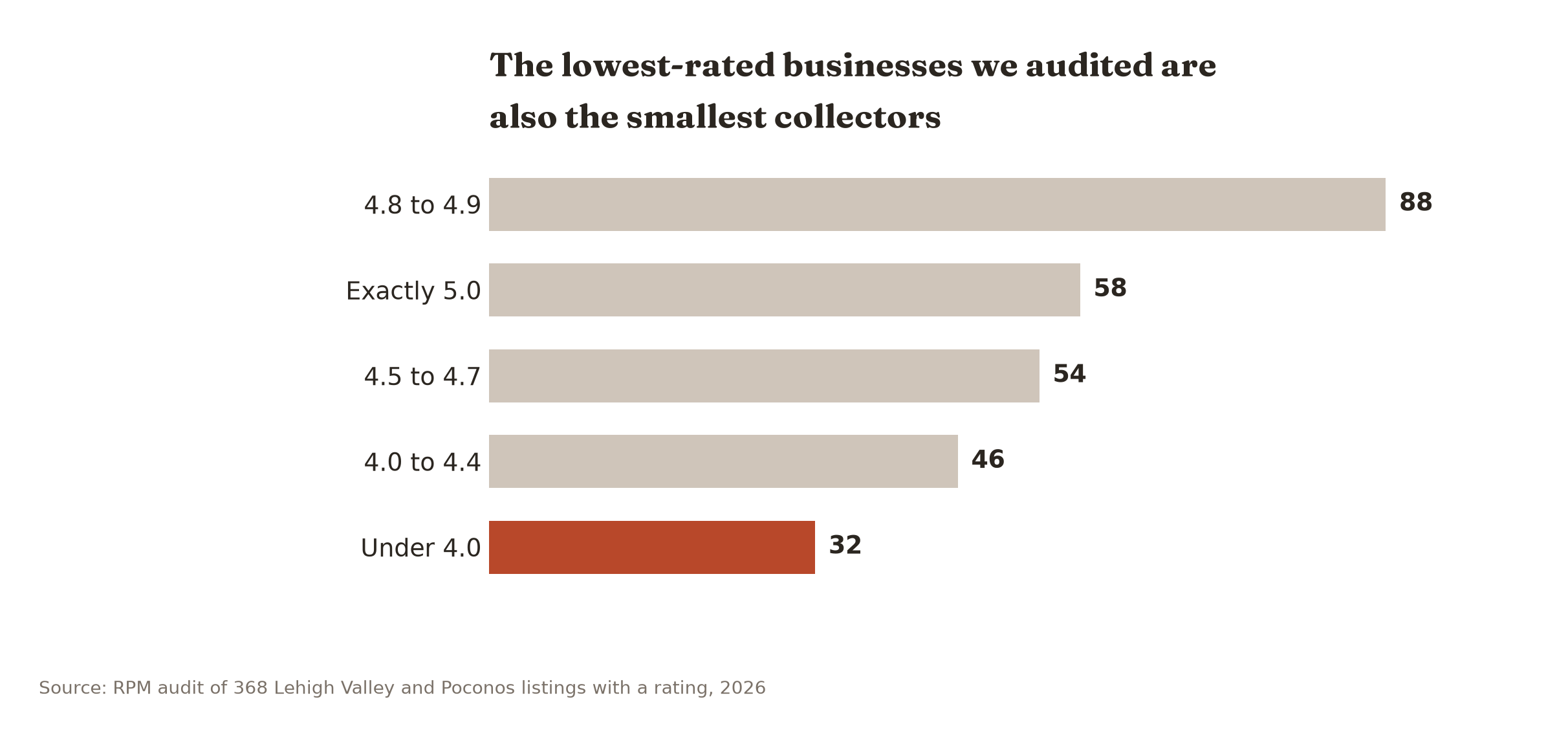
Low-rated businesses around here are not worse at the work. Mostly they are smaller collectors. The complaint always gets written. The praise only gets written when somebody asks.
The first hour
Do not respond in the first hour. Do not respond from the truck. Do not respond at 10 p.m.
Read it once, then go do something else. Almost every response that made a situation worse was typed inside sixty minutes of the notification, usually by the owner, usually on a phone.
What to do in that hour instead: pull the job. Find the invoice, the date, the tech, and what actually happened. Half the time the review is about a different thing than it appears to be, and about one time in ten it is not your customer at all.
Then respond within 24 to 48 hours. Fast enough that it looks like you are paying attention. Slow enough that you are not writing angry.
The shape of a response that works
Three sentences. That is it. You are not writing to the reviewer, who has already made up his mind. You are writing to the next homeowner who reads it while deciding whether to call you.
Sentence one: name the specific thing, so it is clear you know the job.
Sentence two: say what you did or will do about it.
Sentence three: one line offering to sort it out, from you by name.
No apology paragraph. No policy explanation. No history of your company.
When they are right
“Bob, you’re right that we missed the Thursday window on the water heater and nobody called you. That’s on our scheduling, and we’ve changed how we handle same-day reschedules since. Call me on the office line and I’ll make the trip charge right.”
When it is about price
“Thanks for the note, Susan. The $1,850 covered the condenser, the line set and the permit with Palmer Township, and I know that’s more than the phone estimate suggested. I should have walked you through the permit cost before we started. Call the office and I’ll go through the invoice line by line with you.”
Notice what that does not do. It does not argue that the price was fair. It concedes the one real failure, which was communication, and it puts the actual numbers on the page where the next reader can see them.
When you cannot find the job
“We don’t have a record of service at this name or address, and I’d like to sort that out rather than guess. If we did work for you under a different name, call the office and ask for me. If this was meant for another company, we understand.”
Polite, factual, and it tells the next reader you looked.
Words that make it worse
Never write “as I explained to you on the phone.” It reads as a fight in public and the reader takes the customer’s side by default.
Never explain your policy. Nobody has ever been persuaded by a cancellation policy in a review response.
Never mention the customer’s payment history, their house, or anything you learned inside their home. Beyond being bad manners, that is the fastest way to lose a small-town referral network. In a place like Jim Thorpe or Lehighton, one response like that circulates for a decade.
And never copy the same reply onto four different reviews. It is visible, it looks automated, and it undoes the point of replying at all.
Reply to the good ones too
This is the part shops skip, and it is easier than the hard ones.
An account with 80 reviews and 80 owner replies reads like a business somebody is running. An account where the only replies sit under the two one-stars reads like a company that only shows up when it is angry.
Two sentences on a good review is plenty. Name the job and the town if you can: “Thanks Dave. Glad the Mitsubishi head in the Brodheadsville sunroom is keeping up.” That is more useful than “Thank you for your business,” and it puts your service and your town in text.
When you should not respond
Three cases.
If it is not a customer and it is clearly an attack, flagging it is the right move. A public reply mostly draws eyes to it. Do both if you want, but the flag matters more.
If the reviewer is escalating, and every reply you post pulls another edit from them, stop. You will not win that and it is now a running argument on your listing. Reply once, leave the offer to talk, and let it sit.
If there is a lawyer or an insurance claim involved, do not write a word before whoever is handling it reads your draft. That happens on roofing jobs here more often than you would think, especially after a spring hail run.
Take it off the listing and onto the phone
The public reply is not where the problem gets solved. It is the invitation. The solving happens on a call, and the call is what sometimes gets the review edited.
When you get them on the phone, do not relitigate. Ask one question: what would make this right. About half the time the answer is smaller than you feared, and a fair number of people are mostly angry that nobody called them back in March.
Never ask them to take the review down. Fix the thing, thank them, and stop. Some customers update the review on their own, which is worth more than a deletion because the edit is public. Asking outright makes you look like you are buying silence, and in a service area the size of Carbon County that story travels.
The actual fix
Responding well limits the bleeding. It does not raise your rating. Only volume does that.
If you are sitting under 4.5, the job is not review management, it is review collection, and you need two or three a week for a season. A shop in Nazareth in our audit needed ten reviews to catch its map-pack leader. A shop in Allentown needed 265. Those are different projects with the same first step.
What reviews buy you, and what they do not, is laid out in the review engine. The mechanics live in two other posts: how to ask without being awkward, and the texts that get answered.
One honest limit. If your rating is under 4.0 because the work has genuinely slipped, collecting faster does not save you. It just documents the current state of your company more thoroughly. Fix the crew problem first, then start asking, and give it a full season.
How long before it comes back
A rating recovers roughly as fast as you collect. At three new reviews a week, a shop at 4.6 on 40 reviews is back near 4.8 inside a quarter. At one a month, it takes years, which is why most shops never recover and just live with it.
The reply itself works faster than that. It does nothing for your average and a fair amount for the homeowner reading it tonight.
What to do next
Open your listing and count two things: how many reviews have an owner reply, and the date of the newest review. If replies are under half, spend twenty minutes tonight catching up. If the newest review is older than six weeks, that is the bigger problem.
What you cannot see from your own screen is how your rating and your count compare to the three companies taking the calls in each town you cover. Or whether the bad review is really what is keeping you out of the map pack.
Our Local Visibility Scan shows you that, free. A map-pack grid across the Lehigh Valley and the Poconos, your reviews against your top three competitors, site speed, and the biggest leak we can find. One page. No call, and nothing about you ends up on a list somewhere. If you want every review read and sorted into what is fixable and what is noise, that is the $399 Strategy Session, and you keep the report either way.