Writing Pages an AI Can Actually Quote
A remodeling company in Brodheadsville has 65 Google reviews at a perfect 5.0. On its website, the menu items for About Us, Project Gallery and Testimonials all reload the homepage, and the contact page lists hours that contradict the Google listing. The competitor holding the map spot for kitchens in that town has 45 reviews.
There is nothing on that site an assistant could repeat to a homeowner. No price, no answer, no working page past the front door. When somebody in Chestnuthill Township asks what a kitchen remodel runs out here, the machine has to quote somebody, and it will not be the company with the better reviews.
Kitchen and bath leads come in hardest between April and June around here, before people give up and go to the shore. Six weeks of being unquotable during that stretch is a season.
This is how to write a page that a machine can lift a sentence from, and that a human will read all the way down. The two turn out to be the same job. Start with the wider AI search picture if you want the reason behind the mechanics.
What being unquotable costs
You do not get an error message. You just never appear.
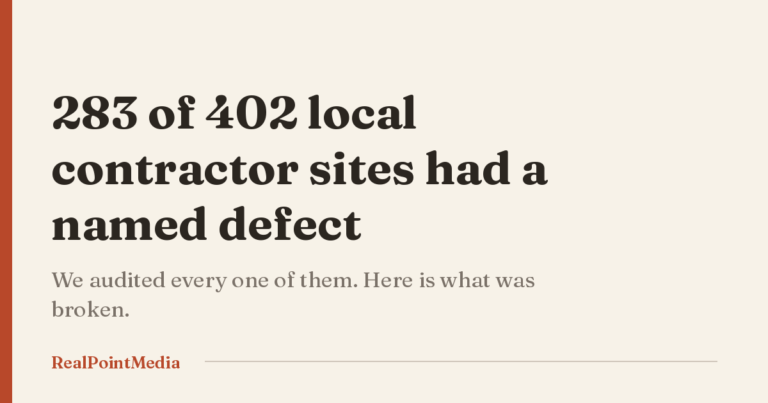
We looked at 402 home services businesses across the Lehigh Valley and the Poconos and counted how many had something an assistant would either find nothing to say about or get actively wrong.
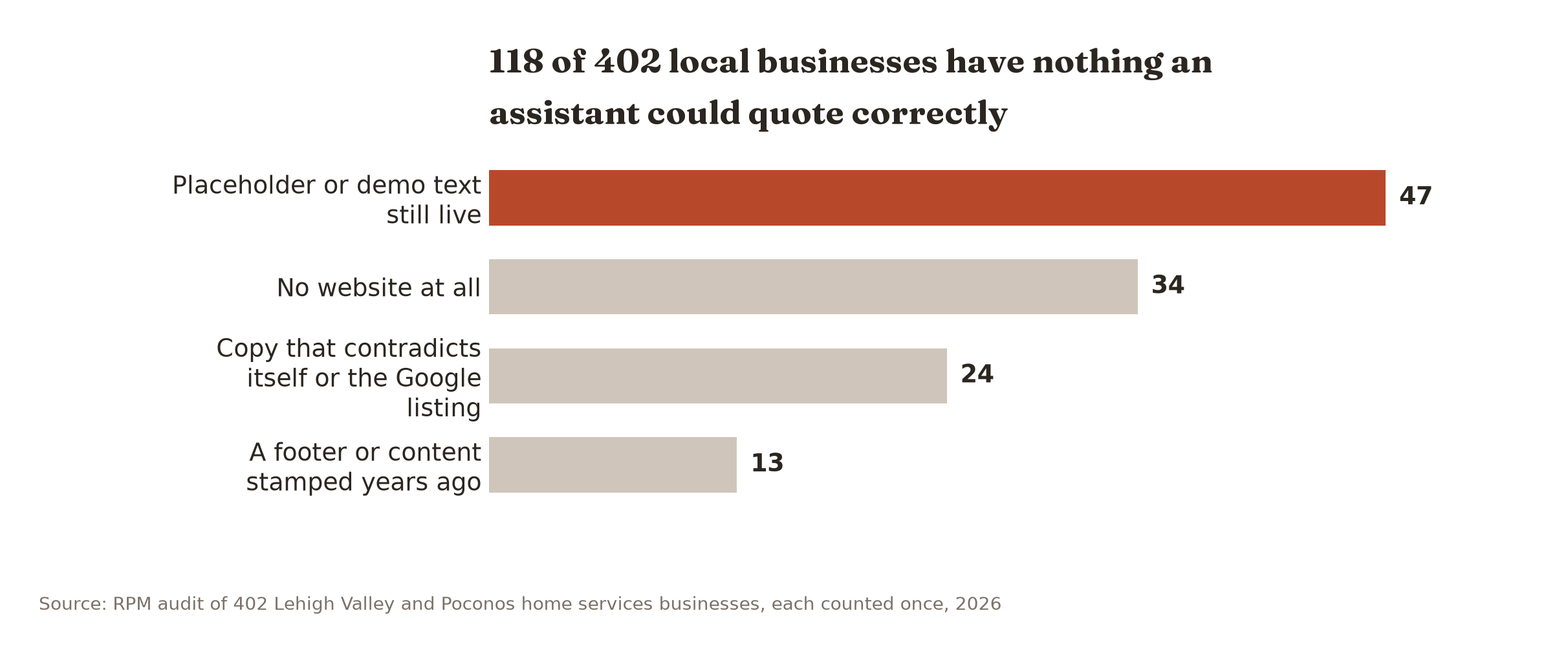
One hundred eighteen of 402. Forty-seven of those are still running the template’s demo copy on a live homepage. A Hellertown HVAC shop still shows “Core Business Keyword” and “List Item 1 Write a description” on its front page, while sitting on 66 reviews at 4.9. One Stroudsburg roofer, 226 reviews deep, runs three testimonials from people who do not exist and a leftover software pricing table on the live site.
Twenty-four have a self-contradiction about something basic, usually how long they have been in business. Thirteen have a footer or content stamped years ago. Thirty-four have no website at all.
The reviews are real in every one of those cases. The page is what fails.
One question per page, and put the question in the header
A page about “Our Services” answers nothing. A page titled “What a boiler replacement costs in Carbon County” answers one thing, and a machine looking for that answer can find it.
Pick the questions from your own phone. The five things customers ask before they book are your first five pages. For most trades around here that is price, timeline, whether you charge for the estimate, what your warranty covers, and whether you come out this far.
Done when: your top five pages each have a header that is a question a customer has actually asked you out loud.
Answer in the first two sentences, with a number in it
This is the whole technique. Everything else is cleanup.
Bad opening: “Every home is different, and we tailor our approach to each customer’s unique needs.” There is no sentence in that a machine can repeat and no sentence a homeowner can act on.
Good opening: “A standard 50-gallon gas water heater replacement in the Lehigh Valley runs $1,900 to $2,800 installed, including haul-away and the permit. Tankless conversions start around $4,600 because of the venting.”
Both sentences carry a number, a place, and a condition. That is a quotable unit. Whether it ends up in an AI answer or in front of a homeowner on a phone, it does the same work.
Done when: you could read your first two sentences aloud on a job site and the customer would know the range.
Date the number and name the place
An undated price is a liability and a machine treats it as one. Write “as of spring 2026” next to any dollar figure, and put the real geography in the sentence.
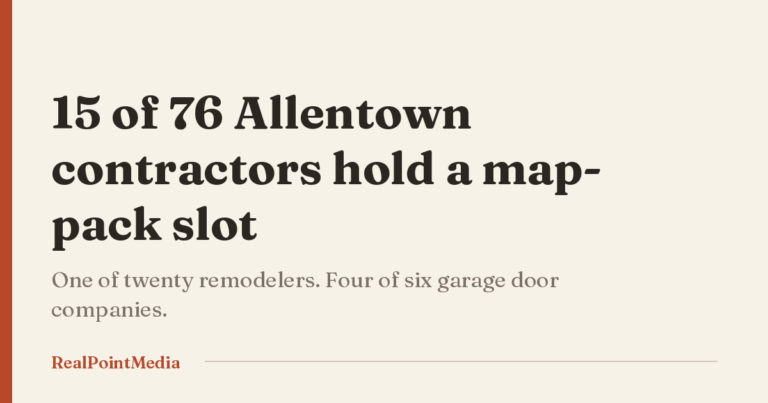
Naming the place is the part that wins here. There are national pages competing for “water heater replacement cost.” There is almost nobody competing for what it costs in Palmerton, and the homeowner in Palmerton is the one who calls you. A general paragraph can replace a general page. It cannot replace a specific one, because the specifics only exist on your site.
Done when: every dollar figure on the page carries a season or a year, and a township or a town.
Say when it does not apply
Most contractors leave the caveat out, worried it costs them the call. It does the opposite.
“That range assumes a same-for-same swap in an accessible basement. If the unit is in a finished attic on a Jim Thorpe hillside house, add $600 to $1,200 for access and venting.” That sentence does three jobs. It protects your quote, and it proves you have actually been in those houses. It is also the most quotable line on the page, because it is the part nobody else wrote.
Done when: every price range on the page is followed by a sentence naming what pushes it higher.
Put the words where a machine can find them
Text baked into a graphic is invisible. Text inside a PDF price sheet is close to invisible. Text inside a slider that swaps every four seconds, or a tab that only loads after a click, is unreliable at best.
The crude test costs nothing. Open the page, press Ctrl-F, and search for your own price or your own town name. If the browser cannot find it, stop redesigning and start retyping.
We found a Brodheadsville remodeler whose entire nav reloads the homepage. Everything it wrote below the fold might as well not exist.
Done when: Ctrl-F finds your price, your towns, and your phone number as text on the page.
Fix the things your site says about itself
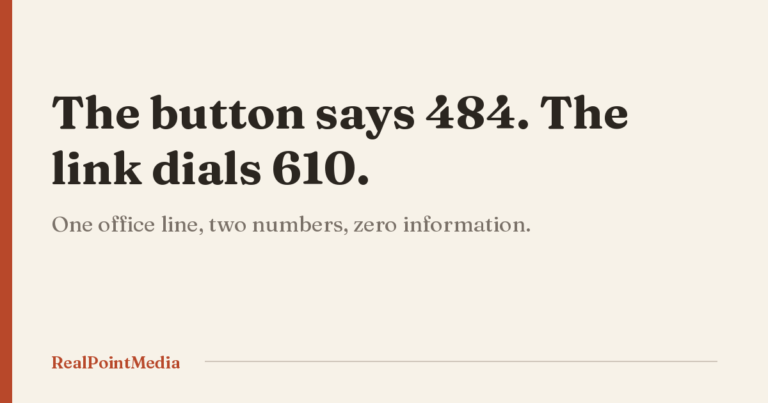
One HVAC company in Lehighton has a Google listing reading “7+ years in business” and a homepage reading “over 25 years.” Both live on the same day. A Brodheadsville hero slider claims 34 years on one slide and 22 on the next.
A person shrugs at that. A machine reading both has no basis to choose, so it usually says nothing about the business at all. Silence is the worst outcome, worse than being quoted with the wrong number.
Five facts, one version each: years in business, phone, service area, hours, and the exact spelling of your company name. Check them against your site, your Google profile, your Facebook page, and Yelp.
Done when: the five facts match in all four places.
What most people get wrong
They think schema will do it. LocalBusiness and FAQ markup are worth adding and we add them on every build. They describe a page. They do not write one. Markup on a page that says nothing specific is a label on an empty box.
They stuff an FAQ block with questions nobody asked. Fourteen accordion items, every answer two sentences of nothing. It looks like content and it reads like filler. Two real questions with real numbers beat fourteen invented ones, and the invented ones were only ever there for a plugin.
They start writing for the machine instead of the customer. This is the one I would push back on hardest. Every technique above makes the page better for a homeowner sitting in a truck outside your competitor’s office. Specific, priced, dated, honest about limits. If a tactic makes the page worse for her and better for a crawler, it is a bad tactic and it will stop working anyway.
The part nobody can promise you
There is no report that tells you a specific page got quoted.
Google does not publish which pages feed an AI Overview. OpenAI does not give you a citation log. Ask the same assistant the same question twice and the sources change. We cannot run a clean before-and-after on a single page and tell you the rewrite caused the result, and anyone selling you that measurement is selling a number they made up. The honest version is in what AI Overviews did to local search traffic, and the checks you can actually run are in how to show up in ChatGPT search.
What we can say is that the pages written this way perform better in the ordinary ways we do measure. They rank for longer phrases, they hold a reader longer, and they get quoted back to us on sales calls. The AI upside comes free with that.
How long this takes
Rewriting one page: two hours if you already know your numbers, a week if you have to go look them up. Most of that week is you, not a writer.
Showing up anywhere: six weeks to four months for a new page to get picked up, longer in Allentown or Bethlehem where the field is deeper. In Palmerton or Kunkletown, faster, because there is almost nothing to compete with.
Start with two pages, not twelve. Price and service area. Those two carry most of the weight, and if you never write another one you have still fixed the part that was costing you.
What to do next
Open your main service page tonight and read the first two sentences out loud. If there is no number in them, you have your weekend project, and you do not need to hire anybody to do it.
What you cannot check from your own screen is how those pages stack up against the companies competing with you in each town you serve. Or which of your listings currently disagree with each other.
The Local Visibility Scan does that, free. Your position in each town, how your reviews compare to whoever is ahead of you, a load time, and the three fixes we would start with. One page, no phone call, and your information stays with us.
If you want the full read, including what your reviews actually say and where the AI answers currently land, that is the $399 Strategy Session. You keep the report either way.