Teardown: A Pocono Restaurant Site
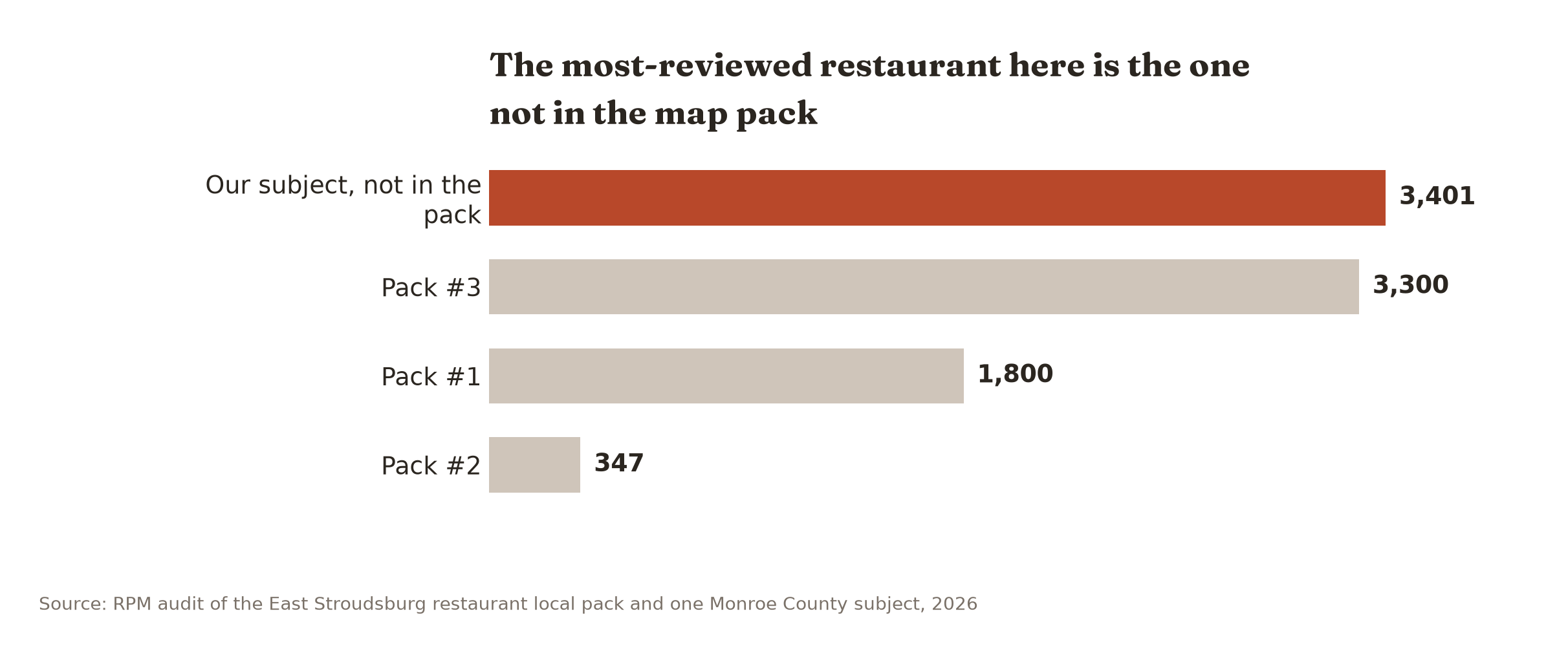
A barbecue and steak house in Monroe County has 3,401 Google reviews. That is more than any restaurant currently holding a spot in the East Stroudsburg map pack, including one with 3,300.
It is not in that pack. And the browser tab on its homepage reads, in full, “Home.”
Late April in the Poconos is when the summer bookings get made. Families are picking a rental for July and looking up where to eat near it, from a phone, in a different state, using words like “barbecue near Bushkill” rather than the restaurant’s name. Every one of those searches is a table this place does not get.
Anonymized, because the business does not deserve to be embarrassed and the failure is a common one. Here is the scorecard, what it does better than most restaurants we look at, and the one number that makes the whole thing hard.
The scorecard
| Measure | Result |
|---|---|
| Google rating | 4.1 |
| Google reviews | 3,401 |
| Local pack position, “restaurants east stroudsburg pa” | Not in the three |
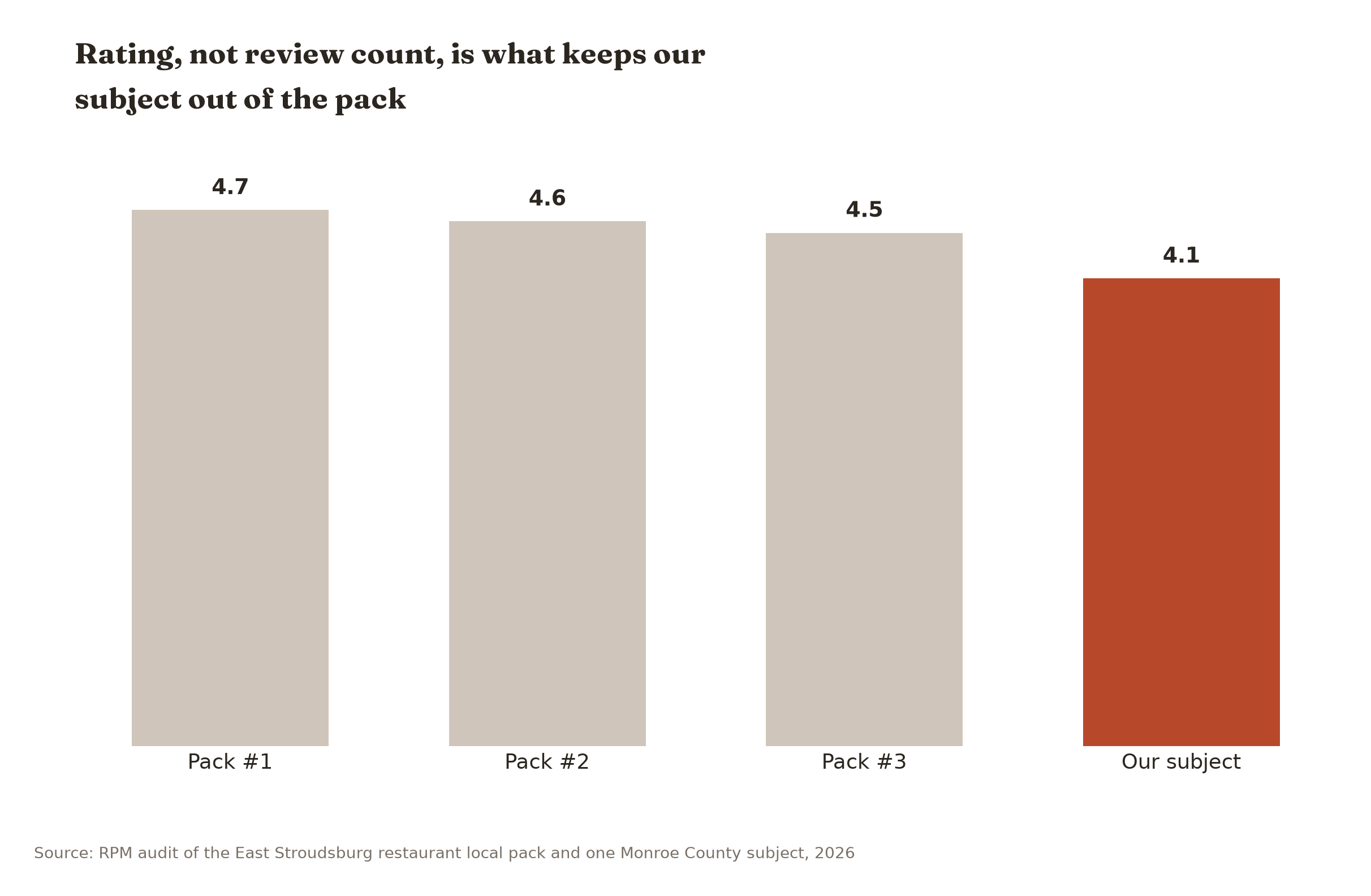
| Ratings held by the three in the pack | 4.7, 4.6 and 4.5 |
| Homepage title tag | “Home” (4 characters) |
| H1 heading on the homepage | None |
| Meta description | None |
| Words of text on the homepage | 142 |
| Images with alt text | 0 of 2 |
| Time to interactive | 162ms |
| Menu format | Real HTML text with prices |
| Town in the site’s own address | Different from the town on its Google listing |
| Hours published | “7 days from 11:00 am,” no closing time |
Three things it gets right that most restaurants don’t
The menu is text, with prices, on a web page
This is the one that matters most and almost nobody does it. The menu is not a PDF. It is not a photograph of a laminated card. It is real text, with real prices, appetizers running from about nine to thirteen dollars, sitting on a page a phone can read at a stoplight.
A PDF menu is invisible to a lot of what reads the web now, painful to pinch and zoom, and usually eighteen months out of date. Every restaurant site we tear down in this region has one. This one does not, and that is worth real money in a market where half the customers have never been in the door.
It loads in 162 milliseconds
We use two seconds as the target. This is roughly a twelfth of that.
Cell coverage between Marshalls Creek and Bushkill is not uniformly great, and a heavy site is worse on a weak signal than a strong one. A page this light survives a bad bar of service on Route 209 on a Friday evening. Most restaurant sites, loaded with a video header and a reservation widget, do not.
3,401 people wrote about this place
Twenty-plus years of goodwill sits in that number. A new restaurant cannot buy it, an agency cannot manufacture it, and it is the reason this teardown is worth writing. There is an enormous asset here that the website is not connected to.
Three things costing them covers
The usual caveat. We have no access to this restaurant’s analytics or its book, so the figures below are arithmetic with the assumptions written out. Substitute your own average check and your own covers.
1. The homepage title is the word “Home”
The title tag is the blue link in a Google result and the text on the browser tab. This one is four characters long, contains no restaurant name, no town, and no mention of barbecue, steak or seafood.
There is also no H1 heading and no meta description, and the homepage carries 142 words total. So when somebody searches for barbecue near their rental, there is very little on that page for Google to match and almost nothing for an AI assistant to quote back. The local guides and directories outrank the restaurants themselves for “restaurants east stroudsburg pa,” and this is why.
Say the site gets 2,000 visits a month in the shoulder season, which for a restaurant with this review count is a conservative guess. A homepage title that names the food and the town is worth a few percentage points of click-through on every search impression. If it produced 60 extra visits and a quarter of those became a table of two at a $70 check, that is roughly $1,050 a month, from a change that takes ten minutes.
The fix: rewrite the title to name the restaurant, the food and the town. Add one H1 that says the same thing in a human sentence. Add a meta description. Write 300 words on the homepage covering what kind of place it is, what it is known for, and where it sits relative to the landmarks visitors actually know.
2. The site and Google disagree about what town this is in
The contact page gives a Marshalls Creek address with one zip code. The Google listing gives an East Stroudsburg address with a different one. Both are defensible locally, since one is the postal name and the other is the township everyone searches for. Google does not know that.
Address consistency is one of the older signals in local search and it still matters. Two towns and two zips for one building is the kind of thing that keeps a business out of a pack it otherwise belongs in.
The hours make it worse. “7 days from 11:00 am” has no closing time in it. A family deciding at 8:40 on a Saturday whether they can still get in cannot answer that question from this website, and neither can an assistant asked “is it open.”
The fix: pick one address format, match it exactly on the website, the Google listing, Yelp and TripAdvisor. Publish real open and close times for each day of the week, in text, and update them when the summer schedule changes in June.
3. Nothing on the site asks anyone to do anything
There is online ordering, which is good, and it is a link in the navigation like any other. There is a contact page with no form on it. There is no reservation path, no private events enquiry form, no email signup for the people who eat here four times a summer.
For a restaurant with private event space, that last one is the expensive gap. A graduation party or a rehearsal dinner is worth many ordinary covers, and right now the only way to start that conversation is to call during service.
The fix: one short enquiry form on the private events page, four fields, date, headcount, name, phone. Then check that it delivers to a real inbox, and check it again in two months.
The number that makes this hard
Here is the part an agency selling a rebuild would leave out.
The pack this restaurant is missing from is held by businesses at 4.7, 4.6 and 4.5 stars. Our subject is at 4.1. Review count is not the problem. Rating is.
Now do the arithmetic on fixing it. At 4.1 across 3,401 reviews, getting the average to 4.3 takes roughly 970 consecutive five-star reviews. Not 970 reviews. 970 in a row with no bad ones mixed in, which is not going to happen in a restaurant.
That is a two-year project at best, and it is not a marketing project. It is a kitchen and service project, and no website work changes it. So we would not sell this owner a rating strategy. We would tell him the truth, which is that the rating is slow and the title tag is ten minutes, and he should do the ten-minute thing first.
The one thing we would change first
The title tag, the H1 and 300 words of homepage copy, this week, before Memorial Day traffic starts.
This place has 3,401 reviews and a menu already in readable text. It is two hours of writing away from being the answer to “where should we eat” for every family booking a Poconos rental this summer. The rating fight can wait. The pack fight may never be winnable. Being findable by name, by food, and by town is available right now and costs almost nothing.
Then fix the address mismatch and publish closing times. Both are free, both take an afternoon, and both are the kind of thing that quietly decides whether a hungry family drives your way or keeps going.
If you want the method behind all of this, the full teardown process is written out here. The roofing teardown covers a business that ranks and cannot close, and the HVAC teardown covers one that cannot be contacted at all.
What to do next
Open your own site on a phone and read the browser tab. Then search your restaurant’s food and town, not its name, and see whether you appear at all. Both checks take two minutes and most owners have never run either one.
What is harder to see is which of the two fights you are actually in: findability, which is cheap and fast, or rating, which is slow and belongs to the kitchen. Getting that wrong costs a year.
The $399 Strategy Session tells you which one you have. You get your position against the local pack, and your rating and review math run out to a real timeline. Plus site speed, what your reviews actually say about service, and the single fix we would make first. You keep it either way, and the $399 refunds against any project you start with us in the next 60 days.