What a Plumbing Company Should Pay for a Website
The median plumbing company we audited in this region has 58 Google reviews. The company holding the top map-pack spot against them has 194. That is the widest review gap of any trade we looked at, and it tells you most of what you need to know about where a plumber’s money should go. Budget $4,500 to $9,000 to build a plumbing website in the Lehigh Valley or Poconos, then $150 to $300 a month after. Here is what that buys, what pushes it higher, and the three situations where a plumber should not buy one at all.
What plumbers around here actually pay
| Tier | Build | Monthly | What is in it |
|---|---|---|---|
| Rented template | $0 down | $99 to $199 | Stock layout, four pages, a form. Usually 36 months, and you own nothing at the end. Of the plumbing sites we checked, 14 were still showing the template’s own placeholder copy on a live page. |
| Built for local search | $4,500 to $9,000 | $150 to $300 | Separate pages for drain cleaning, water heaters, well pumps, repipes, sewer and septic, plus town pages for where you actually drive. LocalBusiness schema, Google Business Profile work, a review wall with automatic review requests, call tracking, and emergency call routing that works at 2am. Our Local Website System starts at $4,500 fixed. |
| Custom | $15,000 to $40,000 | $500 and up | Original design, real photography, two-way dispatch into ServiceTitan or Jobber, membership plan signup and recurring billing, multi-location. |
Two to fifteen trucks, one to three counties, you are in the middle row. The bottom row is a lease, not a purchase, and at $199 a month across a 36-month contract it costs $7,164 for something you hand back.
The review gap is the plumbing problem
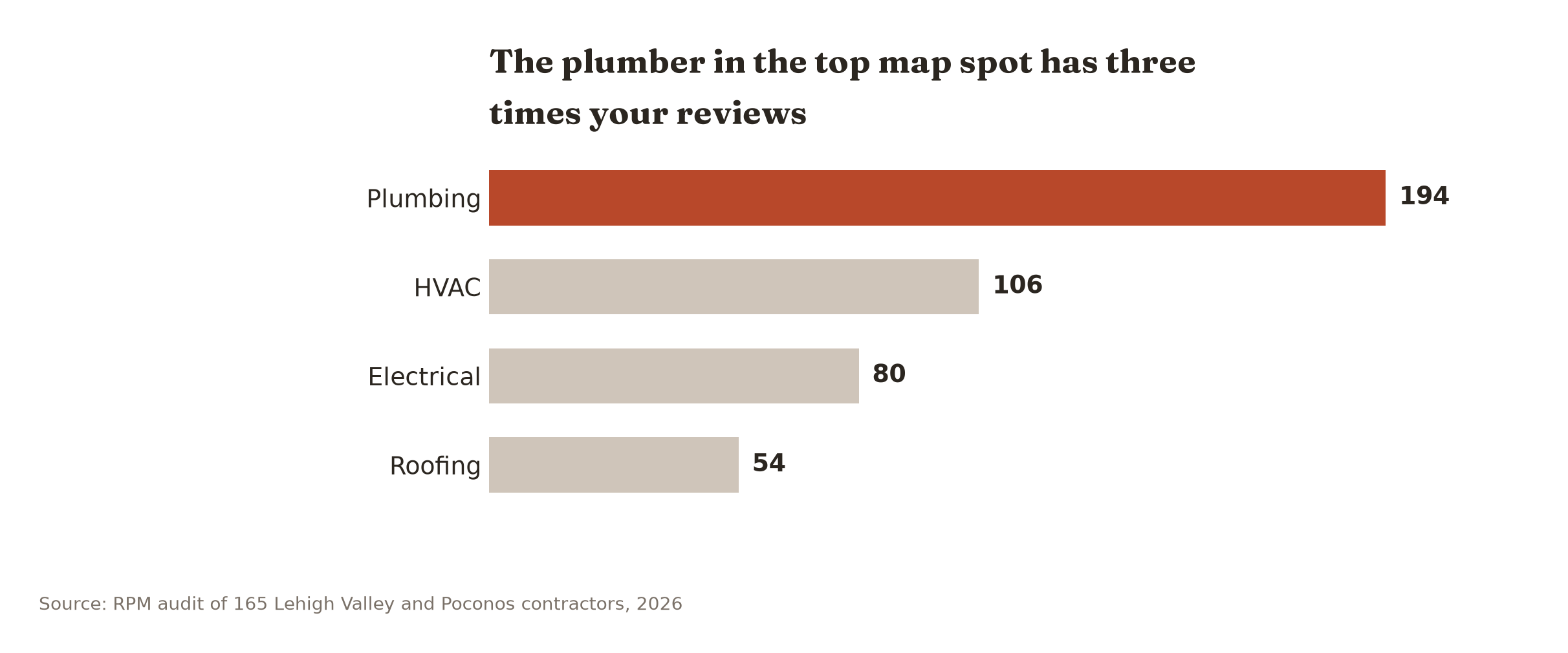
Look at the shape of that. In roofing, the company in the top spot has a median of 54 reviews. In HVAC it is 106. In plumbing it is 194.
Plumbing is the trade where the market consolidates hardest around one or two names per town, and those names collect reviews at a rate a two-truck shop cannot match on accident. The big shop in your town is not lucky. It has a process: every tech sends the review link from the driveway before he pulls out.
Here is why this matters for your website budget. If you are at 58 reviews against a 194-review incumbent, a $9,000 site does not close that. A review system inside a $4,500 build does, over about a year. Buy the system, not the pixels.
Half-finished sites are worse in plumbing than anywhere else
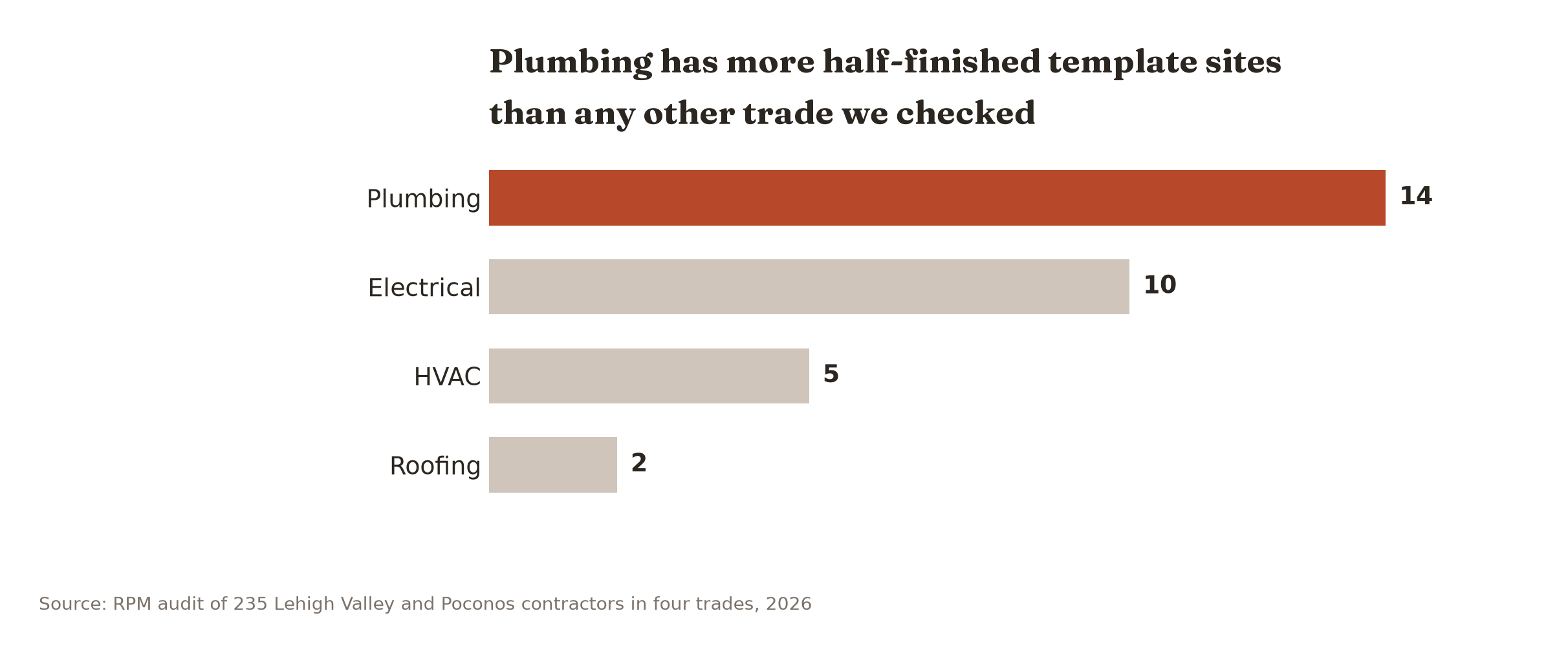
Fourteen plumbing sites in our set were running live pages with the builder’s filler text still on them. Words like “Keyword Term H3” and “List Item 1 Write a description” sitting on a homepage, in public, on a site somebody is paying for every month.
One of them belongs to a Brodheadsville company with 401 reviews and a perfect five-star average. Four hundred and one. They are not in the map pack, and their homepage says “Write a description.” Somebody sold them that site and never looked at it again.
This is the cheapest thing on this page to check. Open your own homepage right now and read it like a stranger.
Four things that move a plumbing quote
- Emergency routing. Your highest-value job of the month arrives at 11pm on a Sunday in February with a split line in an unheated Poconos cabin. If that form goes to an inbox until Tuesday, you lost a job worth more than the site. Routing after-hours submissions to a phone as a text is a small build item and the highest return in the quote.
- How many service lines you sell. Drain and fixtures is four pages. Add well pumps, water treatment, septic, sewer lateral replacement and tankless and you are at nine or ten. In Carbon and Monroe counties, where a real share of homes are on wells and septic, those pages are not optional. In Bethlehem city they mostly are.
- Membership plans. Online signup with recurring billing is worth building when you have a few hundred members. It is not worth building to sign your first twenty.
- Whether anything talks to dispatch. A form that emails you is standard. A form that creates a job in ServiceTitan is a project with a real price. Ask which one is in the number.
The April version of this problem
Right now, the last week of April, your call mix is changing. The frozen-line calls are done. What replaces them is well pumps that failed over the winter. Outside spigots that split in March and nobody noticed until the hose went on. The first round of septic and sewer calls from Poconos houses that sat empty since Christmas.
Almost none of that is on a typical plumbing website. Most of them have a homepage, an about page, “Services,” and a contact form. A homeowner in Effort searching for who fixes a well pump finds nothing on your site that says you do, so he calls the shop whose page says it plainly.
Each of those is one page. Five or six pages, written once, covering what people in your counties actually call about in each season. That is what the middle tier buys, and it is a bigger lever than anything visual in the quote.
When you should not buy this
Three cases where the right answer is to keep the money.
Your reviews are under 40. Given the 194-review median on the other side of this fight, a website is the second thing you do, not the first. Ninety days with every tech sending a review link from the truck will move your position more than any build. The review system is worth paying for. The 12-page site can wait until fall.
You do emergency work only and you are always full. Emergency plumbing has the shortest decision window in the trades. Nobody comparison shops a flooded basement, they call whoever appears first and answers. If you already appear and you already answer, more website will not help you. Profile work and call handling will.
You have no website and nine of the plumbers we checked are in the same position. That sounds like an argument for buying one. It usually is. But say you are a one-truck shop under about $300K, still deciding if you are a service plumber or a remodel sub. Run a $30 a month template, put everything into the Google Business Profile, and spend the $4,500 when you know what you sell. The general cost breakdown walks through that call in more detail.
Three checks that catch an overpriced quote
Ask them to name the service pages and the towns
“Twelve pages” is not a proposal. Which twelve. If nobody on their side can tell you whether Palmerton gets a page and whether well pumps get their own page, they have not looked at your business. The HVAC version of this post makes the same point, because it is the single most reliable tell in a contractor quote.
Send yourself a lead at 9pm
Before you sign, find a site that vendor built, submit the form on a Friday night, and see what happens. Nothing arriving until Monday is your answer. National search volume for “how to get plumbing leads” is only about 70 a month. The cost per click is $44 and the competition rating is high. The people selling plumbing leads know exactly what one is worth. Do not buy a site that drops them.
Check the footer for a real address and a real year
Four of the plumbing sites in our audit publish no street address anywhere. Several carry copyright years that stopped updating two or three years ago. Both are visible to a homeowner in four seconds and both say the same thing: nobody is home. If the vendor’s own portfolio sites have stale footers, yours will too.
When it starts paying for itself
Form and speed fixes work the day they go live. Map-pack movement takes 60 to 120 days where it is possible at all, and in Allentown and Easton, where we audited 11 plumbing companies each, it takes longer than that. Town-plus-service rankings run four to eight months. Reviews are the slowest and the surest: expect a year to go from 58 to 150 at a steady pace, and expect that to matter more than everything else on this page combined.
On payback, a water heater replacement or a well pump job covers a meaningful slice of a $4,500 build. Two or three extra jobs a month gets you whole inside the first year. Drain cleaning alone does not, which is worth being honest about before you sign. If your average ticket is under $250, build the review engine first and the website second. Roofers face the opposite math, because one job pays for the whole thing.
What to do next
You now know the price bands, the four things that move them, and that the review gap is the real fight in this trade. Two things you can do tonight in ten minutes: read your own homepage for leftover template text, and count your reviews against the shop that keeps taking the calls you want.
What you cannot check from your own phone is how you rank across the whole service area, town by town, and how far behind you actually are in each pack. Google personalizes the results you see based on where you are standing, which makes your own search a bad measurement tool.
That grid, with site speed, competitor comparison and a read on what your reviews actually say, is the $399 Strategy Session. You keep the written report no matter what you do next. It also refunds against any project started within 60 days.