Why Your Site Is Slow, and What It Costs You
I sat in a truck on Route 33 north of Nazareth in March while a plumbing owner tried to pull up his own site to show me a photo of a job. Two bars of signal. We watched a white screen for eleven seconds, then a slider that had been sitting on that homepage since 2018 loaded, and then his phone number. He said, “that’s not right, it’s fast at the shop.” It is fast at the shop because his shop has fiber and his browser has been caching that site for six years. Here is what actually makes a contractor site slow, what it costs in estimates, and the honest limit on how much of your problem speed really is.
What slow costs you, in jobs
Nobody in the Poconos leaves your site because of a benchmark. They leave because the thing they wanted did not appear.
The searches that matter to you come from people who cannot wait. A furnace out in February in Palmerton. A pipe letting go on a Sunday in Emmaus. Those homeowners open three listings from the map pack, in three tabs, and call whichever one shows a number first. If yours is the one still loading a hero video, you were never in the running. He does not remember you as slow. He does not remember you at all.
That is the real cost, and it is worse for emergency trades than for remodelers. Nobody comparison-shops a kitchen at midnight. They do comparison-shop a burst pipe, and they do it in under a minute.
What we can and cannot tell you
Here is the limit up front, because a lot of this subject is sold with numbers nobody measured.
Across the Lehigh Valley and the Poconos we pulled apart 402 home services businesses. We ran real performance measurements on three of them. Three. The rest we opened in a browser and read.
So we are not going to hand you a regional average load time, because we do not have one and neither does anybody else selling you speed work. What we do have is the three we measured and a very clear picture of what is sitting on the other 399, which is the same audit behind our full symptom list.
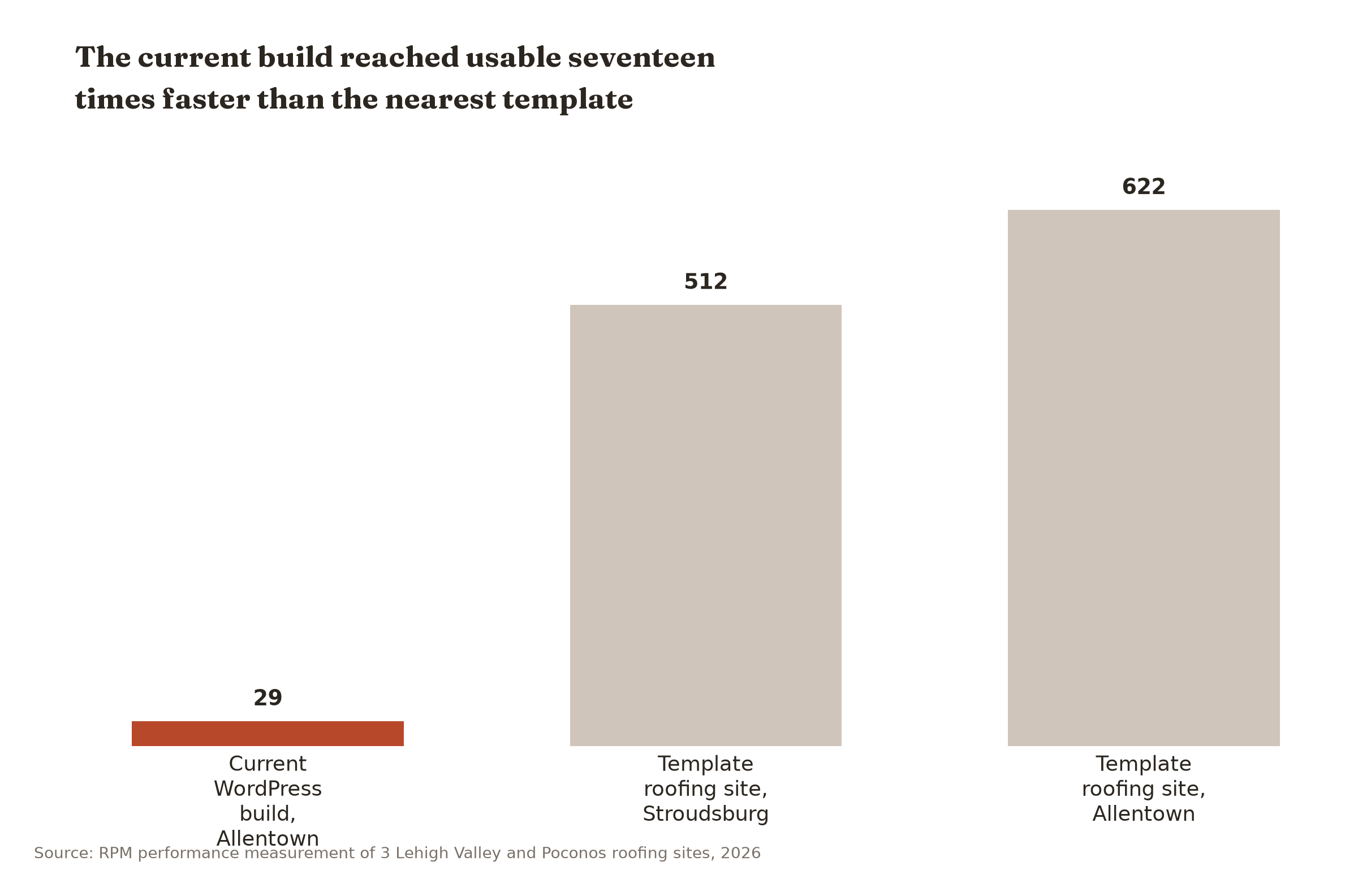
Three sites, so treat it as an illustration and not a study. The fast one is a current WordPress build in Allentown with 2,150 words on the page and content updated in the last month. The slow two are templates. One is a Hibu build with a 323KB page and 16 HTML parse errors. The other has a 203KB page, more than 60 parse errors, and a body element closed in the wrong place.
All three of those numbers are fine in absolute terms. That is worth saying plainly. On a good connection, none of these sites is the disaster the speed industry implies. The gap shows up on two bars on Route 611, and it shows up in what else the parse errors tell you about who built the thing.
The five things actually slowing local contractor sites
Photos straight off a phone
This is the biggest one and it is nearly always the owner’s own doing. A modern phone shoots a 4MB image. A gallery of twenty job photos uploaded as shot is 80MB of page. Your web person resized them once in 2019 and nobody has resized anything since.
Fix: every image on the site under 200KB, in WebP, sized to the space it occupies. This is a one-afternoon job and it is usually most of the improvement.
Sliders nobody scrolls
One Easton HVAC site is still running Slider Revolution 5.4.8, which is 2018-era software, on a homepage whose copy reads “Celebrating 133 Years” and whose newest newsletter is from 2020. The slider loads five large images before the visitor sees anything.
Nobody watches slide four. Take the first slide, make it a static image, delete the plugin.
Page builders stacked on page builders
We found sites running WordPress with Divi, WordPress with Elementor, and in one case WooCommerce active on a service business that sells nothing online. Each of those ships its own CSS and JavaScript on every page, whether the page uses it or not.
You cannot fix this by tuning. This is the point where a rebuild becomes cheaper than another year of patching, and we wrote the rebuild-versus-refresh test here.
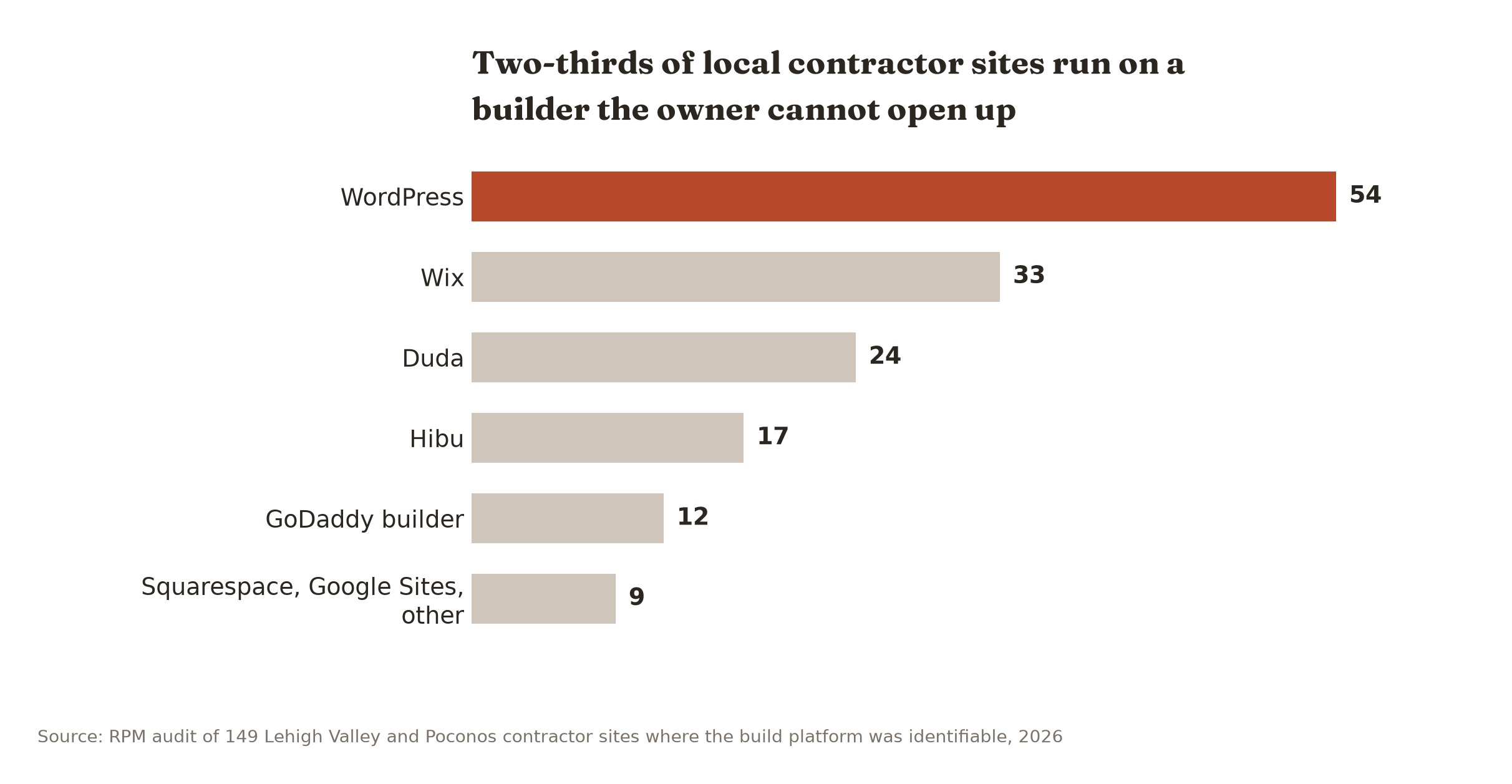
That matters for speed because of what you are allowed to touch. On WordPress you can strip a plugin, resize an image library, and change a host. On most of the hosted builders you can change the photo and the words, and everything else is a support ticket.
Assets loading from somewhere else
Seventeen of the sites we audited pull something over plain HTTP onto an otherwise secure page. HomeAdvisor badges hotlinked from HomeAdvisor. Accreditation logos served from a third party’s server. A logo file still living on a host the company left years ago.
Every one of those is a request to a machine you do not control, and your page waits on it. When that server is slow, your site is slow, and you will never know why.
Tracking you forgot you installed
One Lehighton HVAC site runs Google Tag Manager plus two separate Facebook pixels. Two. One is from an agency that stopped working with them.
Open your site’s source and count the tracking scripts. If there is one you cannot explain, it is costing you load time to send data to somebody who is not reporting to you.
What most owners get wrong here
The first mistake is testing on the office wifi. Test on cellular, outside, in a private window, on the oldest phone in the shop. That is the experience you are actually selling.
The second is buying speed work when the real problem is that the page shows nothing. Three of the 402 sites we audited serve a completely blank white page to visitors. Nine have images with no file behind them, so the layout holds the gap open and never fills it. A site that renders nothing in 0.8 seconds is not fast. It is empty, and no optimization plugin fixes empty.
When speed is not your problem
Most of the time, honestly, it is not the first thing.
Of the 402 businesses we audited, 259 were not in the map pack at all. If a homeowner in Bethlehem never sees your listing, your load time is irrelevant. You are not losing the race, you are not in it. That is a different problem with a different fix.
And if you are already in the pack and the phone rings enough, do not spend $2,500 shaving a second. A Jim Thorpe roofer holds the top map spot on 92 reviews with a footer dated 2023 and an estimate form gated behind a math question. His site is not fast and it does not matter, because his profile and his reviews are doing the work.
Speed is worth real money in two cases. You are in the pack and getting clicks that do not become calls. Or you serve an emergency trade where the decision takes forty seconds. Outside those two, it goes behind reviews and the profile on the list, every time.
How to check yours in ten minutes
- Open PageSpeed Insights, put in your homepage, read the mobile tab only. Ignore the desktop score entirely.
- Then do the real test. Private window, cellular data, standing outside. Count out loud until your phone number appears.
- Under three seconds, leave it alone. Three to six, resize your images and delete the slider. Over six, or a white screen, you have a structural problem and tuning will not reach it.
- Check the same three steps on the page you send people to from Google, which is often not your homepage.
Expect image work to land within a day of being done. Anything that needs a platform change takes weeks, because the platform is the thing being changed. Go back to the full symptom checklist if speed turns out not to be your leak.
What to do next
The ten-minute test above costs nothing and you can run it in the parking lot before your next job. Do that first. Most owners discover their site is fine on speed and broken somewhere they never looked.
What you cannot see standing in one parking lot is how you are doing everywhere else. Your results change with where you are, and the towns where you are losing are usually the ones you never search from.
Our free Local Visibility Scan puts that on one page. Where you rank town by town across the Lehigh Valley and the Poconos. Your reviews against your top three competitors, your measured site speed, and the biggest single leak we find. No sales call, and your information does not go anywhere else.
If you want the whole thing taken apart, competitors and keywords and what your reviews actually say, that is the $399 Strategy Session. The report is yours regardless, and the fee credits against any project started within 60 days.