Call Tracking for Contractors, Explained
An Allentown plumbing company has 97 Google reviews at a 5.0. The call button on its homepage displays 484-264-2130. The link behind that button dials 610-762-7349, and two more call links in the footer dial the same 610 number.
Nobody is losing calls to that. Both numbers ring. But the owner cannot tell you what either number produced, because neither one is attached to anything. It is one office line wearing two hats.
That is the situation for most companies in this region. The phone rings four times on a Tuesday in March, and by Friday nobody remembers whether those were ads, the Google listing, or the sign on the truck. Four jobs, no information.
Call tracking fixes that for roughly the price of a tank of diesel a month. It is one piece of the larger job of knowing which marketing produced the work, and for most contractors it is the piece that matters most, because the trades still run on voice. Here is what it actually is, how to set it up, and the one way it can hurt you if you do it carelessly.
What a tracking number actually is
A tracking number is a real phone number you rent, which forwards straight to your office line. The caller dials it. It rings on your regular phone. Nothing about answering changes.
The difference is that the software in the middle writes down what happened: which number was dialed, when, how long the call lasted, and whether anyone picked up. Give each marketing channel its own number and your call log turns into a source report without anyone typing anything.
Vendors that do this for companies your size include CallRail, which is the one we set up most often, and the call tracking built into Podium and similar platforms. Pricing runs by numbers rented and minutes used, and all of them publish it, so check it before you sign. At the call volumes we see on a six-to-forty-person contractor around here, it is a small line item, not a decision that needs a board meeting.
What skipping it costs
Here is the math in the shape that matters. If you spend $900 a month on ads and the listing is free, and you cannot separate the two, then every slow month you are choosing blind between cutting the $900 and cutting nothing.
Owners in that position almost always cut the ads, because the ads are the line on the bank statement. Sometimes that is right. When it is wrong, you find out three months later when the pipeline empties, and by then the campaign has to be rebuilt from scratch.
One number in your call log would have settled it in ten seconds.
Setting it up
- Count your channels before you buy anything. Write down every place your phone number appears where money changes hands: Google Ads, the truck wraps, yard signs, the directory listing, the spring mailer. Most companies this size land on four or five. If you write down twelve, you are counting things you have not paid for since 2023. Done when: you have a written list and every item on it has a dollar figure beside it.
- Buy one number per channel, in the right area code. This matters more here than in most markets, because your service area probably crosses a county line. A 610 or 484 number reads as local in Allentown, Bethlehem, Easton and Nazareth. A 570 number reads as local in Stroudsburg, Brodheadsville, Lehighton and Jim Thorpe. If your yard signs go up on both sides of Blue Mountain, buy both and split them by where the sign is planted. One HVAC company in our audit of 402 regional businesses prints a single phone number about a dozen times on a site headed “Based in Nazareth, PA.” The number is a 516 area code, which is Long Island. Area codes register with people. Done when: every channel on your list has its own number and the area code matches the county it advertises in.
- Leave your Google Business Profile number alone. This is the one that can hurt you. Your listing’s primary phone number should match the number on your website and in your directory listings, because Google uses that consistency as a signal of who you are. Swapping a tracking number into that field without care is how businesses end up with mismatched records across the web. You do not need it there anyway. Google already reports how many calls the listing produced, inside the profile itself, at no cost. Done when: the number on your listing, your site footer and your invoices are all the same number.
- Turn on dynamic insertion for the website. This is the piece that swaps the number displayed on your site depending on where the visitor came from. Someone arriving from a Google search sees one number, someone from a paid ad sees another, someone typing your domain sees your real one. The software handles the swap. Your job is to check it on a phone afterward, because the failure mode is a site that shows the tracking number but keeps the old number in the click-to-call link. That is exactly the Allentown situation at the top of this post, and it is the most common install error we find. Done when: you open your own site on your phone, tap the number, and the phone dials the digits you can see on the screen.
- Get the offline numbers printed correctly. Truck wraps, yard signs, door hangers, the sponsorship banner at the ballfield. Each one gets the number for its channel. This is the part with a real cost, because a wrap is not cheap to redo, so do it at replacement time rather than tearing off good vinyl. Done when: you can walk out to the lot and read the tracking number off the truck.
- Tag the calls. The software records every call. It does not know which ones were customers. Somebody has to spend five minutes a day marking calls as a job, a quote, a wrong number, or a salesperson. Without that step you get a count of rings, which is nearly useless. A channel that produces forty calls from people asking if you do commercial work is worse than one that produces six failed water heaters. Done when: last week’s calls are all tagged and you can filter the log to real customers.
- Push the source into your job software. Jobber has a lead source field on the client record. ServiceTitan has a campaign field on the job. Fill it in from the call log, and your revenue report becomes a marketing report. This is the step that turns a pile of calls into a dollar figure per channel. Done when: you can run a report in your own software showing revenue by lead source for last month.
The phone problems we actually find
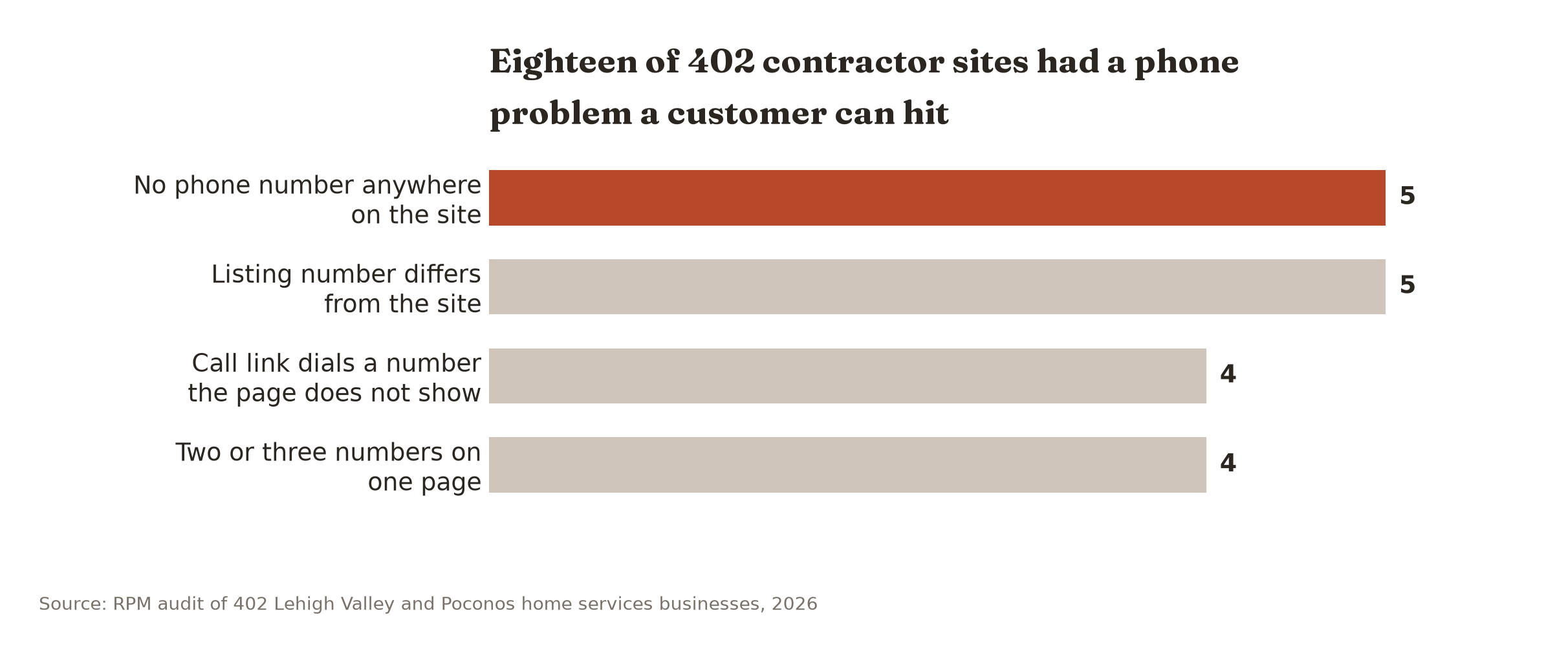
Across those 402 audited businesses, eighteen had a phone problem a visitor could hit before any tracking question came up. Five had no phone number anywhere on the site. Five publish a number on their Google listing that does not match the number on their own pages. Four have a call link that dials something other than what it displays. Four print two or three different numbers on one page.
A remodeling company in Brodheadsville shows homeowners two phone numbers on the homepage, and the only clickable call link on the page dials a third. That is not a tracking setup. Nobody planned it. It accumulated over three website changes and two office moves.
Fix that before you buy tracking software. Tracking a mess produces a tracked mess.
Three ways this goes wrong locally
The first is the consistency problem already covered. Track everything except your Google Business Profile’s primary number and you will not run into it.
The second is the two-county area code split. We have watched contractors in Palmerton and Lehighton put a Lehigh Valley number on Carbon County yard signs because it was the number they already had. Answer rates on a cold callback are worse when the number looks like it is from somewhere else. If you serve both sides, own numbers on both sides.
The third has nothing to do with software. Tracking will tell you how many calls went unanswered, and for most contractors that number is the most uncomfortable thing in the report. A crew in a crawlspace in Effort does not hear the phone. If you find out you missed thirty calls last month, the tracking has done its job, and the fix is a different project. The symptoms post covers the rest of what leaks before a lead ever reaches you.
When not to bother
If you have exactly one marketing channel, skip this. A company whose only source of work is its Google Business Profile does not need tracking numbers, because Google’s own call report already answers the only question there is. Spend the setup afternoon on reviews instead.
Skip it also if nobody in the building will do step six. Tagging calls is a daily five minutes, forever. An untagged call log becomes a subscription you pay for and never open, and we have inherited plenty of those from other agencies.
And be honest about size. If your total marketing spend is $300 a month, the reporting will not change any decision you would not have reached by feel. Get the spend up to where a wrong answer costs real money, then instrument it.
How long before it tells you anything
Data starts arriving the day you install it. It becomes trustworthy at about 60 days, and it becomes useful at 90, which is roughly when every channel has had a chance to produce more than a handful of calls.
Start now and the numbers you get will be shaped by the season, not your marketing. Mid-March is the tail of no-heat calls and the front edge of AC pre-season, and that swing is bigger than anything a campaign will do to you. Read the channel mix, not the totals, until you have a full year to compare against.
One more thing worth knowing before you commit. Recorded calls are the most useful part of this and the part people forget they bought. Listen to ten of them in your first month. Most owners discover something about how their own phone gets answered that is worth more than the source report.
What to do next
You can count your channels, check your own click-to-call link on your phone, and confirm your listing number matches your site tonight. That takes fifteen minutes and it is the whole foundation.
What you cannot check from your own phone is how much of your service area can see you in the first place. Whether Nazareth sees you and Bath does not, how your review count stacks against the three companies above you, and which of your pages homeowners actually land on.
Our free Local Visibility Scan does that. It comes back with your pack position in every town you serve, how your review count stacks against the three companies beating you, a measured load time, and the one leak we would plug first. One page. There is no call attached to it, and we do not hand your details to anyone.
If you want the full read, including your call and form data and what your reviews are actually saying, that is the $399 Strategy Session, and you keep the report either way. Get your free Visibility Scan.