How to Ask Customers for Reviews Without Being Awkward
A plumber in Nazareth told me he would rather snake a main line on Christmas Eve than ask a customer for a review. He has 42 of them. The company holding the top Nazareth map spot has 55, and the middle of our whole plumbing set is 58.
He is not lazy and his work is good. He just hates the moment, so the moment never happens, and thirteen reviews stand between him and the pack.
My guess is that gap is worth about one job a month to him, which for a Nazareth plumbing ticket is not a rounding error. This post is about how to make the ask so it stops feeling like begging, and what to say word for word.
What it costs to skip this
We audited 369 home services listings across the Lehigh Valley and the Poconos. Here is where everybody actually sits.
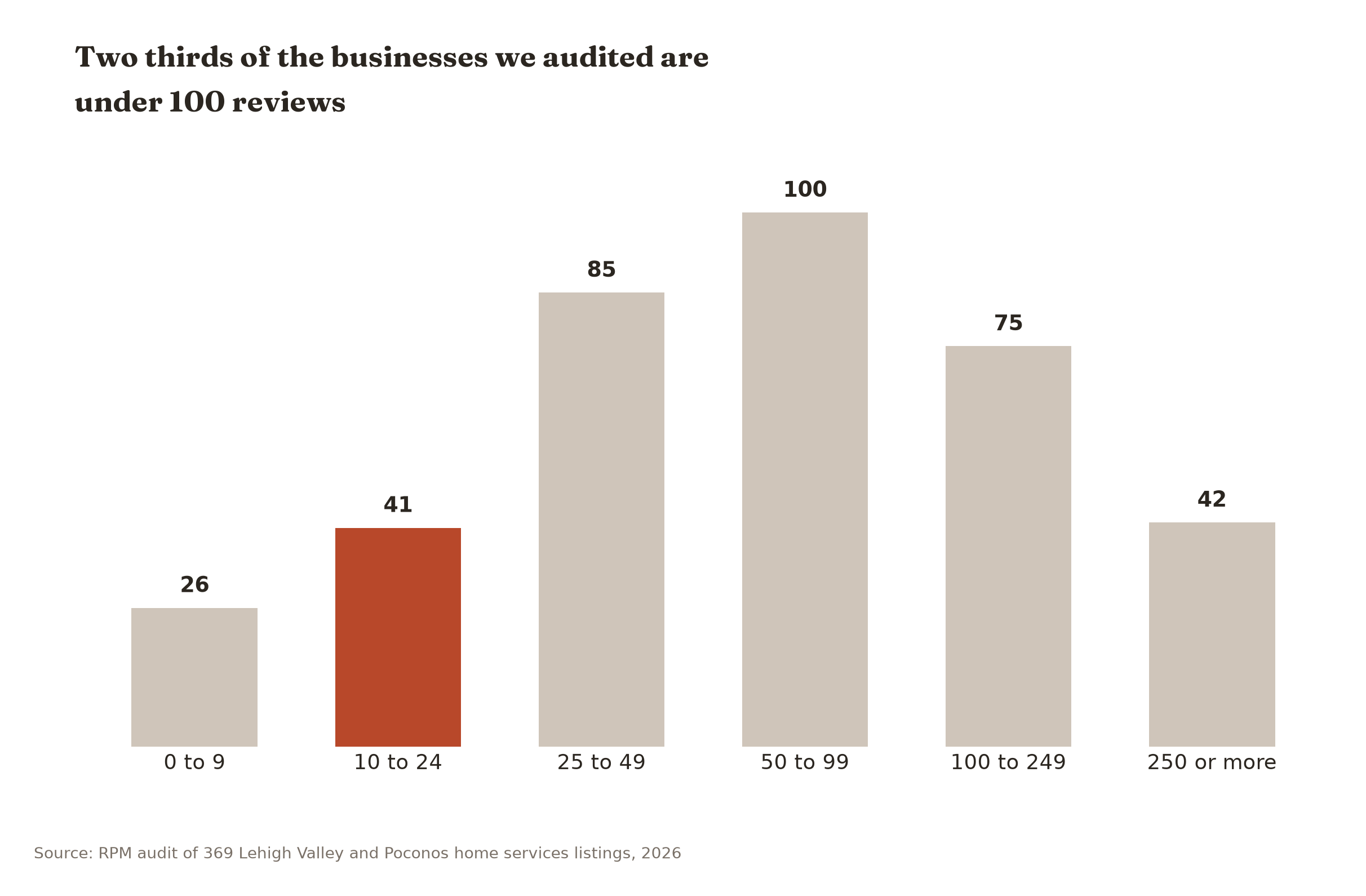
Sixty-seven of those businesses are under 25 reviews. Twenty-six are under ten.
A homeowner in Bethlehem comparing three heating companies on a phone at 9 p.m. is not reading them. She is looking at two numbers and picking. Under 25, you lose that comparison every time, no matter how good you are.
The gap is not a marketing problem. It is about eleven seconds of conversation that nobody is having.
One caution before the steps. Reviews are not a button that puts you in the map pack, and the review engine post has the audit numbers on that. What a review count does is decide which of the visible names gets the call, and whether Google trusts your listing enough to show it at all.
Why it feels awkward, and the fix
The awkwardness comes from one thing: you are asking for a favor with nothing in your hand.
Except you do have something in your hand. You just spent four hours in a crawlspace in February. The customer feels that, and most people want a way to say thanks that costs them nothing. A review is that. You are not begging, you are handing them the thing they were already looking for.
The fix is to stop treating it as a request and start treating it as a step in closing out the job. Nobody feels weird saying “I’ll email you the invoice tonight.” Say the review line in exactly that register.
The five steps
1. Get your one-tap link first
Open your Google Business Profile, find “Ask for reviews,” and copy the short link. It starts with g.page/r/. That link opens the star box directly.
Do this before you do anything else, because half the shops that decide to start asking never get past this step.
Done when: you tapped your own link on your own phone and the stars came up in under three seconds.
2. Pick the moment, not the day
The ask happens on site, at the truck, while the customer can still see the work. Not in an email three days later.
For a repair, that is right after you explain what you did. For an install, it is after the walkthrough, once they have touched the new thermostat. For a roof, it is when the crew has the driveway swept and they are standing in it looking up.
If you wait until the office calls about the invoice, you have attached the review to the part of the job where they part with money. That is the wrong half.
Done when: you can name the exact minute of a job when the ask happens for each of your service types.
3. Say eleven seconds, then stop talking
Here is the line. It is short on purpose.
“If we did right by you today, would you mind leaving us a Google review? Office will text you the link in a bit, it’s about thirty seconds.”
Then shut up and let them answer. The silence is the part people fill with a yes.
What that line does. It gives them an out, in the first four words. It names the platform so they are not hunting for it. It warns them a text is coming, so the text does not read as spam. And it sizes the favor. Thirty seconds is a real number, so say it.
Do not offer anything. No gift card, no discount, no entry into a drawing. Google’s review policy prohibits incentivized reviews outright, and the penalty is not a warning. Google can pull reviews in bulk from a listing, and you have no appeal worth the name once they do.
Done when: each tech has said the line out loud, in his own words, without reading it off anything.
4. Text the link the same day
Same day, before dinner, from the number already in their phone. The window where somebody feels good about a repair closes fast.
Jobber, Housecall Pro and ServiceTitan all fire this from the job. If you run on paper, the office manager sends it by hand, which works fine under 20 jobs a day. Either way it should not depend on somebody remembering.
Done when: a job that closed at 2 p.m. has a text out by 6 p.m. without anybody being reminded.
5. One follow-up, then leave them alone
Nothing after three days, send one shorter text. Then stop forever.
Two asks is the whole policy. The third one costs you more goodwill than the review is worth. In a town like Palmerton or Jim Thorpe, where everybody knows everybody, that math is worse than it looks on a spreadsheet.
Done when: the hard stop is written into your process, not left to whoever is in the office that week.
What people around here get wrong
Three mistakes, in the order we see them.
Asking only the happy ones. Techs self-select. They ask the customer who was delighted and skip the one who was fine, which means you collect a third of the reviews you could. Ask everybody the work went normally for. “Fine” customers write good reviews. Also, screening people before you ask, so only the happy ones get the link, is against Google’s policy on review gating. It is also the kind of thing that gets reported by a competitor.
Running the ask through the wrong person. In most shops the tech has the relationship and the office has the system. Splitting it works. Having the office make a cold ask to somebody who never heard about it from the tech does not.
Asking, and sending people to a dead site. We audited one East Stroudsburg company sitting at a perfect 5.0 whose website link on Google goes to a Facebook page. Another returned a 503 error. If that is you, sort the site out first, because reviews will just deliver more people to the hole. Here is how to tell whether your site is the problem.
What about commercial and repeat customers
Different rules. A property manager in Stroudsburg with eleven buildings is not writing you a review after a service call, and asking every time will annoy him.
Ask once a year, from the owner, by phone, and be direct about why: “We’re trying to get the Google listing up where it should be. Would you write two lines?” Commercial customers understand that request because they have the same problem.
How long before it works
Two weeks to see the first ones. Ninety days before your count looks different to a stranger.
Rough math: your monthly jobs, times the share where a tech actually asked, times about a quarter. An HVAC shop running 120 calls a month and asking on half lands around 15 a month. A kitchen remodeler doing four jobs lands one. Both are working correctly.
That 25% is our own number from client accounts, not a published study. Shops that do the verbal ask well beat it. Shops that skip it and only send texts run closer to 5%, which is the single clearest pattern we have.
Ninety-six businesses in our audit had more reviews than their map-pack leader and were still not in the pack. The review engine post covers why.
What to do next
Tonight: copy your review link, send it to yourself, and write the eleven-second line on an index card for the truck. Tomorrow: tell one tech to say it on every job for a week and count what comes back.
What you cannot check from your own phone is the part that decides whether the reviews pay off. Where you actually show up across your whole service area, town by town, and how your count compares to the three companies taking the calls in each one.
Our Local Visibility Scan does that, free. You get a map-pack grid across the Lehigh Valley and the Poconos, your reviews against your top three competitors, your site speed, and the biggest leak we can see. One page, no appointment to sit through, and nothing about you gets sold on. If you want the full version with your reviews read line by line, that is the $399 Strategy Session, and you keep the report either way.