Getting Found When Customers Ask AI Instead of Google
A roofing company in Lehighton has 115 Google reviews at a 5.0 average and is not in the Lehighton map pack. The three companies holding those spots sit on 5 reviews, 8 reviews, and none at all. One of them has no website on its Google listing, so every click that placement earns has nowhere to land.
Now a homeowner on Blue Mountain skips Google entirely and asks an assistant on her phone who to call about ice damage. The assistant reads back two or three names. The roofer with 115 reviews is not automatically one of them, because the assistant is reading roughly the same signals Google reads, and those signals already have him losing.
Four estimate calls a month is a conservative guess at what that costs a roofing company in Carbon County in March. At an average roof job in this region, that is real money going to a company with five reviews.
Here is what we actually know about getting named by an AI assistant, what nobody has measured yet, and what is worth doing about it before AC season.
Three places a homeowner now gets an answer without clicking you
You do not need to track the industry. You need to know the three doors, because they behave differently.
Google’s AI Overview. The paragraph Google writes at the top of the results page. It went to all US users in May 2024 and has been there ever since. Google told investors in 2025 that it reaches more than two billion people a month. For a question like “how much does a roof repair cost,” it answers the question on the page. For “roofer near me,” it usually gets out of the way and Google shows the map pack, which is the part that matters to you.
Google also launched AI Mode, a full conversational tab, in 2025. Same engine, longer answers, fewer links.
ChatGPT. OpenAI added live web search to ChatGPT in October 2024 and opened it to everyone, logged in or not, in early 2025. By late 2025 OpenAI was saying ChatGPT had around 800 million weekly users. Some share of those people are asking it questions that used to be Google searches. Nobody has published a credible number for how many of those are local service questions in a county like Monroe.
Everything else. Gemini on Android phones, Copilot in Windows and Bing, Perplexity, Siri handing certain questions to ChatGPT since Apple shipped that in December 2024. These matter less individually. They pull from similar places.
The practical takeaway: two of those three doors run on the same local data Google already has about you. That is good news, and it is the reason most of this post is not about AI.
What nobody can tell you yet, including us
There is a lot of confident writing about AI search right now. Most of it is guessing in a suit.
Four things are genuinely unknown, and an agency that does not tell you this is selling you something.
There is no rank tracker. You can track your position for “hvac repair easton pa” in Google every day for a year. You cannot do that with an assistant, because there is no position. There is a paragraph, and it is written fresh.
The answers are not stable. We have asked assistants the same local question several times across a couple of days and gotten different company names back. Not slightly different. Different businesses. Any tool that claims to give you an “AI visibility score” is averaging something that moves on its own.
The referral data is close to useless at your volume. A local contractor site in this region runs somewhere between 300 and 3,000 sessions a month. Even if your analytics tags a handful of visits as coming from an assistant, a handful is noise. You cannot make a decision on eleven sessions.
Nobody has measured this for home services in a rural county. The studies that exist skew toward national publishers and e-commerce. What a Brodheadsville homeowner does at 9pm when the furnace quits is not in anybody’s dataset that we have seen.
So when we say something below, it is either observed, cited, or labeled as our guess. Hold us to that.
Where the answers seem to come from
You can reverse-engineer a fair amount by reading the citation links these tools show. When an assistant names local businesses in this region, the sources it shows are usually some mix of the same five things:
- The Google Business Profile, or the equivalent map data. Name, category, hours, review count, rating, service area.
- Directory and aggregator pages. Yelp, Angi, BBB, Nextdoor threads, chamber listings, county trade association pages.
- Your own site, when it has a page that plainly answers the question.
- Review text itself, not just the star count.
- Local news and forum mentions. The Reddit thread about who fixed somebody’s septic in Chestnuthill Township counts.
Notice what is missing from that list. Your homepage hero slider. Your services grid. The 400-word “About Us” page. None of it gets quoted, because none of it says anything specific enough to quote.
Notice also that four of those five are off your website. This is the part that surprises owners. The single biggest thing you control for AI answers is the same Google Business Profile you have been ignoring since 2019.
What we found on 402 local sites in this region
We audited 402 home services businesses across the Lehigh Valley and the Poconos. HVAC, plumbing, roofing, electrical, remodeling, tree work, paving, garage doors. Allentown down to Kunkletown, Bethlehem out to Jim Thorpe. For 283 of them we logged a single primary problem, the thing we would fix first.
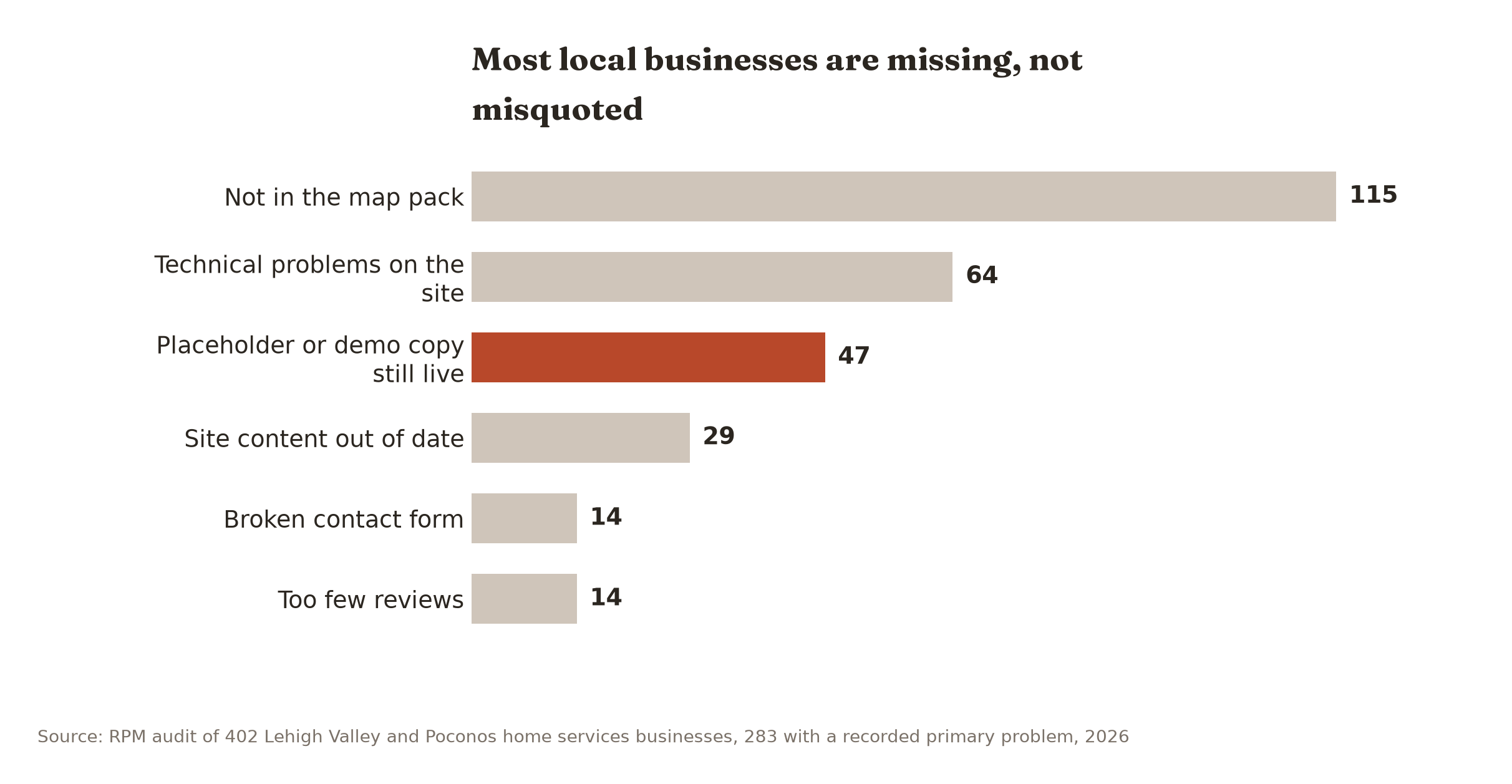
The largest bar is absence. One hundred fifteen of these companies are not in the map pack for their own trade in their own town. Being absent from the map is the AI problem too, because the map data is the spine of the local answer.
The second story is the one that surprised us. Forty-seven of these sites still ship the template’s placeholder copy. Live, today, on the homepage. One HVAC company in Hellertown has a homepage that reads “Core Business Keyword” and “List Item 1 Write a description” while sitting on 66 reviews at 4.9. A Stroudsburg roofer with 226 reviews has three fake testimonials from invented people and a leftover software pricing table on the live site.
If an assistant reads that page, there is nothing on it to say about the business. The 226 reviews are real. The page is not.
Your town changes the math more than your trade does
This is the part that makes national AI-search advice useless here.
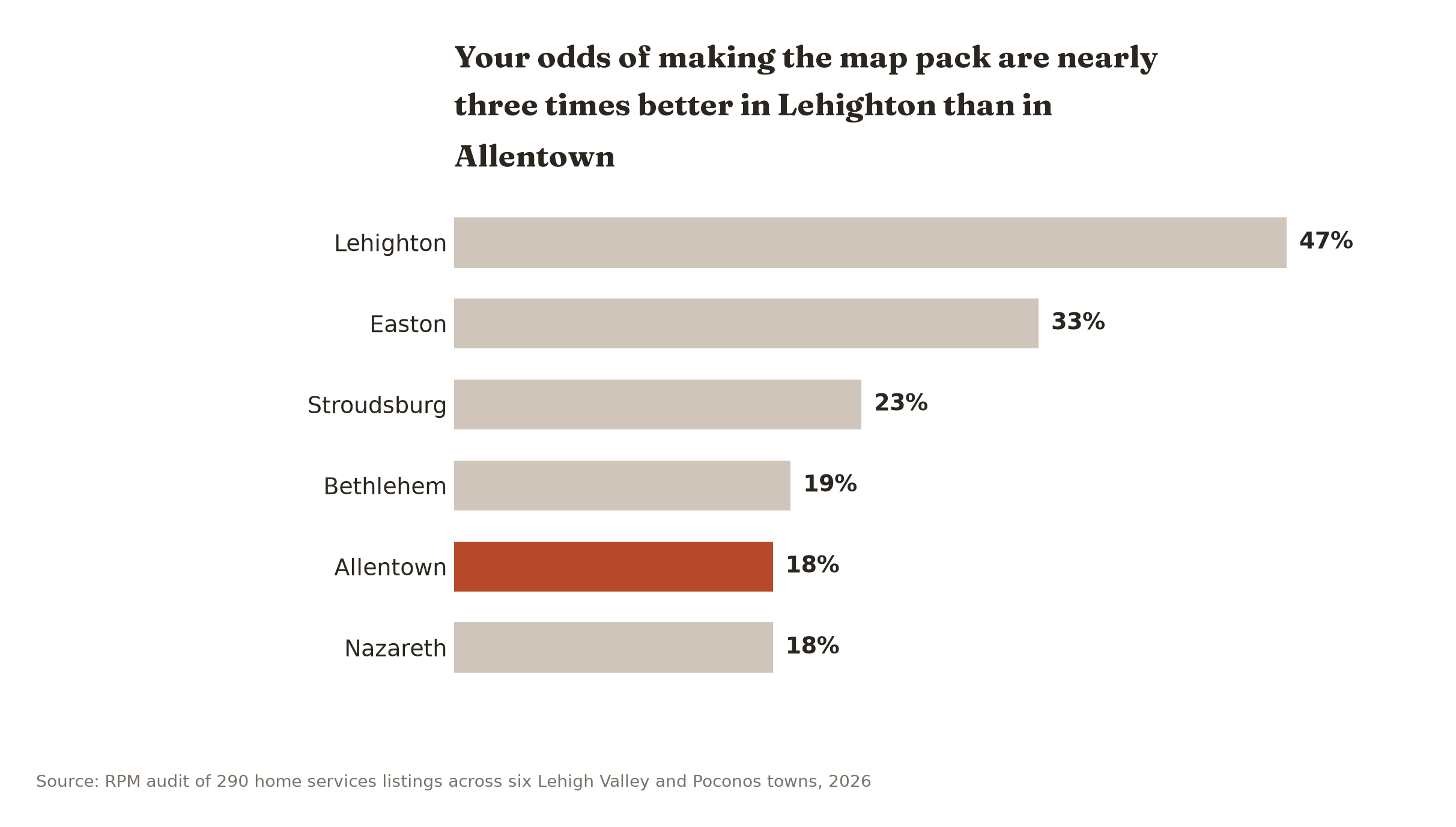
In Lehighton, 14 of the 30 companies we checked are in the map pack for their trade. Nearly half. In Allentown, 15 of 83. Under one in five.
That is not because Lehighton contractors are better at marketing. It is because there are fewer of them and the bar is lower. A Lehighton map pack held by a roofer with 5 reviews is winnable this quarter by anybody with a real site and forty reviews. An Allentown pack where the median company carries 104 reviews is a two-year project.
The same logic runs through the AI answers. If an assistant is picking two or three names for “who repairs furnaces in Palmerton,” it is picking from a much shorter list than it would for Allentown. Your odds in a small town are much better than any national blog post will tell you, and the work is cheaper.
So before you spend a dollar on any of this, know which pond you are in. If your service area covers Carbon and Monroe counties, you have several ponds, and they are not equally hard.
The work that actually moves it
Here is the uncomfortable part for anyone selling an AI package. The list of things that make an assistant more likely to name you is almost identical to the list of things that win the map pack.
1. Fix the Google Business Profile completely. Right category, every service listed, real hours including whether you actually answer at 11pm, service area set to the towns you actually drive to, photos from this year. This is the one hour of work in this post that pays back the fastest.
2. Get the review count into the game for your town. Not a number somebody made up. The median in your town, from the chart above, plus a bit. In Jim Thorpe that is about 40. In Allentown it is over 100.
3. Make sure your name, address, and phone match everywhere. If your Google listing says “7+ years in business” and your homepage says “over 25 years,” an assistant reading both has no idea which to repeat. We found one Lehighton HVAC company with exactly that contradiction live on both pages at the same time.
4. Put the towns on the page as words. An assistant asked about Brodheadsville needs to find the word Brodheadsville somewhere that is not a map embed. Not a stuffed city-page farm. One honest service-area paragraph that names the townships you cover.
5. Answer the actual questions on their own pages. What a boiler replacement costs here. Whether you charge for estimates. How fast you get to a no-heat call in February. These are the pages that get quoted, because they are the only pages with a quotable sentence on them.
6. Let the crawlers in. Most contractor sites are fine here. But if your developer blocked everything that is not Googlebot, or your site is one long JavaScript app that renders nothing in plain HTML, you are invisible to half of these tools. Worth one check.
7. Be findable on the sources they cite. Yelp, Angi, and the BBB show up in citation lists constantly, whether you like those platforms or not. You do not have to pay them. You do have to have a correct, claimed listing.
That is the whole program. Seven items, six of which any good local search project already covers. If somebody quotes you a separate monthly fee for “AI search optimization,” ask them which of these seven they are doing that they were not already doing.
What this is worth in dollars right now
Honestly? Less than the person selling it to you will say.
For a contractor doing $2M in the Lehigh Valley, our guess is that assistant-driven calls are currently a low single-digit share of inbound. We cannot prove that, for the reasons in the section above. The honest version is that we cannot separate it from the rest of the phone traffic. We walked through why the traffic math is so hard to read in what AI Overviews did to local search traffic.
Two things make it worth doing anyway.
First, the work overlaps almost completely with the work that gets you into the map pack, which we can measure and which pays now. You are not spending an extra dollar. You are doing local search properly and getting the AI upside free.
Second, the direction of travel is not ambiguous. Google’s AI Overview went from a lab experiment to two billion monthly users in roughly two years. Whatever share of your calls it represents in March 2026, it is not going to be smaller in 2028.
What we would not do is reorganize your marketing budget around it this year.
Do not buy an AI package
There is a category of product being sold right now under names like AEO, GEO, and AI visibility monitoring. Usually $500 to $2,000 a month. Here is our position, stated as a position.
The monitoring tools are measuring an output that changes when you ask twice. The optimization work is mostly the seven items above. And there is currently no public documentation from Google or OpenAI describing a lever you can pull that is specific to AI answers and does not also affect ordinary search.
The clearest example is llms.txt, a proposed file you put on your server to tell AI tools what your site is about. It was proposed in September 2024 and picked up a lot of excitement. In 2025 Google’s John Mueller said publicly that he was not aware of any AI service actually using it, and compared it to the old keywords meta tag. Nobody has shown otherwise since. If an agency’s AI deliverable is an llms.txt file, you are paying for a text file.
Skip the package. Spend the same money on reviews and a site that loads. If you are trying to figure out what that costs, we published the real numbers in what a website costs a local business in 2026.
Twenty minutes, your phone, tonight
You do not need us to run the first check. Do this after dinner.
- Open ChatGPT or Gemini on your phone. Ask it the way a customer would. “Who should I call for a water heater replacement in Nazareth PA?” Not your company name.
- Write down every business it names. Ask the same question again tomorrow and write them down again. Notice how much the list changes.
- If you are named, ask a follow-up: “what do people say about them?” Read what it says back. That is your reputation, summarized by a machine, in front of a customer.
- If you are not named, ask “why did you pick those?” The answer is unreliable, but the sources it shows are real. Look at which ones it cited.
- Now search the same thing in Google and look at the map pack. Nine times in ten, the overlap between the two lists will tell you the whole story.
Done when you have two lists on paper and you can see whether you are on either one.
A full version of that check is our teardown process, written up in public. The ChatGPT-specific steps live in how to show up in ChatGPT search.
How long before any of it shows up
Profile fixes: days. Google reindexes a business profile fast, and assistants that read map data follow within a couple of weeks.
New pages that answer real questions: six weeks to four months before they get cited anywhere, in our experience, and longer in a competitive town like Allentown or Bethlehem.
Reviews: this is the slow one. Going from 30 to 80 reviews at an honest pace takes most contractors six to nine months. Start it in April and you are in decent shape for the fall heating rush.
One caution on all three. Because the answers move on their own, you will see your own results swing for reasons that have nothing to do with your work. Do not judge this month to month. Judge it on whether the phone rings more in the fourth quarter than it did last year, and on your map-pack position, which holds still long enough to measure.
What to do next
You can run the phone check above yourself in twenty minutes, and you should. You can count your reviews and compare them to the three companies above you.
What is harder to see from your own screen is where you stand across a whole service area. Whether you hold Lehighton but lose Palmerton. Which of the sources these assistants cite have your business listed wrong. What your reviews actually say when something reads all of them at once.
That is the $399 Strategy Session. We look at your site, your profile, your reviews, your top three competitors in each town you serve, and where the AI answers currently land. You get the full written report and you keep it, whether or not you ever hire us. If you start a project with us inside 60 days, the $399 comes off the price.