What a Website Costs a Local Business in 2026
A Palmerton electrician showed me a quote for $18,400 last fall. Eleven pages, a “brand discovery workshop,” and a video header. He runs two vans and does almost nothing outside Carbon County. He did not need $18,400 of website, and the quote never once mentioned his Google Business Profile, which is where roughly nine out of ten of his calls were already coming from. A real website for a Lehigh Valley or Poconos home services company runs $4,500 to $15,000 to build, plus $150 to $300 a month to keep it alive. Here is what moves that number, what the money actually buys, and when you should not spend it at all.
The three price bands, and who belongs in each
Almost every quote you will see in this region falls into one of three bands. The bands are not about quality of design. They are about how much of the work is done by a person who knows your market.
| Band | Build cost | Ongoing | What you actually get | Who it fits |
|---|---|---|---|---|
| Template, self-serve | $0 to $1,500 | $20 to $60/mo platform fee | A Wix, Squarespace, GoDaddy or Duda template you fill in yourself. Pages, a contact form, a gallery. No schema, no call tracking, no local pages, no one watching it. | A one-truck operation under about $300K that is still figuring out what it sells. |
| Built for local search | $4,500 to $9,000 | $150 to $300/mo | Six to fifteen pages written for your towns, LocalBusiness schema, Google Business Profile optimization, a review wall and a review-request system, call tracking, booking, and an analytics setup you can read. Our Local Website System starts at $4,500 fixed. | Most of this region. Two to fifteen trucks, $500K to $8M, one to three counties of service area. |
| Custom build | $15,000 to $40,000 | $500/mo and up | Custom design system, original photography and video, integration into ServiceTitan or Jobber, sometimes a customer portal or a quoting tool, multi-location structure. | Multi-location, franchise, or a company where the site takes payment and runs scheduling directly. |
The middle band is where nearly every company in the Lehigh Valley and the Poconos belongs. I will defend that below, including the cases where it is wrong.
What the $4,500 is actually paying for
Design is the cheapest part. It is also the part every quote leads with, because it is the part you can see.
Here is the honest split on a $4,500 build. Roughly a fifth of it is layout and design. Another fifth is writing pages that name Nazareth, Brodheadsville and Palmerton instead of “the greater Lehigh Valley area.” A page that names one town can rank for that town. A page that names a region ranks for nothing. The rest is plumbing you never see. Schema markup so Google knows your hours and your service area. A form that actually delivers to an inbox someone checks. Call tracking, so you know which job came from where. And the Google Business Profile work that decides whether you appear in the map at all.
That last item is the one that moves money. We pulled records on 283 businesses across the two regions and sorted each one by the single biggest thing costing them work. The website design was almost never the answer.
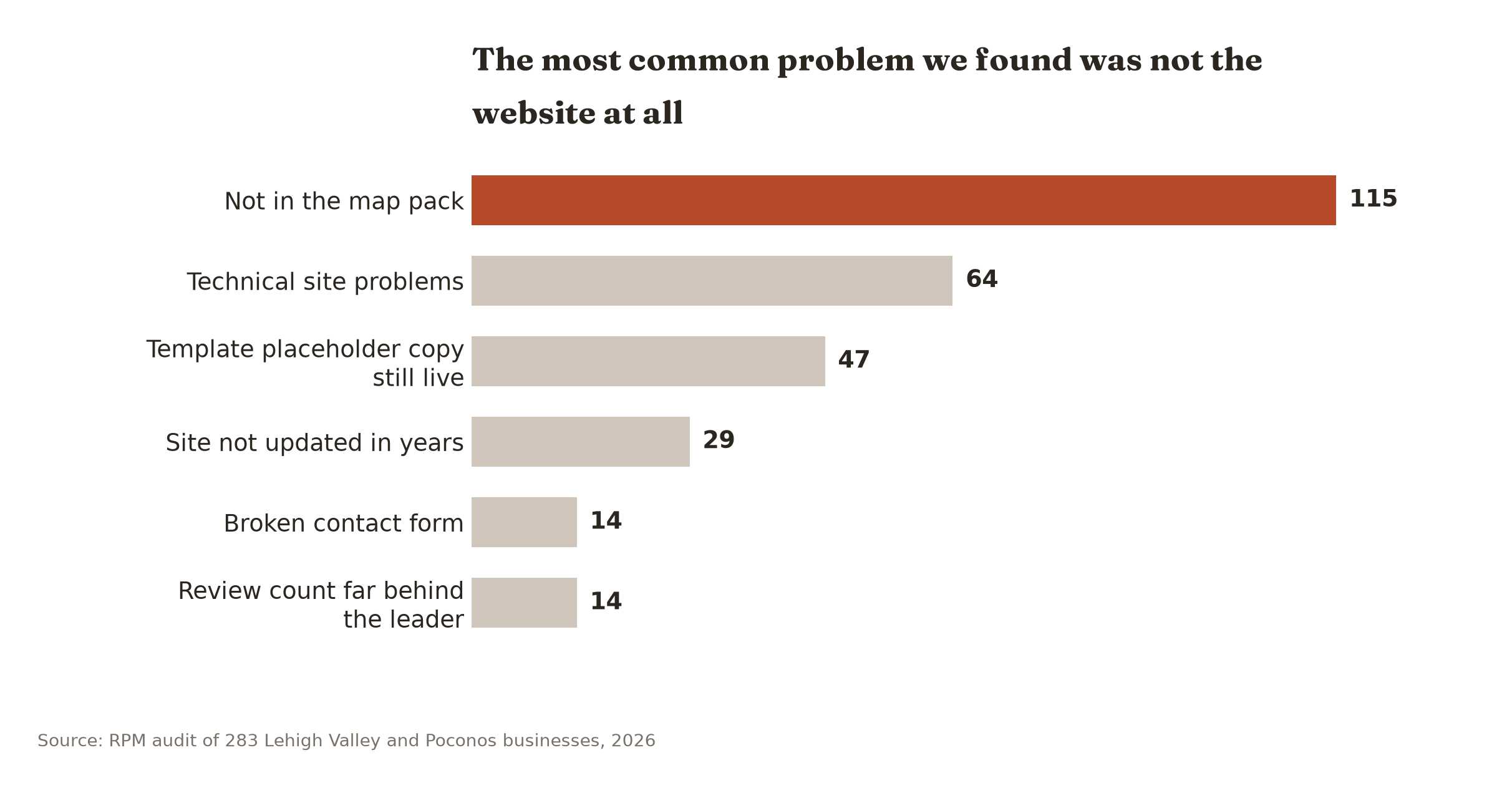
One hundred fifteen of those 283 had a functioning website and were simply not in the map pack for their own town. A prettier site would not have moved one of them.
Six things that move the number
When a quote comes in higher or lower than $4,500, it is usually one of these.
- How many towns you actually serve. This is the biggest single driver and the one most owners get wrong. A Kunkletown HVAC shop covering Carbon, Monroe and Northampton counties needs six to ten town pages, each written differently. An Emmaus shop that will not drive past Macungie needs one. That difference is $2,000 to $3,000.
- How many services you sell. Four service pages is standard. A company doing residential HVAC, commercial refrigeration, ductwork and generator installs needs eight, and each one is a real page with real copy.
- Whether you have photos. If you have 200 job photos on your phone, you are done. If you need a photographer on site for a day, add $800 to $1,500. Original photos of a Jim Thorpe roof or a Route 33 job trailer are worth it, and they are something a competitor using the same stock library cannot copy.
- Whether anything has to talk to your software. Sending form fills into Jobber or ServiceTitan is a few hours. Two-way scheduling is a project. Ask exactly which one is quoted.
- Content you write versus content they write. Writing is about a third of the labor. If you hand over real copy, the price drops. Most owners say they will and then do not, and the project sits for two months.
- Whether the old site has to be kept alive. If you have 60 blog posts ranking and 400 indexed URLs, the redirect and migration work is real. If you have a six-page template, there is nothing to migrate and nothing to protect.
The $99 a month website, and why the math is worse than it looks
You have gotten this pitch. No money down, $99 or $199 a month, site live in two weeks.
Run it out. At $199 a month over four years you have paid $9,552, which is more than the middle band costs outright, and at the end of it you own nothing. Stop paying and the site comes down. That is the entire business model, and it is why the contract is 36 months.
It is not always the wrong call. If cash is tight and you need something live before roofing season, a rented site beats no site. Just price it as a lease and put a date on your calendar to get out of it. What I object to is the version where the owner believes he bought something.
We ran into 17 sites in the audit set built on one particular sold-to-contractors platform, and the pattern was consistent. Five of the 17 still had the template’s own placeholder copy sitting on the live homepage. One Hellertown HVAC company, 4.9 stars on 66 reviews, was still showing the builder’s filler text where the headline goes, on both the home page and the contact page. Nobody at the vendor ever looked at it again after launch, because nobody was paid to.
Redesign or start over
This is the question I get most, and the answer is usually cheaper than the owner expects.
Keep what you have and fix it if three things are true. Your site loads in under about three seconds on a phone on cell data, not office wifi. You have pages that already rank for something, even one town. And the platform is not fighting you, which in practice means WordPress or a real CMS rather than a proprietary builder you cannot export from.
If all three hold, you are looking at a $1,500 to $3,000 fix, not a rebuild. Content, schema, speed, forms, profile. We have done exactly that for a Stroudsburg plumbing company that did not need a new site and knew it.
Start over when the platform blocks you. If you cannot add a page without paying the vendor, you are stuck. Same if the site is not responsive on a phone, or there is no way to get your own content out. Every dollar spent improving it is a dollar you will spend again. National search volume for “website redesign cost” runs about 260 a month at a $36.86 cost per click. That tells you how many owners are standing where you are, and what agencies will pay to be the one who answers.
Why the Poconos number is different from the Valley number
Same trade, same size company, two different builds. This is not a regional quirk worth ignoring, it changes what you should buy.
In Allentown, Bethlehem and Easton you are fighting density. We audited 83 businesses in Allentown alone, most of them within the same 20-minute drive of each other. Ranking there takes more pages, more reviews, and more patience, and the honest number sits at the upper end of the middle band. The upside is volume. There are enough searches to justify the spend.
In Carbon and Monroe counties you are fighting distance and a different customer. A large share of Poconos work comes from second-home owners who are not standing in the house. They are booking a well pump inspection from a kitchen in North Jersey, from a phone, often at night. For that customer the gallery does not matter and the booking form and the text-back do. Fewer searches, but a smaller field. Seven of the 41 roofing companies we checked for map-pack presence held a spot. In Jim Thorpe, four of the five HVAC companies we looked at were in the pack, because there are only five.
Practical version. A Stroudsburg or Brodheadsville shop can often win with the base build and a serious review push. An Allentown shop usually cannot, and should budget for the upper half of the range plus ongoing work.
The monthly number nobody quotes you up front
A website is not a purchase. It is a piece of equipment, and equipment has a service interval.
Ours is $150 to $300 a month, and it covers hosting, updates, backups, security, uptime monitoring, and a human who fixes things without a ticket number. That range is not unusual. What is unusual is agencies stating it in the proposal instead of after the build.
If nobody is on maintenance, the site slowly dies. We found 29 sites in the audit set whose last real update predates their current phone system. One Lehighton roofer still had a 2019 copyright footer and a contact form pointing at an email address he lost when he changed providers. He had been paying for hosting the whole time.
Ask any quote two questions. What is the monthly after launch, and what happens if I stop paying it. If the answer to the second one is “the site goes down,” you are renting, not buying, and the price should reflect that.
When you should not buy this
There are four situations where I will tell you to keep your money. I have told all four to people who were ready to sign.
You have fewer than 25 Google reviews. Go get reviews first. Across the trades we audited, the business sitting in the number one map spot has a median of somewhere between 54 and 194 reviews depending on the trade. A new website does not close that gap. Ninety days of asking every customer does, and it costs you nothing but the asking. Come back after.
You are booked solid through the season. If you cannot answer the phone you already have, a site that generates more calls is a liability, not an asset. Spend the $4,500 on a dispatcher or a second van and build the site in the slow month.
You are under two years old and still changing what you sell. Half the companies I talk to in year one are doing different work in year two. Run a $30 a month template, put everything into the Google Business Profile, and let the market tell you what you are. Building a ten-page site around a service you drop in eight months is a waste.
Your problem is the map pack, not the site. This is the most common one. If you have a decent site, good reviews, and you still do not appear when someone in your own town searches for your trade, the fix is profile and proximity work, not a rebuild. That is a much smaller project and a much smaller invoice. There are a few symptoms that tell the two apart, and they are worth ten minutes before you sign anything.
Three checks you can run yourself before you sign
You do not need to know what a canonical tag is to catch a bad quote. Run these three.
Ask what the pages are, by name
A real proposal lists page titles. “Home, About, Services, Contact, and 8 additional pages” is not a list, it is a placeholder. Make them name the eight. If they cannot name which towns get a page, they have not looked at where your customers are, and you are paying for a template with your logo on it.
Who owns the domain and the files after launch
The right answer is you, on both, with no conditions. We have picked up three clients in the last year who could not move their own site because the agency held the domain registration. Ask for it in writing. A vendor who hesitates here is telling you something useful.
Make them show you two sites in your own trade
Pull up their work on your phone. Tap the phone number in the header. If it does not dial, they shipped a site where the single most valuable element on the page is decoration. One Northampton County HVAC company we checked, about 100 reviews and a five-star average, has a site with no phone number on it anywhere. Not in the header, not in the text, and its one “Contact us” button links back to the homepage. They are in the map pack. The map pack is carrying the entire business, and the site is carrying nothing.
Then look at whether the two sites are the same layout with different colors. That is fine at $4,500. At $15,000 it is not.
Why you are getting so many calls from agencies
Here is a number that explains your voicemail. Agencies bid on Google Ads to reach owners shopping for a website, and what they pay per click varies wildly by trade.
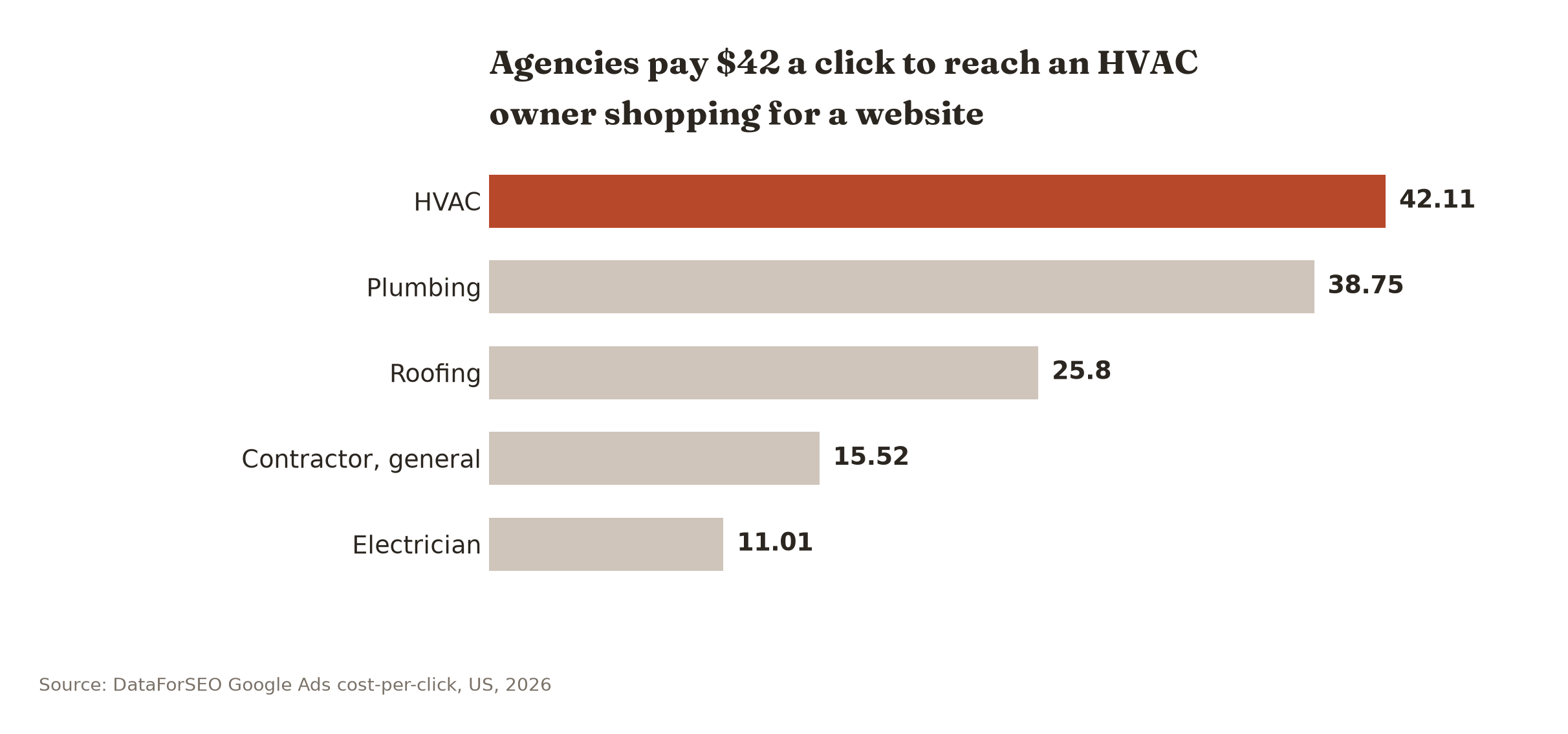
Forty-two dollars for one click from an HVAC owner. That agency needs to close roughly one in fifty of those clicks to break even, which is why the follow-up is relentless and why the first number quoted is rarely the real one. It also tells you something about where the sales pressure is. If you are an electrician, at $11 a click, fewer people are chasing you, and you have more room to take your time.
How long before it pays for itself
Honest ranges, from what we have watched locally, not from a case study deck.
Site speed and form fixes show up in days. If your form was broken, it is not broken now, and that is immediate. Map-pack movement takes 60 to 120 days in most towns and longer in Allentown, where we audited 83 businesses competing in the same radius. Organic rankings for town-plus-service terms take four to eight months. If someone tells you 30 days, they are describing paid ads, not search.
The math is simple enough to do on a napkin. If your average job is $900 and the site produces two extra jobs a month, a $4,500 build is paid off in the third month. If your average job is $180, it takes a lot longer, and you should be honest with yourself about that before you sign. This is why the same website is a good buy for a roofer and a questionable one for a handyman.
Two more things worth reading before you spend. What a proper audit actually looks at, so you can tell whether the quote is based on anything. And how this changes when customers ask an assistant instead of Google, which is already happening faster in this region than most owners think. If you are in a specific trade, the numbers shift: HVAC and roofing each have their own ranges and their own traps.
What to do next
You now know the three bands, the six things that move the price, and the four situations where the right answer is to spend nothing. You can check your own review count, your own hours, and whether your phone number dials on a phone, all in about ten minutes tonight.
What you cannot easily see from your own screen is where you rank across your whole service area, town by town. Or how your reviews and speed stack against the three companies taking the jobs you are not getting. Google shows you a flattering version of your own results. That is not what your customer in Brodheadsville sees.
That comparison is the $399 Strategy Session. You get the full picture, competitors, site speed, what your reviews actually say, and a written priority order. The report is yours whether you ever hire us or not. Start a project inside 60 days and the $399 comes off the invoice.