The Review Engine: How Local Businesses Get Reviews Without Chasing Them
A roofing company in Allentown has 917 Google reviews at 4.9 stars. It is the review leader for the whole Lehigh Valley, by a margin nobody else is close to. When we pulled “roof replacement allentown pa” during our audit, that company was not in the map pack and it was not on page one of the regular results. The three companies sitting in the pack had 124, 266 and 147 reviews.
So the biggest reputation in the region is losing the search that sends a homeowner to a roofer. Call it four to eight estimate requests a month going to somebody with a quarter of the proof.
This post covers three things. What a normal review count looks like in your trade around here. What reviews actually buy you, and what they do not. And the five-part routine that produces three to six a month without anybody chasing customers.
What a normal review count looks like in your trade
We audited 402 home services businesses across the Lehigh Valley, Carbon County and Monroe County. 369 of them had a Google review count we could read. The middle of that pack is 63 reviews.
That number moves a lot by trade.
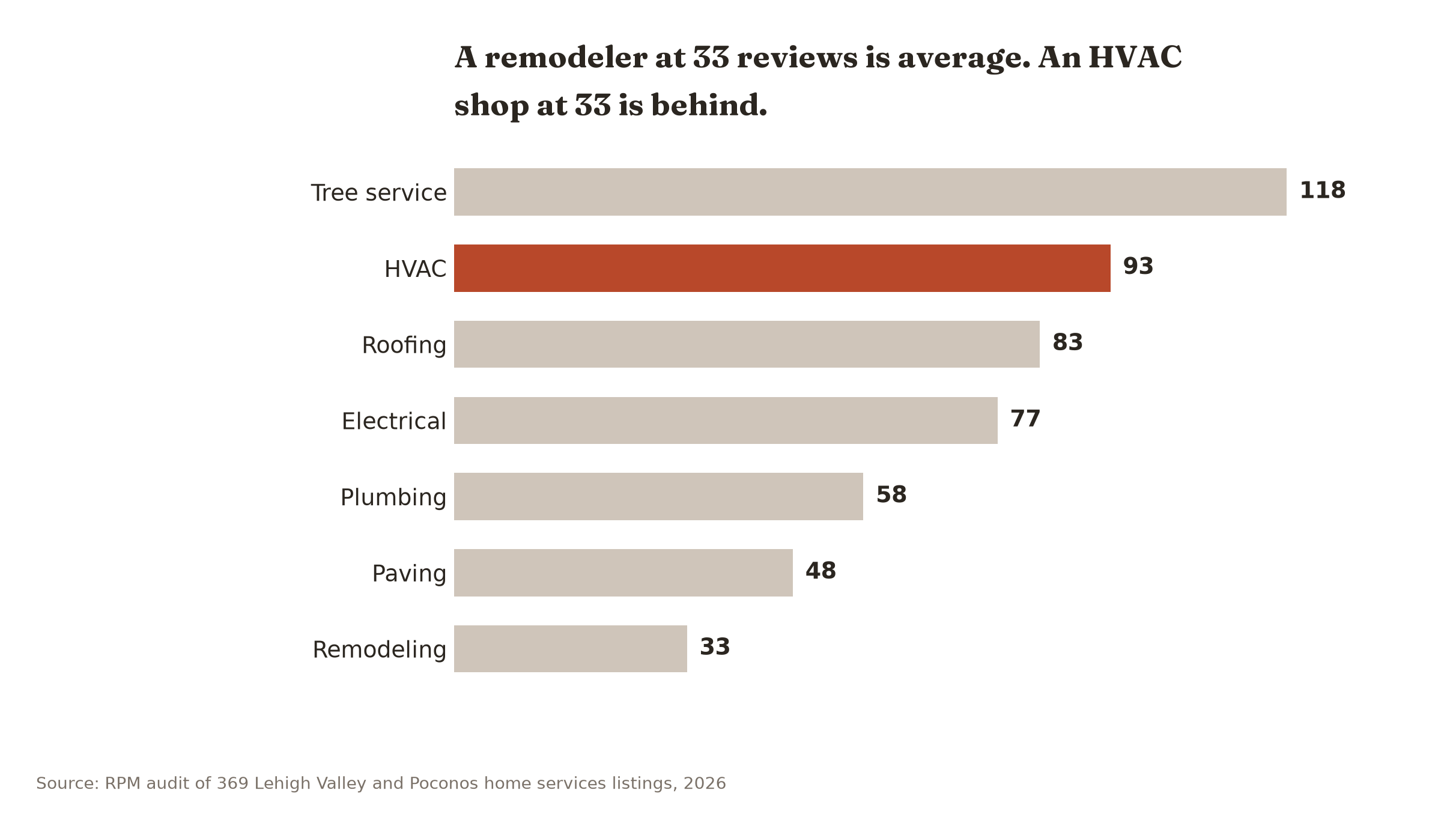
Find your trade and read the number. If you are under it, you are below the middle of your own field in your own region, and every homeowner comparing three names on a phone screen can see that.
Remodelers get a break here. The middle of that group is 33 reviews, because kitchen and bath jobs are fewer and further apart than furnace calls. An HVAC company doing 40 service calls a week has no excuse for sitting at 30.
Twenty-six of the 369 had fewer than ten reviews. Sixty-seven had fewer than 25. If you are in that group, this is the whole project for the next 90 days and nothing else on your marketing list matters as much.
Reviews are not a button that moves you into the map pack
This is where most review advice lies to you, so here is what our own data says.
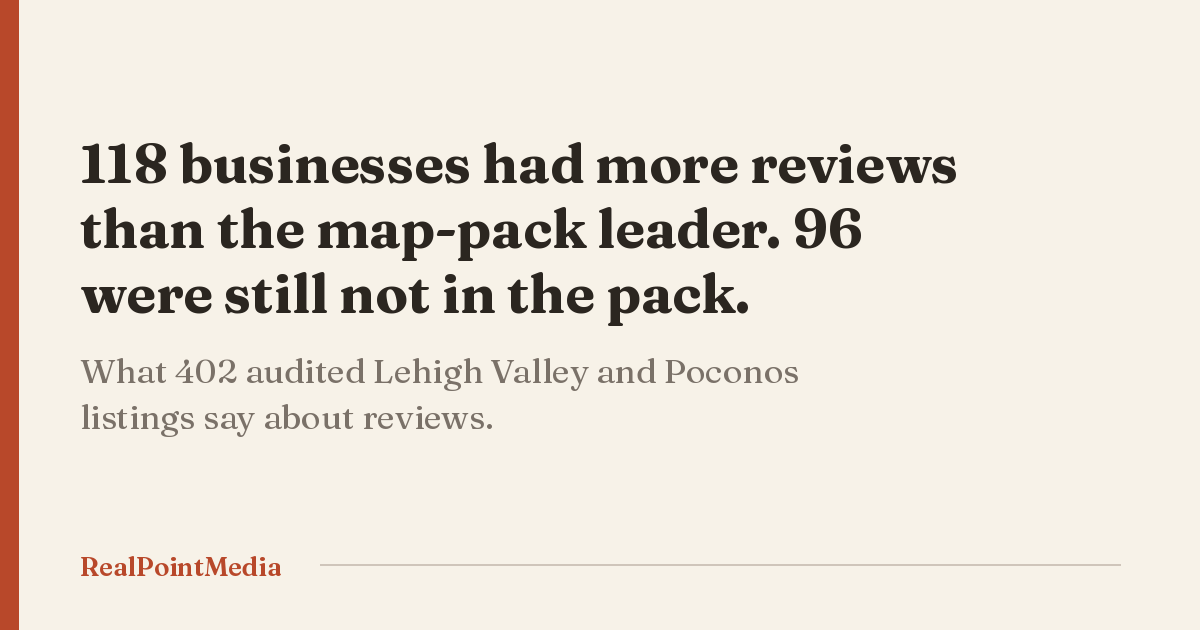
258 businesses in the audit had both their own review count and the review count of the company holding the top map-pack spot for their town and trade. 118 of them had more reviews than that pack leader. Ninety-six of those 118 were still not in the pack.
Read that again. Having more reviews than the winner, in almost every case, did not make you the winner.
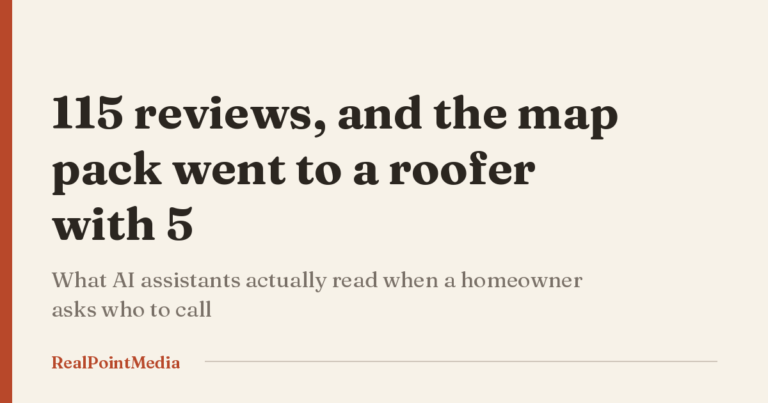
A roofer in Lehighton sits at 5.0 on 115 reviews and shows up at organic position nine. The three Lehighton map spots that day went to companies with five reviews, eight reviews, and no reviews at all. One of them had no website on its listing, so every click it earned had nowhere to land.
Palmerton is stranger still. The median pack leader in our Palmerton pull had three reviews. Three.
What reviews do influence is the part that is harder to see: whether Google trusts the listing at all, and whether the homeowner picks you once you are visible.
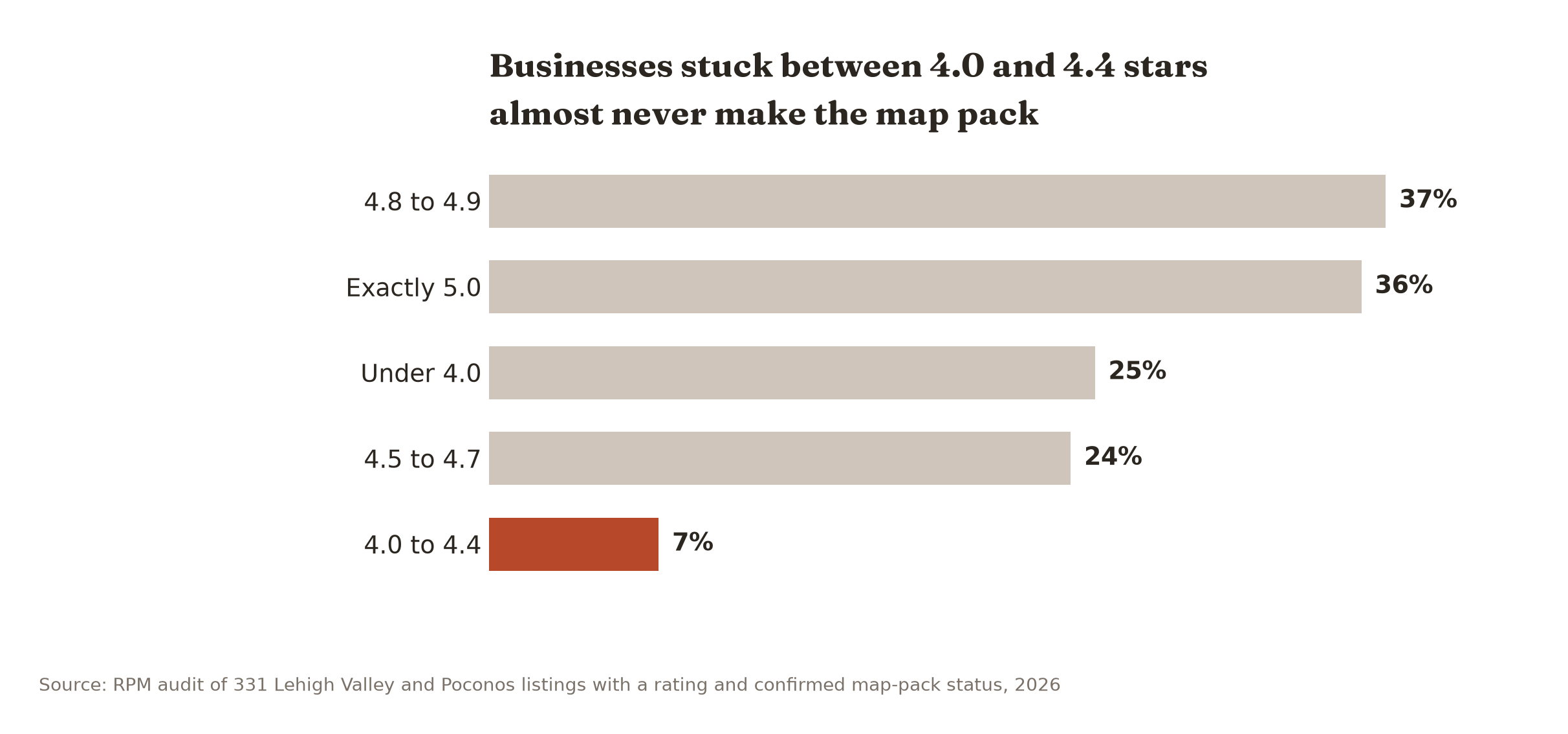
The 4.0 to 4.4 band is the number that should scare you. Thirty businesses in our audit sat in that range. Two of them made the map pack. That is a worse showing than the businesses rated under 4.0, which at least tend to be older listings with deeper histories.
Our read, and we will call it a read rather than a finding: somewhere around 4.5 is where a rating stops being a liability. Below that, more reviews do not save you. They just publish the problem to more people.
What reviews are actually buying
Three things, and none of them is a ranking.
First, the pick. A homeowner in Bethlehem with a dead heat pump opens the map pack, sees three names, and taps one. Two HVAC companies in our Bethlehem set were both at 4.9 on 36 reviews. One was in the pack and one was not, and the one that was not had a better website. The reviews did not decide the ranking. They decided which of the three visible names got the call.
Second, recency. A listing with twelve reviews, none since 2023, tells a homeowner you might not be in business. We saw this constantly. The date on your newest review is doing more work than the count.
Third, the words. Reviews that say “replaced our water heater in Nazareth on a Sunday” put your service and your town in text Google can read, written by somebody other than you. That is the only kind of keyword text nobody can accuse you of stuffing.
Google reviews, and almost nothing else
You will get pitched on Angi, Yelp, Facebook, Nextdoor, BBB and whatever your trade association runs. For a home services company in this region, Google is worth more than all of them combined, and it is not close.
The reason is mechanical. Google reviews feed the map pack, the knowledge panel on the right of the results, and increasingly the answer an assistant gives when somebody asks it to find a plumber in Emmaus. Nothing on Yelp feeds any of that.
There are two exceptions worth your time. If you do a lot of work through a builder or a property manager, a handful of reviews on the platform they use is worth having. And if your trade association directory ranks for your town, which happens in smaller Carbon County markets, get listed there once and forget about it.
Everything else is a distraction. Point the whole routine at one place. Split your asks across four platforms and you will end up below the middle on all four.
The engine, in five parts
Everything below assumes you are not going to chase anybody. Chasing does not scale and it makes your techs hate you. The routine has to run on its own.
1. One person owns the number
Not “the team.” A name. In most shops this is the office manager, because she is the one who already calls people about invoices.
Her job is not to collect reviews. Her job is to know the count on Friday afternoon and to notice when a week goes by with none.
Done when: one person can tell you today’s review count from memory, within five.
2. The ask happens on site, out loud
The tech says one sentence before he gets in the truck. “If we did right by you today, would you mind leaving us a Google review? You’ll get a text from the office in a bit with the link.”
That is it. No card, no clipboard, no speech. The sentence does two jobs: it gets a verbal yes, and it warns the customer a text is coming so the text does not read as spam.
Review requests sent without a verbal ask first convert at a fraction of the rate. We have watched this on client accounts for two years and it is the single biggest lever in the whole routine.
Done when: you have heard each of your techs say the sentence, in their own words, without reading it.
3. The link is one tap
Go into your Google Business Profile, find the “Ask for reviews” option, and copy the short link. It looks like g.page/r/ followed by a string. That link opens the review box directly with the stars ready.
If you are sending anyone to “google.com and search for us,” you are losing most of them at the search step. A 62-year-old homeowner in Brodheadsville will try twice and give up.
Done when: you have tapped your own link on your own phone and landed on the star box in under three seconds.
4. The text goes out the same day
Same day, from the number the customer already has in their phone, before dinner. Not the next morning. The window where somebody feels good about a repair is measured in hours.
Most field software does this. Jobber, ServiceTitan, Housecall Pro all have a review request step you can fire from the job. If you are running on paper, the office manager sends it by hand from the shop phone, which works fine at under 20 jobs a day.
Done when: a job closed at 2 p.m. has a request sent by 6 p.m., without anybody remembering to do it.
5. One follow-up, then stop
If nothing comes in after three days, send one more text. Shorter. Then leave them alone forever.
Two asks is the whole policy. A third one costs you goodwill worth more than the review.
Done when: your process has a hard stop written into it, so nobody decides to try a fourth time.
The math that tells you what to expect
Take your completed jobs in a month. Multiply by the share where a tech actually made the verbal ask. Multiply that by about 0.25.
An HVAC shop in Nazareth running 120 calls a month, asking on half of them, lands around 15 new reviews a month. A remodeler doing four kitchens a month, asking on all four, lands one. Both of those are fine. They are just different businesses and they need different timelines.
That 25% figure is ours, drawn from client accounts rather than a published study. Treat it as a planning number, not a law. Shops that do the verbal ask well run higher. Shops that skip it run closer to 5%.
Put them where somebody will read them
A review sitting on Google is working half a shift. The other half happens on your own site, where a homeowner who already clicked through is deciding whether to call you or go back to the results.
Pull your newest reviews onto the page. Not a scrolling widget with a logo on it, which loads slowly and gets ignored. Real text, on the page, with the first name, the town and the job. “Heat pump replacement, Palmerton, February.” That last part is what makes it believable and it is also the only version of it Google can read.
Put three on the home page near the phone number and the rest on a page of their own. If you run separate pages for furnace repair and water heaters, sort the reviews onto the matching page. A homeowner reading about water heaters wants to hear about water heaters.
One more thing most shops miss: reply to every review, good and bad. Two sentences is plenty. An account with 80 reviews and 80 owner replies reads as a business somebody is actually running.
Your number, town by town
Here is the middle of our audit by town, next to the middle review count of the company holding the top map spot there. The right-hand column is the target that actually matters, because it is the number a homeowner is comparing you against.
| Town | Businesses audited | Median reviews | Median reviews, top map spot |
|---|---|---|---|
| Allentown | 83 | 104 | 80 |
| Stroudsburg | 52 | 61 | 69 |
| Bethlehem | 48 | 53 | 47 |
| Easton | 43 | 52 | 91 |
| Nazareth | 34 | 54 | 55 |
| East Stroudsburg | 30 | 52 | 106 |
| Lehighton | 30 | 50 | 33 |
| Brodheadsville | 29 | 57 | 122 |
| Jim Thorpe | 18 | 36 | 33 |
| Palmerton | 16 | 37 | 3 |
Source: RPM audit of 402 Lehigh Valley and Poconos listings, 2026.
Two things jump out of that table if you work these towns.
Lehighton, Jim Thorpe and Palmerton are cheap. The companies holding those map spots are sitting on 33, 33 and 3 reviews. If you run crews up Route 209 and you have 80 reviews, you are already over the bar and your problem is somewhere else on your listing.
East Stroudsburg and Brodheadsville are expensive. The top spots there are held on 106 and 122 reviews, well above what the typical business in those towns carries. Monroe County has a handful of large operators who got serious about this years ago, and catching them takes a year of steady asking, not a quarter.
If most of your work is in Allentown, note that the median business there already carries more reviews than the median pack leader. Reviews are table stakes in that market. They will not differentiate you.
What the engine will not fix
This is the part most agencies skip, so here it is plainly. There are four situations where running this routine is a waste of your time.
Your rating is under 4.0. An HVAC company in Easton in our audit sits at 3.6 on 32 reviews. The company holding the top Easton map spot is at 4.9 on 1,100. More reviews at 3.6 does not close that. Fix whatever is generating the 1-stars first, and if you already know what it is, you do not need us to tell you.
Your listing sends people nowhere. One East Stroudsburg HVAC company sits at a perfect 5.0 on 17 reviews and the website link on its Google listing goes to a Facebook page. Another company’s roofing site returned a 503 error to our browser. Reviews pour water into a bucket with no bottom. Fix the bucket. Our post on how to tell whether your site is costing you jobs covers the checks.
You are outside the town you are trying to rank in. Proximity to the searcher is still the heaviest factor in the map pack. A Kunkletown shop trying to win Allentown searches is fighting geography, and 200 reviews does not move your address.
The work is genuinely bad right now. If you lost two good techs in January and you know the quality slipped, do not pour asks into that. You will collect an honest record of a bad quarter and it will sit on your listing for years.
How long before it moves
Ninety days to feel it. Twelve months to change your position in a competitive town.
In practice what happens first is not a ranking change. It is the phone conversation changing. Somewhere around 40 or 50 reviews, people start calling you already sold, and your close rate on estimates goes up before anything moves on Google. That shows up in your numbers well before the map pack does, which is why it is worth tracking which marketing actually produced the job rather than watching rankings.
The map pack takes longer and depends on things reviews do not control. We have seen a Stroudsburg client go from outside the pack to spot two in about seven months. The reviews were half of that project. The Google Business Profile rebuild was the other half.
The two mechanics each have their own post. Here is how to ask without being awkward, and here are the review request texts that get replies.
What to do next
You can check your own review count, your rating, and the date of your newest review in about five minutes. You can also open the map pack for your main term and count your competitors’ reviews. Do that tonight.
The rest of the picture is harder to see. Where you rank across your whole service area, town by town. What your reviews say when you read all of them at once. And which of the four or five things on your listing is holding you out of the pack.
That is the $399 Strategy Session. We pull your map-pack grid across the Lehigh Valley and the Poconos. We read your reviews and your top three competitors’ reviews, check your site speed and your listing, and give you the order we would fix things in. You keep the report. If you hire us for a project within 60 days, the $399 comes off the price.